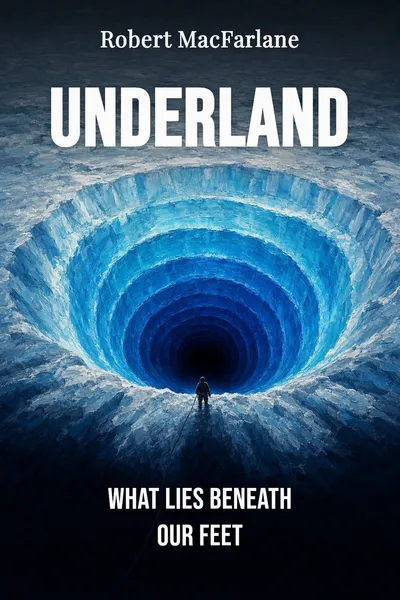
Underland
What lies beneath our feet
Description
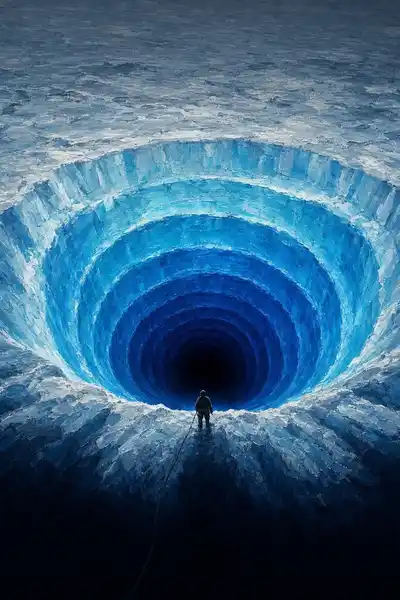
Robert Macfarlane has spent most of his writing life going up. Mountains, ridgelines, the old paths that cross open country — his earlier books moved through landscapes you can see, under a sky you can read. Then, in 2019, he published Underland, and the whole compass swung. This time he went down: into a burial chamber in the Mendip Hills, into the dark matter laboratory buried beneath a Yorkshire potash mine, into the drowned rivers of the Italian Dolomites, the catacombs under Paris, the blue meltwater tunnels of a Greenland glacier. The book is a descent, chapter after chapter, into places most of us will never stand.
What makes the journey more than spelunking is what Macfarlane finds waiting in the dark. The underground, it turns out, is where humans have always done a few very specific things — and always the same few, across cultures separated by continents and by tens of thousands of years. We go down to shelter what we love, to extract what we want, and to hide what we fear. Below the surface, geology stops being scenery and becomes a clock, one that ticks in millions of years and makes a human lifetime look like a spark.
Underland is nature writing, but it strains against the category. It is also travel, geology, myth, grief, and a long argument with time itself. Macfarlane keeps circling one uncomfortable idea: that we are the first species capable of leaving marks in the deep earth that will outlast not just us, but our whole civilization — and that most of those marks are ones we would rather not sign.
The question we’re asking : Why have humans, everywhere and always, gone underground for the same handful of reasons — and what does the earth's timescale do to how we see ourselves?What we’ll see : A descent through the buried places where we shelter, take, and hide things, and where deep time quietly rearranges the sense of who we are.
Table of contents
01Chapter 1 — The three things we do with the dark
Macfarlane opens with a proposition that organizes the entire book: across every culture he can find, humans have used the underworld for three purposes. We shelter things there — the precious, the vulnerable, the dead we want kept safe. We yield things from there — ore, coal, salt, the metals a civilization runs on. And we dispose of things there — waste, poison, the objects and memories too dangerous or too shameful to keep in the light. Shelter, yield, dispose. Once he names the pattern, it appears everywhere he goes.
The pattern is old. In the Mendips he crawls into a chamber where Bronze Age people laid their dead, and the impulse to place the beloved below ground reads as continuous with a Paris family vault or a nuclear repository sealing away spent fuel. The instinct to bring the underworld the things we most want to protect, or most want gone, seems to sit deep in the species. Macfarlane does not treat this as coincidence but as a kind of grammar, a set of gestures we keep repeating without deciding to.

02Chapter 2 — A network older than the forest
Before the descents into rock and ice, Macfarlane spends time in one of the strangest underlands of all: the soil beneath a forest floor. There, threads of fungus called mycelium lace through the ground, connecting the roots of trees into what researchers have nicknamed the wood wide web. Through these fungal networks, trees trade sugars, send chemical warnings, and even route resources to their struggling neighbors. A dying tree may pump its remaining carbon into the network for others to use. The forest above ground, which looks like a crowd of individuals competing for light, turns out to rest on a hidden economy of exchange.
Macfarlane walks the Epping Forest with the scientist Merlin Sheldrake, learning to read this buried commerce, and the encounter reframes everything that follows. The underland is not dead matter to be extracted. It is alive, communicative, ancient — a system that predates and outperforms most of what we have built on top of it. The metaphors he reaches for keep failing, because our language for the underground is a language of tombs and mines, of stillness and death, and here is a below-world that is more social and more generous than the world of daylight.
03Chapter 3 — Deep time, and the shortness of us
The phrase that haunts Underland is deep time — the vast, geological span in which mountains rise and erode and species come and go, measured not in generations but in eons. Macfarlane borrows it from geology, where a single stratum of rock can represent millions of years, and he keeps trying to make the reader feel it rather than merely know it. Standing in a cave, touching stone laid down before mammals existed, he confronts the plain fact that a human life is too short to register on the clock the earth actually keeps.
Deep time is easy to invoke and almost impossible to hold. Macfarlane's method is to go to places where it presses physically on the body. In the Slovenian karst he follows underground rivers that have carved the limestone over unimaginable spans. In Greenland he stands on ice that fell as snow thousands of years ago, ice that carries in its trapped bubbles a readable archive of ancient atmospheres. The ice is a book of deep time, and it is melting — meaning the past itself is now draining away in front of him, faster than it was written.
04Chapter 4 — What we bury for people we'll never meet
The deepest reckoning in Underland is about audience. When Macfarlane visits the sites where nations plan to bury their nuclear waste — sealed into rock meant to hold for a hundred thousand years — he arrives at the strangest communication problem humans have ever faced. Spent fuel will remain lethal for longer than any language has ever survived, longer than any nation, possibly longer than the species. How do you warn a being you cannot imagine, in a tongue that does not yet exist, not to dig here? Engineers and semioticians have genuinely debated hostile architecture, warning symbols, even breeding cats that change color near radiation. Every solution founders on the same wall: we are writing to a reader beyond the reach of our meaning.
This is where the book steps back from its caves and glaciers to see what they have been circling all along. The underland is where we deposit our legacy, and legacy is a message sent to strangers in the future. For most of history that message was tender — grave goods, painted hands on cave walls, the dead laid down with care. What Macfarlane traces is a shift. The great things we now consign to the deep earth are not gifts but hazards: waste, carbon signatures, plastics that will fossilize, the residue of an extractive civilization. We have become a culture whose most durable bequest is the thing it is trying to hide.
05Conclusion
Macfarlane surfaces, at the end, back into ordinary light — Norwegian coast, family, the near future of an ordinary life. But the book has changed the ground he stands on. Having gone down into burial chambers and dark-matter labs, into living soil and dying ice and rock meant to hold poison for a thousand centuries, he can no longer treat the earth beneath his feet as inert. It is full: full of the dead we sheltered, the wealth we tore out, the waste we tucked away, and the deep time that will outlast every arrangement we make.
Related books