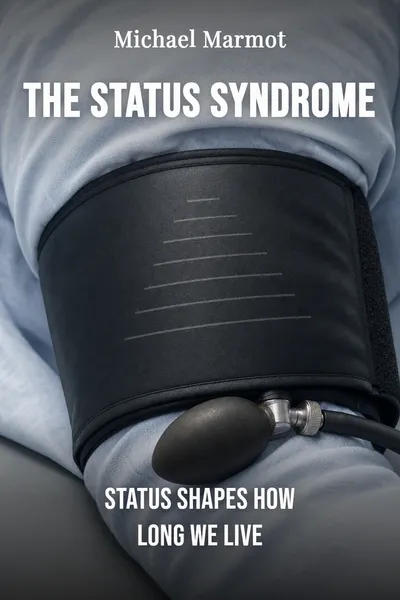
The Status Syndrome
Status shapes how long we live
Description
In 1967, a young British epidemiologist named Michael Marmot began following the health of some 18,000 civil servants working in Whitehall, the cluster of ministries at the heart of the British government. It was, on paper, a study of heart disease. What made it unusual is that everyone in it belonged to the same organization, breathed the same London air, had access to the same national health service, and none of them was poor. They were clerks, executives, administrators, and permanent secretaries — a tidy hierarchy of grades, from the messengers at the bottom to the mandarins at the top.
The result, when the numbers came in, was hard to look away from. Men in the lowest employment grade were dying at roughly three times the rate of the men in the highest. And it wasn't a simple split between the comfortable and the struggling. Each step down the ladder carried a higher risk of death than the step above it — a smooth slope from top to bottom. The finance officer lived longer than the clerk beneath him and less long than the director above him. Marmot called it a social gradient in health, and it refused to disappear no matter how he adjusted the figures.
That gradient became the work of a career and eventually a book, "The Status Syndrome," published in 2004. In it Marmot marshals nearly thirty years of evidence to argue something most of us never suspect: that where we stand relative to others — our rank, our sense of control, our participation in the life around us — shapes not just how we feel but how long we live.
The question we’re asking : If it isn't poverty, bad medicine, or bad habits, why do people higher up the ladder consistently live longer than the people just below them?What we’ll see : How a study of British civil servants revealed a graded link between social standing and survival, and what Marmot thinks is doing the killing.
Table of contents
01 Chapter 1 — The gradient nobody expected
For most of the twentieth century, the story of health and society was told as a story about poverty. Poor people got sick and died young because they lacked food, warm homes, clean water, and doctors. Fix the material deprivation, the thinking went, and the health gap would close. It was a reasonable story, and for the truly destitute it was largely true. What Whitehall showed is that it doesn't explain nearly enough.
The civil servants Marmot studied were not deprived. Even the men at the bottom had steady jobs, salaries, housing, and the National Health Service. Nobody in the study was going hungry. And yet the gradient ran cleanly from top to bottom, as if health were being rationed by rank. The people just below the top were healthier than the people below them, who were in turn healthier than the people below them. There was no cliff edge, no line where hardship began. There was a slope, and everyone was on it.

02 Chapter 2 — The autonomy that keeps you alive
The word Marmot keeps returning to is control. Two people can hold jobs that look similar in pay and prestige and yet differ enough in one respect to change their odds of survival: how much say they have over their own working day. Do they decide when to take a break, how to solve a problem, what to do next — or does someone above them decide it for them? In the Whitehall data, the lower a person's grade, the less control they reported, and the less control they reported, the worse their heart fared.
This maps onto a body of research in occupational health about what makes work harmful. The dangerous combination, it turns out, isn't simply working hard. It's high demand paired with low control — being asked to deliver a great deal while having little authority over how it gets done. A senior official may work punishing hours and carry enormous responsibility, yet he sets much of his own agenda. The clerk carries lighter formal responsibility but obeys the clock and the instructions of others. The clerk's job, on this measure, is the more corrosive one.
03 Chapter 3 — Where the body meets the pecking order
To turn a social position into a shorter life, there has to be a route through the body, and Marmot draws on both animal and human research to trace one. The central character is stress — not the everyday sense of feeling frazzled, but the physiological response the body mounts when it senses a threat it cannot control. That response is beautifully designed for short bursts: hormones surge, the heart speeds up, energy floods to the muscles. It is designed to be switched off once the threat passes.
The trouble is what happens when the threat never quite passes. Chronic activation of the stress system — cortisol running high week after week — is linked to raised blood pressure, disturbed blood sugar, more fat carried around the middle, and inflammation in the arteries. These are precisely the pathways that lead to heart disease and diabetes. A life spent low on the ladder, with high demands and little control, is a life in which the alarm system rarely gets to stand down.
04 Chapter 4 — A public-health problem, not a personal one
Step back from the civil servants and the monkeys and the argument becomes a quarrel with how we usually explain who gets sick. The dominant story is individual. People are told that their health is in their own hands: eat better, move more, stop smoking, manage your stress. There is truth in all of it. But Marmot's data keep pointing past the individual to the structure the individual is standing in. The lower grades smoked more not out of some free-floating recklessness, but partly because they had less of the control and belonging that make it easier to look after yourself in the first place.
This reframes health inequality as a question of how a society is arranged rather than a tally of private failings. If the gradient is produced by the unequal distribution of autonomy and participation, then it can be addressed by distributing those things more evenly — through the design of work, education, and the conditions in which people raise children. Marmot's argument implies that giving people more genuine control over their lives is not a luxury or a morale exercise. It is, in the most literal sense, a health intervention.
05 Conclusion
It began as a study of heart attacks among clerks and mandarins, and it ended as an argument about what standing does to a body. The Whitehall civil servants gave Marmot something rare: a group alike in nearly every material way, differing mainly in rank, and separated all the same by years of life. From that clean experiment came a claim that has held up across decades and continents — that the smooth slope linking social position to survival is not an accident of poverty or a quirk of habit, but a signature of how control and belonging are shared out.
Related books