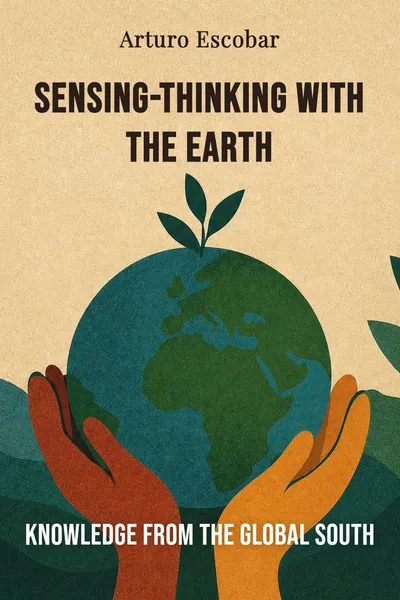
Sensing-Thinking with the Earth
Knowledge from the global South
Description
In 2008, in Colombia's southwestern Cauca Valley, a transnational mining company began exploring a gold-rich mountain called Cerro El Gallo, near a town whose Afro-descendant and Indigenous communities had farmed its slopes for generations. The company arrived with permits, environmental-impact studies, and the familiar language of development: jobs, royalties, modernization for a region the national map had long treated as backward. The communities who lived there answered in a register the paperwork had no column for. The mountain, they said, was not a deposit. It was a being they lived with — a weaver of water, a relative, part of what they called the territory. The disagreement was not about the price of the land. It was about what the land was.
Arturo Escobar, a Colombian-born anthropologist, spent decades listening to struggles like this one across Latin America — in the Pacific rainforests, the Andean highlands, the river communities of his home region. What he heard was not folklore dressed up as resistance. It was, he came to argue, an entire way of knowing: a mode of being-in-the-world that refuses the split between humans and nature on which the modern West built almost everything. He gathered that argument into a book whose Spanish title gives it its charge — Sentipensar con la Tierra, sensing-thinking with the Earth.
The phrase itself was borrowed, not invented. Escobar took it from fishermen on the Colombian coast, who told the sociologist Orlando Fals Borda that they thought with both heart and mind at once. From that small, concrete word, Escobar builds something large: a claim that the ecological crisis is, underneath, a crisis of how the modern world imagines reality — and that the global South has been quietly holding an alternative all along.
The question we’re asking : What are communities in Latin America defending when they insist a mountain or a river is not a resource but a relative — and why does that insistence unsettle the whole framework of development?What we’ll see : How a word borrowed from Colombian fishermen grew into a challenge to the idea that there is only one real world.
Table of contents
01 Chapter 1 — One world that claims to be the only one
Escobar's starting point is a quiet observation that becomes, once you see it, hard to unsee. The modern West operates on an assumption so deep it stops looking like an assumption at all: that there is one reality out there, neutral and self-identical, which cultures then interpret differently. On this view, Colombian villagers and mining engineers inhabit the same mountain; they just hold different beliefs about it. One set of beliefs is accurate — the geological one — and the other is a charming or obstructive overlay. Development, in this frame, is simply the process of helping everyone converge on the accurate picture.
Escobar calls this the one-world world: a world that has arrogated to itself the right to be the only world, and to classify all others as culture, myth, or error. He traces it to the long project that philosophers call the Cartesian split — the carving of reality into mind and matter, human and nature, subject and object. Once nature becomes mere matter, inert and knowable, it can be measured, owned, and extracted without ethical remainder. The mountain becomes tonnage. This dualism, Escobar argues, is not a universal truth about reality. It is a particular civilizational habit that has been exported, often by force, as if it were.

02 Chapter 2 — Sentipensar: feeling and thinking at once
Against the one-world world, Escobar offers the word he lifted from the Colombian coast. Sentipensar — to sense-think, to feel-think — names a way of knowing that the modern academy spent centuries trying to purge. Fals Borda, the sociologist who first wrote it down in the 1980s, heard it from fishing communities describing how they understood their world: not by standing back from it as detached observers, but by being inside it, reading the water with body and intuition as much as with calculation. Knowledge, in this mode, is not a view from nowhere. It is a relationship.
Escobar is careful not to turn this into a cozy opposition — warm Southern feeling against cold Northern reason. Sentipensar is not anti-intellectual. The communities he writes about are rigorous observers of tides, soils, seasons, forests; their knowledge is often more precise about a given place than any outside expert's. What distinguishes it is that the knower is never separated from the known. To sense-think the Earth is to accept that you are part of what you are trying to understand, woven into it, answerable to it. The detachment the West prizes as objectivity looks, from here, like a peculiar refusal of responsibility.
03 Chapter 3 — The ontology of the mountain
Return to Cerro El Gallo, the mountain in Cauca, because Escobar insists the argument lives in specific ground, not in abstraction. The communities there did not organize a protest against a mine in the ordinary sense. They mobilized around the defense of territory — and territory, in their usage, is not a surface measured in hectares. It is the dense web of water sources, crops, burial grounds, spirits, and daily practices through which a people and a place co-produce each other. To defend territory is to defend a way of being, not an asset.
What the mining company offered, by contrast, was legible only within the one-world world: a project that converted the mountain into reserves, the reserves into capital, the disruption into a line item to be mitigated and compensated. The environmental-impact assessment could model sediment loads and biodiversity loss with real sophistication. What it could not model was a mountain that is also a being, because its entire grammar assumes nature is object. The two parties were not negotiating over the same thing. They were, Escobar says, defending different worlds that happened to overlap on one patch of ground.
04 Chapter 4 — A world where many worlds fit
Here Escobar's argument opens onto its largest stake, the one that gives the book its political charge: the pluriverse. The word comes most memorably from the Zapatistas in southern Mexico, who called for un mundo donde quepan muchos mundos — a world where many worlds fit. Escobar takes this as more than a slogan. He treats it as a serious ontological proposition: that reality is not one world with many cultural views, but genuinely many worlds, many ways of worlding, coexisting and interfering with one another. The task of politics, on this view, is not to decide which world is correct. It is to let many worlds be.
This is a demanding idea, and Escobar does not pretend otherwise. A pluriverse is not multiculturalism, which still assumes one real world tolerant of diverse beliefs about it. It is harder and stranger: a politics that accepts it may have to coordinate between worlds that do not share the same premises about what exists. The mountain-as-being and the mountain-as-deposit cannot simply be reconciled; one of them has to yield ground, and the pluriversal demand is that the one-world world stop assuming the yielding must always run its way.
05 Conclusion
The dispute over Cerro El Gallo was never resolved into a tidy outcome, and Escobar would be suspicious of any telling that made it one. What the communities of Cauca put on the table was not a better deal but a different world — a mountain that is a relative, a territory that is a way of being, a knowledge that feels and thinks at once. The mining company's permits could not see it, and the state's procedures could not weigh it, precisely because both operate inside the one assumption Escobar spent his career trying to loosen: that there is only one real world, and it is the modern one.
Related books