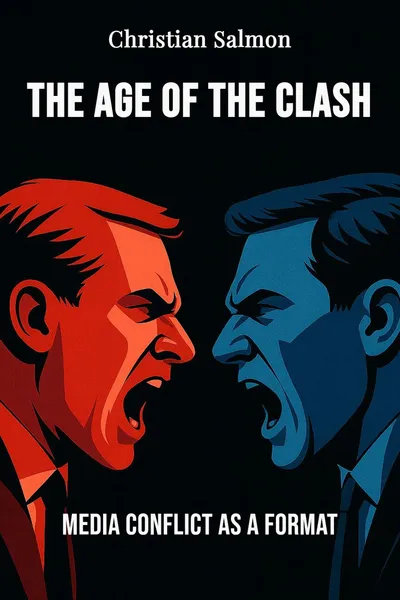
The Age of the Clash
Media conflict as a format
Description
Picture a television studio in the last stretch of a campaign. Two candidates, a moderator who has mostly surrendered, and a running clock. One of them interrupts, the other sighs theatrically, a phrase lands wrong, a face is caught mid-grimace. By morning nobody remembers the policy that was supposedly under discussion. What everybody remembers is the clip — fifteen seconds, pulled out, captioned, replayed on a loop across every screen. The exchange didn't settle anything. It wasn't meant to. In Christian Salmon's reading, this is not a debate that went off the rails. It is the main event working exactly as designed.
Salmon, a French writer who spent years decoding how storytelling colonized politics, turns in this book to what he argues has replaced the story: the clash. The narrative arc — a politician who sells a vision, a beginning and a promised end — has given way to something faster and emptier. The clash has no arc. It has a collision, a reaction, and a replay. It doesn't ask to be believed. It asks to be seen, shared, and seen again. And it travels better than any argument ever could, because friction is the thing the machine around it was built to carry.
What makes the argument uncomfortable is that the clash isn't a failure of our media. It's a product of it — the natural output of a system that rewards collision over meaning, and reaction over the slow work of persuasion. Once we start looking at political confrontation this way, as a format with its own rules rather than a lapse in decorum, a lot of what looks like chaos starts to look like structure.
The question we’re asking : If the clash isn't a breakdown of political debate but a format in its own right, what rules does it run on, and who benefits when it wins?What we’ll see : How a confrontation becomes a unit of content, why it spreads faster than anything it replaces, and the machinery that keeps manufacturing it.
Table of contents
01 Chapter 1 — The scene before the speech
Salmon builds his case backward, starting from what the clash displaced. For most of the twentieth century, political communication ran on the story. A candidate arrived with a biography, a cause, a sense of where the country was headed, and the campaign was the slow unspooling of that narrative. Speeches had beginnings and ends. Promises implied a future. This was the terrain Salmon had mapped in his earlier work on political storytelling — the art of casting a leader as the protagonist of a national drama the voters could believe themselves part of.
The clash belongs to a different regime entirely. It has no biography to defend and no future to promise. Where the story asked for patience — stay with me, here is where we are going — the clash asks for nothing but a glance. It is built for the instant, not the arc. And crucially, Salmon notes, it does not require belief. A story can be exposed as false; a clash cannot, because it makes no claim. It is pure event, a moment of friction that exists to be registered and passed along.

02 Chapter 2 — When the format changed the fighter
Once the clash becomes the main event, Salmon argues, it stops being something that happens to politicians and starts being something they organize their behavior around. The format selects for a certain kind of figure. If what circulates is friction, then the premium goes to whoever generates it most reliably — the interrupter, the provocateur, the one who treats every exchange as a chance to produce a usable fragment. Composure and nuance, the old virtues of the statesman, become dead weight. They don't clip well.
Donald Trump runs through the book as the clearest case, though Salmon is careful not to make him the whole story. Trump's genius, in this reading, was to grasp that the attack itself was the content. A nickname, an insult, a walk-on gesture during a debate — these were not lapses in a campaign otherwise built on a program. They were the campaign. Each confrontation generated its own coverage, and the coverage generated the next confrontation, a loop that needed no underlying argument to keep turning. The provocation was self-financing in attention.
03 Chapter 3 — The clash doesn't inform, it circulates
The heart of Salmon's argument is that the clash is a unit of circulation, not a unit of information. Its value has almost nothing to do with what it says and almost everything to do with how far it moves. A clip that reveals a genuine policy difference and a clip that captures a pure moment of humiliation are, from the system's point of view, interchangeable — what matters is the reaction they provoke and the velocity that reaction gives them. Meaning is incidental. Motion is the whole point.
This is why the clash resists the usual tools of criticism. Fact-checking a story can puncture it. But a clash makes no verifiable claim; it is an affect, a spike of recognition or outrage. You cannot debunk a sneer. By the time anyone has analyzed what was actually said, the fragment has already done its work — it has been watched, shared, quoted, and absorbed into the ambient noise. The analysis arrives as a footnote to an event that has long since moved on without it.
04 Chapter 4 — What the clash feeds on
If the clash were merely a style, it could pass. Salmon's harder claim is that it is held in place by incentives nobody at the center fully controls, and that this is why it keeps winning even against the wishes of most of the people producing it. Step back from the individual confrontation and what comes into view is a set of aligned appetites — the platform's, the broadcaster's, the politician's, and, uncomfortably, the audience's — all of them rewarded when friction travels and starved when it doesn't.
The platforms are the clearest engine. Their business is attention, and attention is captured most cheaply by whatever provokes a reaction. An architecture built to maximize engagement will structurally favor the clash over the explanation, because the clash is denser in the emotion the system is designed to harvest. No editorial decision is required for this to happen; it is baked into the metrics. The same logic colonizes legacy media, which chase the same clips to stay in the same conversation, laundering the format into supposedly serious coverage.
05 Conclusion
Return to the studio, the clock, the fifteen seconds that outlived the debate. What Salmon asks us to see is that nothing in that scene malfunctioned. The moderator who lost control, the clip that erased the content, the audience that remembered the grimace and forgot the argument — each was behaving exactly as the format rewards. The clash is not debate degraded. It is a different thing that has moved into debate's old address and kept the furniture.
Related books