LEGO
The bankruptcy that saved the company
Description
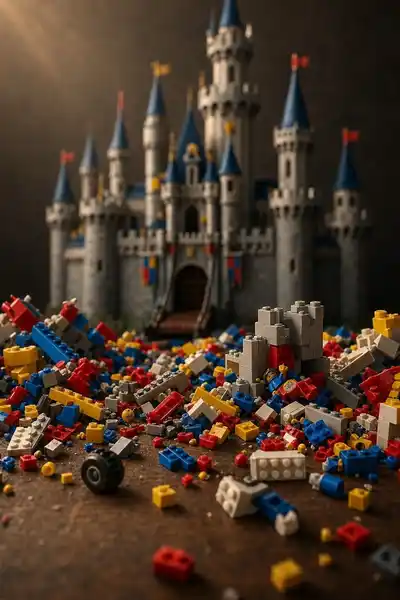
In 2003, the LEGO Group, the Danish toy manufacturer that had been one of the most beloved children’s brands in the world for seventy years, was effectively bankrupt. The company had posted a loss of 1.4 billion Danish kroner, roughly $230 million, on revenue that had been declining for several years. The owning family, the Kristiansens, had brought in outside management consultants and turnaround specialists who had concluded that the business was no longer viable in its current form. The plastic brick that had defined the brand since 1958 the LEGO System of interlocking pieces that allowed children to build anything they could imagine was, in 2003, losing money on every unit sold. The company had been expanding aggressively into theme parks, video games, branded clothing, and dozens of other categories that had taken management focus away from the brick itself. The expansion had produced complexity that the operation could not support. The business was hollowed out.
The recovery LEGO accomplished over the following decade became one of the most-cited corporate turnarounds in recent business history. By 2015, the company had become the largest toy manufacturer in the world by revenue, overtaking Mattel. By 2025, LEGO operated in over 130 countries, had revenue exceeding ten billion dollars, and had recovered the cultural position it had occupied in the 1980s as the default high-quality children’s toy. The trajectory from near-bankruptcy in 2003 to dominant market position in 2015 has been studied in business-school case studies, written up in management books, and held up as one of the rare examples of a successful corporate turnaround that did not involve substantial asset sales or layoffs.
What is less commonly examined is the specific set of choices the new management made, why they worked, and what the case actually reveals about how to repair a brand that has been damaged by overexpansion. The standard reading is that LEGO returned to its core business. The standard reading is partly right and partly misleading. The actual recovery involved a more complicated set of decisions about which businesses to keep, which to abandon, and which to reinvent and the framework that made the decisions coherent has had implications for how other brand-driven companies think about diversification.
The question we’re asking: what had gone wrong at LEGO by 2003, what did the new management do differently, and what does the recovery reveal about brand-focused turnarounds?
What we’ll see: the founding history, the 1990s overexpansion, the Knudstorp turnaround, and what survives.
Table of contents
01 A Danish carpenter and seventy years of bricks
The LEGO Group had been founded in 1932 by a Danish carpenter named Ole Kirk Kristiansen in Billund, Jutland. The name was a contraction of leg godt, Danish for “play well.” Plastic injection molding, which arrived in Denmark in the late 1940s, gave Ole Kirk’s son Godtfred the technical opening to develop the interlocking plastic brick. The patent on the modern LEGO brick design was filed in 1958 and has been the foundational engineering of the company since.
The brick worked at multiple levels. The standardized dimensions meant that any LEGO piece, regardless of when it was manufactured, would connect with any other. The colors and shapes were simple enough for small children and complex enough for older ones to build sophisticated structures. The combination of accessibility and depth was unusual in toy design, and the brick became one of the few children’s products with genuine multigenerational appeal.

02 Why the 1990s expansion failed
The diversification produced complexity faster than the company could manage. The number of unique LEGO pieces in production grew from a few thousand in the early 1990s to over twelve thousand by 2003. Each new piece required tooling, supply-chain integration, and warehouse space. The manufacturing operation, which had been one of LEGO’s competitive advantages, became progressively less efficient as the piece count grew. The cost per piece sold rose. The gross margins fell. The financial cushion that the brick business had generated was eroded by the operating losses of the new initiatives.
The theme-park business was a particular drain. LEGOLAND parks had been opened in Billund (1968), Windsor (1996), Carlsbad (1999), and Günzburg (2002). The parks were capital-intensive, required substantial ongoing operating investment, and produced revenue that did not scale the way the brick business did. The four parks were collectively losing money by 2003, and the operating cash flow they consumed was substantial. The branded clothing and watch lines were generating modest revenue but consuming management attention that could have been spent on the core toy business. The video-game ventures, which had been licensed to outside developers, were generating royalty income but were not building the kind of long-term franchise value LEGO had been hoping for.
03 The Knudstorp recovery
Knudstorp’s strategic argument was simple. The company had to return to making and selling the brick. Everything else had to either contribute directly to the brick business or be abandoned. The piece count had to be reduced. The supply chain had to be simplified. The theme parks had to be either sold or restructured. The licensed-content initiatives had to be evaluated against whether they actually drove brick sales or simply consumed brand equity. The decisions were not philosophically complicated, but they were operationally difficult, and the implementation took several years.
The piece reduction was the most visible operational change. Knudstorp’s team reduced the active piece count from over twelve thousand to roughly seven thousand within three years. The reduction was achieved partly by discontinuing pieces that were used in only one or two sets, partly by standardizing pieces that had been slightly different across product lines, and partly by tightening the design discipline so that new sets used existing pieces wherever possible. The manufacturing-cost-per-piece improved substantially, and the supply chain became substantially more manageable.
04 What survives, twenty years on
The LEGO of 2025 is a different company from the one Knudstorp inherited. Revenue has grown from roughly two billion dollars in 2004 to over ten billion in 2024. The product range has expanded into adult-targeted sets, architecture-themed sets, and creator-platform initiatives that allow customers to design their own products. The brand has remained one of the most trusted children’s brands in the world, with consistent high marks in consumer surveys across markets. The company has continued to manufacture most of its bricks in Denmark, with additional production in Hungary, Mexico, and China.
The strategic discipline Knudstorp introduced has remained operational. The company evaluates new initiatives against whether they contribute to the brick business. The piece count has continued to grow, but at a controlled rate, with new pieces evaluated against the cost of adding them to the manufacturing inventory. The licensed-content portfolio has expanded — adding properties like Minecraft, Friends, and a continuous stream of film tie-ins — but the licensing has continued to operate within the constraint that the resulting sets must drive brick sales rather than substitute for them.
05 Conclusion
Jørgen Vig Knudstorp stepped down as LEGO CEO in 2017 and became executive chairman of the LEGO Brand Group, the family holding company. The leadership of the operating company passed to Niels Christiansen, who had been brought in from Danfoss. The strategic framework Knudstorp had built has continued to operate under the new leadership, with the brick remaining the central asset and the diversification initiatives operating within the discipline he established.
Related books