Apple 1984
The ad that ran once and changed advertising
Description
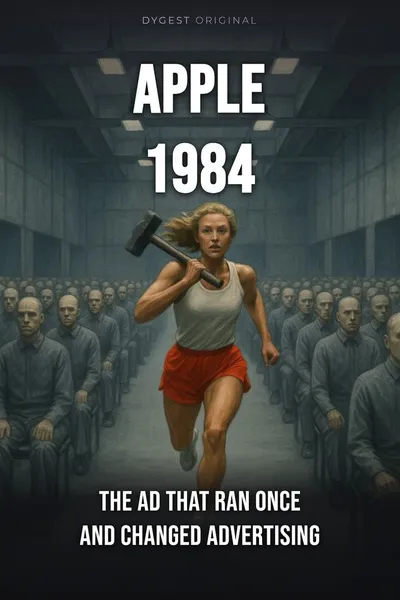
On January 22, 1984, during the third quarter of Super Bowl XVIII, a commercial played on CBS that almost did not exist. It was 60 seconds long. It featured a dystopian auditorium of gray-uniformed people staring at a giant screen, a woman in red shorts running through the hall carrying a sledgehammer, and a voiceover announcing that on January 24, Apple Computer would introduce Macintosh, and "you'll see why 1984 won't be like '1984.'" The spot never named the product. It never showed the product. It cost roughly $900,000 to produce and ran once, at the most expensive moment in American television advertising.
Forty years later, it is arguably the most famous commercial ever made. It has been studied in advertising schools, analyzed in film classes, and parodied by dozens of brands. It is routinely cited as the moment when tech companies stopped behaving like technology vendors and started behaving like lifestyle brands. It launched the Macintosh into one of the most successful product introductions of the decade.
And it almost didn't run. Apple's board of directors watched it in December 1983 and hated it. They asked the ad agency, Chiat/Day, to sell the Super Bowl slot back. The agency stalled. Steve Jobs, then twenty-eight, went to war with his own board to keep it. What happened between the board's rejection and the ad airing explains a lot about how one 60-second film came to redefine what advertising could be.
● The question we're asking: how did a commercial that Apple's own board hated, that ran only once, and that never showed the product become the most influential advertisement of the past forty years?
● What we'll see: the competitive corner Apple was in, the production at Shepperton with Ridley Scott, the board fight Jobs won by running out the clock, and the three structural shifts in advertising that followed.
Table of contents
01 The corner Apple was in
By late 1983, Apple was in trouble. The company had ridden the Apple II to huge success through the late 1970s, but the market had shifted. IBM had entered personal computing in 1981 with the IBM PC, and its clones were quickly becoming the dominant standard. IBM had corporate distribution, a business brand that corporate buyers trusted, and operating-system licensing terms that let dozens of manufacturers ship compatible machines. Apple had none of those advantages.
The Macintosh was Apple's bet against IBM. It used a graphical interface — windows, a mouse, icons — that no mass-market computer had offered before. It was supposed to position Apple not as a competitor to IBM in corporate computing, but as the alternative for everyone who wasn't corporate. The product was interesting. The positioning — Apple as the anti-IBM — was the advertising brief.

02 The ad the board rejected
Ridley Scott shot 1984 in London in September 1983, on a soundstage at Shepperton Studios. The cast included roughly two hundred skinheads hired as extras because the production needed men willing to shave their heads for the dystopian look. The heroine was played by Anya Major, a British discus thrower chosen because she could actually swing a sledgehammer convincingly on camera. The shoot took several days and ran far over its initial budget.
The result was a short film that looked nothing like advertising of the period. It had no product shot, no voiceover explaining features, no demonstration of benefits. It opened on gray crowds marching through tunnels. It held on the dystopian monologue of a Big Brother figure projected on a screen. Only in the final ten seconds did a single line of copy appear: "On January 24, Apple Computer will introduce Macintosh. And you'll see why 1984 won't be like '1984.'"
03 The sixty seconds
The ad aired on January 22, 1984, at 8:43 pm Eastern time. It played once, on CBS, during the Raiders-Redskins Super Bowl. The Raiders won decisively. By Monday morning, the game was a footnote. The advertising was the story.
Every major network news program covered the commercial that week — for free. Nightly News, the morning shows, local affiliates all ran segments analyzing what the ad meant. Newspaper columns debated whether it was art or advertising. The Macintosh launch event two days later, where Jobs introduced the product on stage, was covered with the kind of attention that tech products had not previously received. The Macintosh sold 72,000 units in its first hundred days, well above what Apple had forecast. A significant portion of that demand was attributed, by Apple's own marketing team, to the ad.
04 What changed after
The case that 1984 changed advertising rests on several structural shifts that followed it. The first is that the Super Bowl itself became an advertising event. Before 1984, Super Bowl commercials were expensive spots that ran like any other television advertising. After 1984, they became cultural products in their own right, with their own previews, their own morning-after coverage, their own price premium. Advertisers began using the slot for statement pieces rather than straightforward product promotion, and the Super Bowl became the most important showcase for brand-building advertising in the country.
The second shift is that technology companies began thinking of themselves as brands in the consumer-lifestyle sense. Before 1984, computers were sold the way industrial products were sold — feature sheets, specifications, comparison tables. After 1984, and especially through the 1990s, tech marketing became about identity — who you were if you used this product. Apple's advertising is the clearest throughline, but the pattern shows up at Intel, at Microsoft during the Windows 95 launch, and eventually at every major consumer tech company.
05 Conclusion
On January 22, 1984, a commercial nobody on Apple's board wanted to air ran once on CBS. It cost nearly a million dollars to make, showed no product, and was dismissed by the company's senior leadership as a mistake. By Monday morning it was the most talked-about advertisement in America. Forty years later, it still is.
Related books