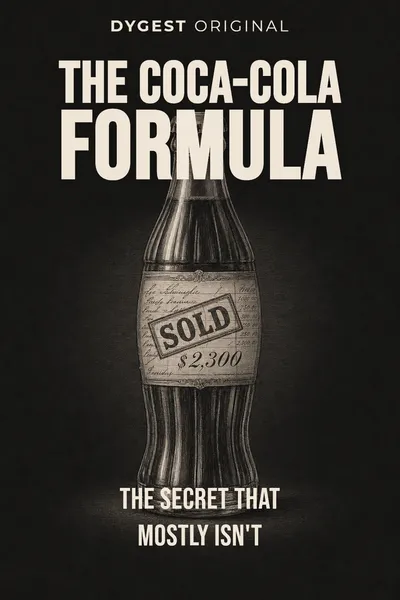
The Coca-Cola formula
The secret that mostly isn't
Description
Inside a building in downtown Atlanta called the World of Coca-Cola, a vault sits behind thick glass. Visitors pay twenty dollars to walk past it. A velvet rope, dim spotlights, and an audio narration tell them that the vault contains the secret formula for Coca-Cola — the most closely guarded trade secret in American commercial history. Only two executives, the narration says, know the full recipe. The formula has never been patented, because patenting would require disclosure. That, visitors are told, is why the drink is still different from every imitation.
Almost every element of that presentation is marketing. The vault opened to the public in 2011 as an exhibit designed to support the brand. The actual formula lives in a different Atlanta bank. The claim that only two executives know it isn't accurate. The formula is probably reconstructible from public FDA filings and chemical analysis, and a fairly close approximation was published in a 1979 cookbook and a 2011 episode of This American Life. The protected asset is not the chemistry. It's the idea that there's chemistry to protect.
The Coca-Cola formula is a useful case for how commercial secrets actually work. The drink was invented by a Confederate veteran in Atlanta in 1886. It contained cocaine until 1903. Its inventor died broke within two years of launching it. The man who built it into a global brand bought it in pieces for about two thousand dollars. The modern mythology of the secret formula was constructed over the following century, and the mythology itself turned out to be more valuable than any chemistry could have been.
● The question we're asking: how did a drink invented by a broke Confederate veteran in 1886, whose recipe has been modified repeatedly and is probably already public, become the most famous trade secret in American commerce?
● What we'll see: Pemberton's invention and his early death, the $2,300 sale that built the brand, the cocaine that was quietly removed, and the modern vault as marketing exhibit rather than security.
Table of contents
01 The inventor who died broke
John Pemberton was born in Knoxville, Georgia, in 1831 and trained as a pharmacist. He served as a lieutenant colonel in the Confederate cavalry during the Civil War. At the Battle of Columbus in April 1865 — one of the last engagements of the war, fought after Lee had already surrendered — Pemberton received a saber wound across the chest. The injury was severe. He was prescribed morphine during recovery and developed an addiction that lasted the rest of his life.
After the war, Pemberton moved to Atlanta and opened a small pharmacy. He spent the 1870s and 1880s experimenting with patent medicines — tonics, elixirs, and syrups sold as treatments for various ailments. His first significant product was Pemberton's French Wine Coca, launched in 1884. It combined wine, coca leaf extract, and kola nut extract. The formulation was modeled on a European product called Vin Mariani, which had a substantial following at the time, including endorsements from several popes. Pemberton marketed his version as a nerve tonic and headache remedy.

02 The $2,300 purchase that built a global brand
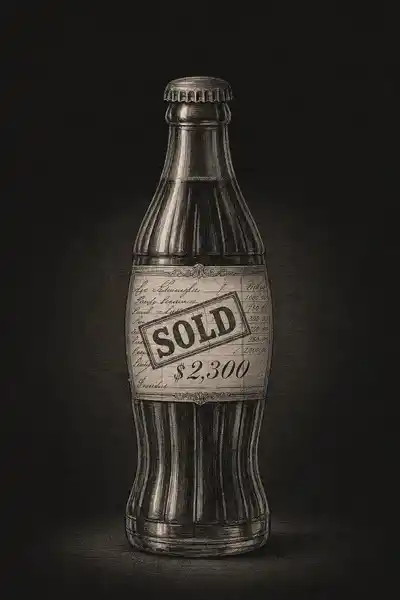
The investor who would eventually acquire all the pieces was Asa Candler, an Atlanta businessman who had been experimenting with patent medicines himself. Between 1888 and 1891, Candler systematically bought out the various people who held fractional claims to the formula. He paid, in total, approximately $2,300 across the several transactions. In 1892, he incorporated The Coca-Cola Company in Atlanta and began the process of building a national brand.
Pemberton himself died in August 1888, at age fifty-seven, of stomach cancer and complications related to his morphine addiction. He was buried in Linwood Cemetery in Columbus, Georgia. His estate was effectively worthless at the time of his death. The drink he had invented was in the early stages of becoming a global brand under someone else's ownership, and neither Pemberton nor his family received any substantial income from it. His son attempted to launch a competing product called Koke, but Candler's lawyers successfully blocked its commercialization in the following decades.
03 The cocaine, the kola, and the changes since
The original Coca-Cola formula contained coca leaf extract, which in its unprocessed form contains cocaine. Pemberton's 1886 recipe included a small amount of cocaine per serving — probably less than what was found in common European patent medicines of the era, but enough to be psychoactive. This was not secret or unusual; cocaine was legal, widely used in pharmacy, and marketed as a stimulant and tonic in the late 19th century.
The Pure Food and Drug Act of 1906 created the first federal requirements for labeling and composition of American food and beverage products. Public attitudes toward cocaine had also started shifting, influenced by a mix of medical concerns and racist framing of cocaine as associated with Black urban crime. By 1903, Coca-Cola had already begun modifying its formula to reduce and eventually eliminate the active cocaine content, using coca leaves from which cocaine had been chemically removed.
04 The secret that is mostly a story
The trade secret mythology, which has always been central to Coca-Cola's marketing, is a carefully maintained asset. The vault exhibit at World of Coca-Cola, opened in 2011, is a product of this mythology rather than evidence for it. The actual company line is that the formula, referred to internally as Merchandise 7X, is known to a very small group of executives and stored in a SunTrust Bank vault in Atlanta. The claim has never been independently verifiable, but the brand has repeated it so consistently for so long that it has become a de facto fact for most consumers.
Multiple credible reconstructions of the formula have been published over the decades. A 1979 book called Big Secrets by William Poundstone published a version that its author claimed was the original Pemberton recipe. In 2011, the public radio program This American Life broadcast an episode in which reporters identified a recipe in a 1979 Atlanta Journal-Constitution article that appeared to match the Pemberton original. Neither publication triggered a meaningful response from the Coca-Cola Company. The drink continued to sell. The mythology continued to hold.
05 Conclusion
The trade secret mythology, which has always been central to Coca-Cola's marketing, is a carefully maintained asset. The vault exhibit at World of Coca-Cola, opened in 2011, is a product of this mythology rather than evidence for it. The actual company line is that the formula, referred to internally as Merchandise 7X, is known to a very small group of executives and stored in a SunTrust Bank vault in Atlanta. The claim has never been independently verifiable, but the brand has repeated it so consistently for so long that it has become a de facto fact for most consumers.
Multiple credible reconstructions of the formula have been published over the decades. A 1979 book called Big Secrets by William Poundstone published a version that its author claimed was the original Pemberton recipe. In 2011, the public radio program This American Life broadcast an episode in which reporters identified a recipe in a 1979 Atlanta Journal-Constitution article that appeared to match the Pemberton original. Neither publication triggered a meaningful response from the Coca-Cola Company. The drink continued to sell. The mythology continued to hold.
Related books