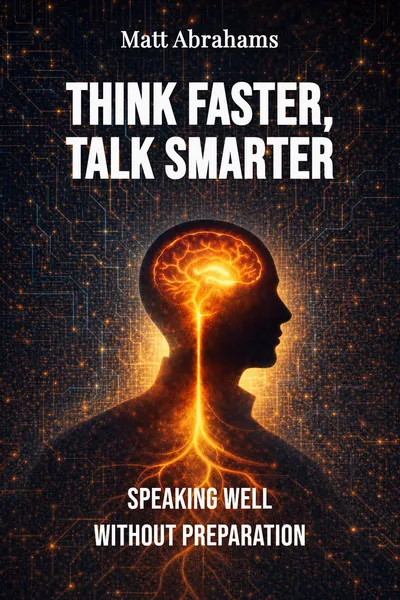
Think Faster, Talk Smarter
Speaking well without preparation
Description
A colleague turns to us in a meeting and says, "So, what do you think?" The room goes quiet. Everyone is looking. And the mind, which had plenty to say thirty seconds ago, produces exactly nothing. This is the ordinary catastrophe at the center of Matt Abrahams's Think Faster, Talk Smarter, published in 2023. Abrahams teaches strategic communication at Stanford's Graduate School of Business, and for years his students kept asking him the same thing. They could prepare a polished talk. What wrecked them was the unscripted stuff: the toast, the Q&A, the hallway follow-up, the feedback nobody warned them about.
His starting point is almost consoling. Most of what we say in a day is spontaneous. We rehearse the interview and then improvise the entire rest of our working life. Yet nearly all advice about speaking well is aimed at the prepared performance, the thing we do least often. The territory where we actually live, the on-the-spot answer, gets almost no attention and generates most of our dread. Abrahams's book is an attempt to close that gap with something more useful than the standard counsel to relax and be ourselves.
What makes the book more than a bag of tips is where it locates the problem. Speaking well without preparation, in his account, is not a personality trait handed out at birth to the naturally quick. It is a set of specific, teachable moves, and underneath those moves, a physical state we can learn to manage. The confident improviser is not thinking faster than the rest of us. They are doing something we can copy.
The question we’re asking : Why do capable, articulate people freeze when they're put on the spot, and what would let them speak well without any time to prepare?What we’ll see : How Abrahams reframes spontaneous speaking as a manageable skill, built on calming the body, leaning on ready-made structures, and paying a different kind of attention.
Table of contents
01 Chapter 1 — The moment the question lands
Abrahams opens with a diagnosis rather than a pep talk. The trouble with impromptu speaking is not that we lack ideas. It is that the demand arrives without warning, and our instinct in that instant is to reach for the perfect answer. We want to be right, to be impressive, to say the smart thing. That ambition is precisely what jams the machinery. Chasing the ideal response in real time floods us with pressure at the exact moment we have the least capacity to handle it.
So the first shift he asks for is a lowering of stakes. Not lower standards, but a different goal: adequacy over perfection. An answer that is present, clear, and roughly on target beats a flawless answer that never arrives because we're still editing it in our heads. Abrahams likes to point out that the audience almost never knows what we planned to say. They only hear what we say. The gap between the imagined ideal and the delivered good-enough exists entirely inside us, and it costs us the very fluency we're trying to protect.

02 Chapter 2 — Anxiety is a body problem first
Before any clever structure can help, Abrahams insists, we have to deal with the physical reality of being nervous. Speaking anxiety is not primarily a thought. It's a cascade in the body: the heart rate climbs, the breath goes shallow, the mouth dries, the hands cool. These are the symptoms of a threat response, and they don't care how competent we are. Telling an anxious person to calm down does nothing, because the problem isn't located where the words can reach. It's in the nervous system.
His most concrete intervention here is breathing, and specifically the exhale. A longer breath out than breath in nudges the body out of fight-or-flight. It's a small, physical lever, available in the seconds before we speak, that actually shifts the state instead of arguing with it. He pairs this with other bodily tactics: staying warm because cold hands read as anxiety to the brain, moving a little to burn off the surplus adrenaline, sipping water to counter the dry mouth. None of this is glamorous. All of it works on the machinery directly.
03 Chapter 3 — Structures beat brilliance
Here is the heart of Abrahams's practical advice, and it's counterintuitive. The way to sound spontaneous is to rely on structure. When we're put on the spot, the brain's working memory is swamped: it's trying to generate content, organize it, and monitor how it's landing, all at once. A ready-made structure offloads the organizing part. It gives our ideas a container to pour into, which frees up mental space for the ideas themselves. Structure, he argues, doesn't constrain spontaneity. It enables it.
The structures are deliberately simple, because complicated frameworks defeat the purpose. His best-known is What? So what? Now what? We say what the thing is, why it matters, and what happens next or what to do about it. Three beats, memorized once, applicable to a feedback moment, a status update, an unexpected question, a toast. Another is problem, solution, benefit. For introductions or answers where we want to persuade, he offers past, present, future. The specific labels matter less than the principle: a small number of portable templates that turn a blank moment into a fill-in-the-blank one.
04 Chapter 4 — Listening is the part nobody rehearses
Step back from the individual techniques and a single idea holds Abrahams's book together: spontaneous speaking is a state we manage, not a talent we possess. Everything in the book is aimed at regulating something, the goal we set, the breath we take, the structure we lean on, so that the mind is free to do what it can already do well. Fluency isn't the reward for being naturally quick. It's what's left over once we stop spending our capacity on panic and perfectionism.
The clearest illustration is his treatment of listening. Most advice about speaking treats listening as a courtesy, something we do while waiting for our turn. Abrahams treats it as the engine of good spontaneous response. When we listen deeply, actually processing what the other person means rather than half-hearing it while rehearsing our reply, we get better material to work with and we buy ourselves time. The answer to "what do you think?" is often sitting inside what was just said, if we were present enough to catch it.
05 Conclusion
The colleague turns to us and asks what we think, and the room goes quiet. Abrahams's book doesn't promise that the quiet stops feeling like anything. The heart still jumps. What changes is what we do in the seconds that follow. We breathe out longer than we breathed in. We drop the search for the perfect line and reach for a shape instead: what, so what, now what. We listen to the question closely enough that the answer half-forms itself. The moment stops being an ambush and becomes something closer to a task with a known procedure.
Related books