
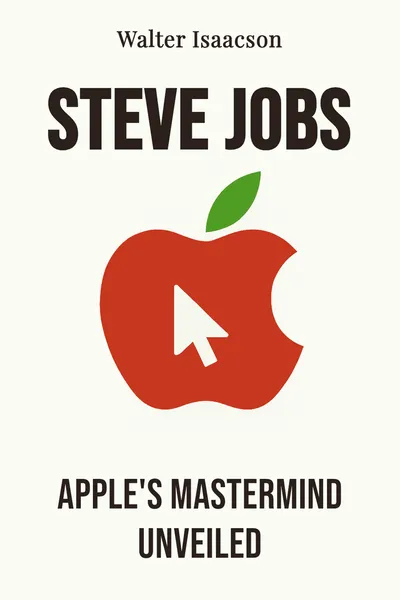
Steve jobs
Apple's mastermind unveiled
Description
Steve Jobs's legacy is multifaceted, reflecting his complex personality and innovative spirit. His approach to business and product development was deeply intertwined with his personal passions, perfectionism, and desire for control, leading to the creation of groundbreaking products that transformed industries.
From the Apple II and Macintosh to the iPhone and iPad, Jobs's work has had a lasting impact on the world of technology. He was known for his ability to combine ideas, art, and technology in ways that invented the future, making Apple the most valuable company on earth.
Despite his abrasive personality, Jobs's focus on perfection and integrated solutions drove Apple to unprecedented success, cementing his place as one of the greatest business executives of our era.
Table of contents
01 Early life and education
Steve Jobs, born on February 24, 1955, in San Francisco, was adopted by Paul and Clara Jobs after his birth parents, Joanne Schieble and Abdulfattah “John” Jandali, were unable to raise him.
Growing up in Mountain View, Jobs was exposed to the burgeoning tech scene of Silicon Valley, developing an early interest in electronics. Demonstrating exceptional intelligence, he skipped several grades in elementary school and discovered his passion for computers during a tour of Hewlett-Packard’s holography lab. This passion led him to call Bill Hewlett, who provided him with parts for a project and offered him a summer job at HP.

02 Atari and india
Steve Jobs spent a year and a half exploring his interests at Reed College before deciding to return to his parents' home in Los Altos, seeking employment.
His determination led him to Atari, where he insisted on being hired, impressing Al Alcorn, Atari's chief engineer, with his boldness. Jobs was hired as a technician at a rate of $5 per hour, saving enough money to travel to India in search of spiritual enlightenment.
After seven months in India, Jobs returned and resumed working at Atari. Meanwhile, Steve Wozniak was employed as an engineer at Hewlett-Packard. The duo collaborated on designing a circuit for a new Atari game, agreeing to equally split the $350 payment.
Their involvement in the Homebrew Computer Club and exposure to the Altair, the first personal computer kit, inspired Wozniak to envision a personal computer integrating a keyboard, monitor, and microprocessor into a single unit, leading to the creation of what would become the Apple I.
03 Apple's inception
The Apple II, launched at the West Coast Computer Faire in April 1977, marked a pivotal moment for Apple, securing 300 orders and a Japanese dealer.
This success led Apple to move from Steve Jobs's parents' garage to a Cupertino office, with Mike Markkula hiring Mike Scott as president to manage Jobs's ambitious ideas.
The Apple II, credited largely to Steve Wozniak's design genius, sold nearly six million units over sixteen years, significantly impacting the personal computer industry.
Despite its success, Jobs sought to innovate further, leading to the development of the Apple III and later the Lisa, both of which failed to capture the market.
04 The macintosh project
After being removed from the Lisa project, Steve Jobs redirected his focus and energy to the Macintosh project, initially led by Jeff Raskin who aimed to create an affordable computer for the masses.
However, Jobs envisioned the Macintosh as something "insanely great" and took control of the project, shaping it according to his vision. Known for his "reality distortion field," demanding perfection, and a management style that was both temperamental and challenging, Jobs drove the Macintosh team to adapt and thrive under his leadership. Team member Andy Hertzfeld reflected on Jobs's approach, emphasizing the goal of achieving greatness rather than beating competitors or financial gain.
Jobs was adamant that the Macintosh would not be compatible with previous Apple products like the Lisa or Apple II, focusing instead on a tightly integrated hardware and software experience. This approach was in stark contrast to IBM's strategy with its personal computer. Jobs's obsession with detail and design led to the Macintosh's unique position in the market, guided by the mantra that "Simplicity is the ultimate sophistication."
05 Departure from apple
In the spring of 1985, tensions between Steve Jobs and Apple CEO John Sculley reached a peak. Disagreements over management styles and the direction of the company led to Jobs being stripped of his duties and given a nominal chairman role.
Feeling marginalized, Jobs sold his Apple shares for over $100 million and founded NeXT, targeting the higher education market. Despite initial struggles and industry skepticism, NeXT eventually caught the attention of Ross Perot, who invested significantly, and IBM, which licensed the NeXTSTEP operating system before later letting the rights lapse.
06 Next and pixar
Upon his return to Apple, Steve Jobs quickly made significant moves, including a groundbreaking partnership with Microsoft announced at the August 1997 Macworld Expo. This partnership, which included a $150 million investment from Microsoft, led to a 33% increase in Apple's stock price, boosting its market capitalization by $830 million. Jobs initiated a "Think different" advertising campaign and streamlined Apple's product line to four core products.
He also took on the role of interim CEO, balancing this with his CEO position at Pixar, and focused on product design, working closely with Jonathan Ives. This collaboration resulted in the successful launch of the iMac in May 1998, which became the fastest-selling computer in Apple's history. Jobs also recruited Tim Cook from Compaq, further strengthening Apple's leadership team.
07 Return to apple
In 2005, Apple's iPod sales were soaring, with twenty million units sold. Steve Jobs foresaw that cell phones could disrupt this revenue stream and decided Apple should enter the market. At the time, a secret team at Apple was working on a touch-screen tablet, but when Jobs saw the prototype, he envisioned its interface as ideal for a phone. He redirected the team's efforts to develop what would become the iPhone. After nine months of intense development and a last-minute design change to feature a stainless steel bezel, the iPhone was introduced at the 2007 Macworld Expo. Jobs famously announced it as a combination of a wide-screen iPod, a mobile phone, and an internet communicator.
Despite skepticism about its $500 price tag, by 2010, Apple had sold ninety million iPhones, capturing over half of the global cell phone market's profits. Meanwhile, the tablet project continued, leading to the iPad's launch. Jobs insisted on simplicity, focusing on the display screen. The iPad's initial reception was lukewarm, partly due to the absence of a USB port and a three-month wait before its release. However, its intuitive design won over consumers, with one million units sold in the first month and fifteen million in nine months.
08 Jobs' legacy
Steve Jobs, the visionary behind Apple, left an indelible mark on the world with his unique blend of passion, perfectionism, and an unparalleled ability to integrate hardware and software into seamless, user-friendly experiences. His approach to business and product development was deeply personal, mirroring his own complex character—driven by desires, artistry, and a relentless pursuit of control. Jobs's philosophy centered on simplicity and unity, which not only defined Apple's products but also propelled the company from a market underdog to a technological titan, surpassing giants like Microsoft in market value.
Jobs's insistence on perfection and integrated solutions was not just about being a control freak; it was about his commitment to creating exceptional products that prioritized the user experience. This approach attracted and demanded the best from his team, fostering an environment where only the most resilient and talented could thrive. Jobs's legacy is not just the transformation of industries through groundbreaking products like the Apple II, the Macintosh, and the iPhone, but also in establishing Apple as a beacon of innovation and creativity.
Related books