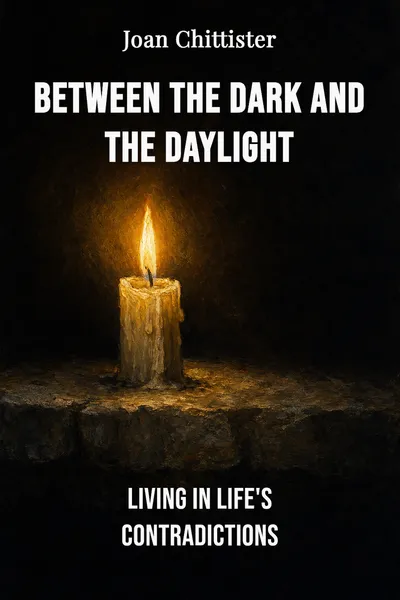
Between the Dark and the Daylight
Living in life's contradictions
Description
Joan Chittister spent most of her adult life inside a Benedictine monastery in Erie, Pennsylvania, watching people arrive at her door in a particular kind of trouble. Not the dramatic kind. The quieter kind: successful, capable, busy adults who could not have said what was wrong, only that something was. They had the career, the family, the calendar full to the edges, and still a low hum of unease that no achievement seemed to switch off. She recognized it because she had felt it herself. In Between the Dark and the Daylight, published in 2015, she names that hum and refuses the usual advice about how to make it go away.
Her wager is unusual. Most books that speak to the overworked mind and the tired heart promise relief — a system, a morning routine, a way to finally get on top of things. Chittister does the opposite. She argues that the unease is not a malfunction to be fixed but a signal to be read, and that the moments when our lives feel most at odds with everything around us are precisely the moments worth staying inside rather than escaping. The dark and the daylight, in her title, are not enemies. They are the two halves of a whole day, and a whole life needs both.
What makes this more than consolation is the shape of the claim. Chittister, drawing on a long monastic tradition of sitting with what unsettles rather than rushing past it, treats contradiction as the native condition of being human — not a problem to solve but a place to live. The book is her attempt to describe how a person actually does that: how they stay upright in the storm without pretending the storm is not there.
The question we’re asking : Why does a full, capable life so often carry a hum of unease that no achievement quiets — and what if that unease is not the problem?What we’ll see : How a monastic writer reframes the contradictions of modern life as the place where a real life is lived, not a fault to be repaired.
Table of contents
01 Chapter 1 — The busy life that hides an empty one
Chittister begins with a distinction she has watched play out over decades: the difference between a full life and a busy one. They look identical from the outside. Both involve someone moving fast, doing much, rarely still. But one is nourished by what it does and the other is being slowly hollowed out by it. The tragedy, she observes, is that busyness is easy to mistake for meaning, because it produces the same exhaustion and the same appearance of significance. We are tired, so we assume we must be living well. We are needed, so we assume we must be doing what matters.
The trouble is that busyness is also an excellent hiding place. As long as the calendar stays full, there is never a quiet enough moment for the harder questions to surface — the ones about whether any of this is what we actually want, whether we are living our own life or a life assembled from other people's expectations. Chittister is blunt that many of us keep ourselves busy precisely so we never have to find out. Overwork, in her reading, is not only a demand imposed from outside; it is often a defense we build from inside, a way of outrunning a silence we are afraid to enter.

02 Chapter 2 — The questions we keep postponing
Once the noise drops, Chittister says, the questions arrive — and they are rarely the ones we expected. They are not tidy problems with answers waiting somewhere online. They are the large, awkward ones we have spent years learning to step around: What is my life for? Why does success not feel the way I was promised it would? What do I do with the grief, the doubt, the sense that I am not becoming who I meant to become? These are the questions, she notes, that seemed easier to avoid, and avoidance felt like maturity because everyone around us was avoiding them too.
Her argument is that postponement has a cost we pay with interest. The unasked question does not disappear; it goes underground and reappears as restlessness, as irritability, as the vague dissatisfaction that follows us into weekends and vacations we had counted on to fix us. We treat that feeling as evidence that we need more rest or a change of scene, when it is often the buried question knocking. Chittister invites us to do the thing that feels backward — to turn toward the discomfort, to sit in the chaos rather than tidy it away.
03 Chapter 3 — Learning to hold two truths at once
At the center of the book is a single move Chittister keeps returning to: the capacity to hold two apparently opposed truths at the same time without collapsing one into the other. We are taught, from school onward, to resolve contradictions — to pick a side, settle the tension, arrive at the clean answer. She suggests that many of life's most important situations refuse that treatment. We can love our work and feel imprisoned by it. We can grieve a loss and be relieved by it. We can hold deep faith and real doubt in the same chest. These are not signs of confusion. They are simply the texture of an adult life honestly examined.
The temptation, when two truths pull against each other, is to declare one of them false — to decide we do not really love the job, or do not really doubt, so the discomfort can end. Chittister names this the great evasion. It buys peace by amputating half of our own experience, and the amputated half does not stay gone. Real steadiness, in her account, comes not from resolving the contradiction but from learning to stand inside it, letting both truths be true and finding that we do not, in fact, fall apart when they are.
04 Chapter 4 — What contradiction asks of a life
Step back from the individual chapters and Chittister's larger proposition comes into view: a good life is not one that has resolved its tensions but one that has grown large enough to hold them. This quietly overturns a story most of us absorb without noticing — the story in which maturity means finally getting things sorted, arriving at a settled place where the striving stops and the contradictions are behind us. She argues there is no such place, and that waiting for it is itself a way of not living. The restlessness we keep trying to cure is not a stage we pass through. It is a feature of being awake.
Read this way, much of what we experience as failure looks different. The person who cannot make their ambition and their longing for rest agree is not broken; they are registering an honest conflict that a full human life contains. The doubt that visits the believer, the loneliness that visits inside a good marriage, the emptiness that visits at the peak of success — Chittister treats these not as errors to be corrected but as the ordinary weather of a heart that is paying attention. The task is not to eliminate them but to learn to live well amid them.
05 Conclusion
The people who arrived at Chittister's door were not looking for another thing to do; they had plenty. They were looking, without quite knowing it, for permission to stop pretending everything reconciled. Between the Dark and the Daylight offers that permission and then asks something in return — that we quit outrunning the unease and turn to meet it. The book closes the loop it opened: the hum that no achievement silences is not a defect in the machinery of a busy life. It is the sound of a life asking to be lived more honestly than busyness allows.
Related books