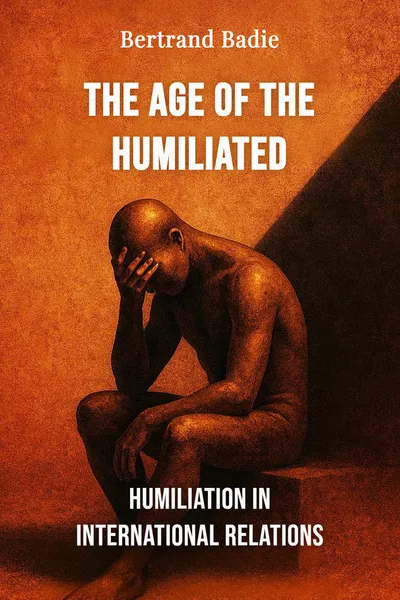
The Age of the Humiliated
Humiliation in international relations
Description
There is a word that rarely appears in the communiqués of foreign ministries, in the briefings of strategists, or in the dry columns of defense budgets: humiliation. It sounds too emotional, too personal, too much like something that belongs to playgrounds and family dinners rather than to the serious business of states. And yet, in his book The Age of the Humiliated, the French political scientist Bertrand Badie argues that this discarded word may explain more about the twenty-first century than any map of military alliances. Wars, insurgencies, diplomatic ruptures — many of them, he suggests, begin with a bruised sense of dignity long before they end in bloodshed.
Badie spent decades studying how power actually circulates between nations, and his conclusion runs against the grain of the whole realist tradition. For centuries, the West built its theory of international relations on a single engine: the pursuit of power, the calculation of interests, the equilibrium of forces. Humiliation did not fit the model, so it was left out. But a feeling that is ignored does not disappear. It accumulates, it hardens, and eventually it rewrites the rules of the game — often in the hands of those the powerful had assumed were too weak to matter.
What happens, then, when we take the affront seriously — not as a metaphor but as a genuine motor of foreign policy? Badie invites us to re-read a familiar history through an unfamiliar lens, where the losers remember what the winners prefer to forget, and where the wounded status of a people can shape decades of conflict.
The question we’re asking : What if humiliation, and not raw power, had become the hidden engine of today's international disorder?What we’ll see : How a feeling diplomats dismiss has quietly reorganized the way nations clash, resist, and ultimately might reconcile.
Table of contents
01 Chapter 1 — The wound the balance of power ignored
The study of international relations has long run on a lean diet of concepts. States seek power, defend interests, and arrange themselves into balances that keep any one of them from dominating the rest. It is an elegant machine, and for a certain stretch of history it worked well enough as a description. What it leaves out, Badie insists, is the felt experience of being on the receiving end — the shame of defeat, the sting of being dictated to, the slow burn of being treated as negligible. Realism measures capabilities; it has no column for dignity.
Badie's wager is that this omission is not a minor blind spot but a structural one. Humiliation, as he describes it, is not simply losing. A state can lose a war and recover its standing. Humiliation is being denied status — being told, implicitly or openly, that one does not belong among the equals, that one's voice carries no weight, that one's history and grievances are not worth considering. It is a relational wound, inflicted by the strong and felt by the weak, and it leaves a residue that no treaty fully clears.

02 Chapter 2 — From Vienna to Versailles, a grammar of status
If humiliation is a driver, where did it learn its grammar? Badie traces it to the way the modern international order was assembled — a club with members and non-members, insiders and supplicants. The Congress of Vienna in 1815 set the template: a handful of great powers gathered to redraw Europe after Napoleon, arrogating to themselves the right to decide the fate of everyone else. Rank was the organizing principle. To be a great power was to sit at the table; to be anything less was to be an object of the discussion rather than a party to it.
The nineteenth century extended this logic across the globe through colonial expansion, which was humiliation institutionalized on a planetary scale. Entire civilizations with long memories of their own grandeur found themselves reclassified as backward, administered by foreigners, and told their traditions were obstacles to progress. The affront here was not merely domination but the denial of equal human and historical standing. Badie argues that the resentments seeded in this period did not dissolve with formal independence; they became part of the political inheritance of the postcolonial world.
03 Chapter 3 — When the weak refuse to play dead
The decisive shift of the contemporary era, in Badie's telling, is that the humiliated are no longer passive. For a long time the hierarchy held partly because those at the bottom lacked the means to contest it. That is no longer true. Decolonization multiplied the number of sovereign states; globalization gave even modest actors access to information, networks, and tools once reserved for the powerful. The affronted now have ways to answer back, and they are using them.
Badie's crucial observation is that these answers rarely take the classical form of state-versus-state confrontation, because that is precisely the game the weak cannot win. Instead, humiliation expresses itself asymmetrically. It fuels insurgencies, non-state movements, and forms of violence that bypass armies altogether. A superpower with overwhelming firepower can find itself unable to prevail against adversaries who have little materially but a great deal to avenge. Power, in the old sense, turns out to be a blunt instrument against a grievance it does not even recognize as legitimate.
04 Chapter 4 — The world as a stage for lost face
Step back from the particular conflicts and a larger picture comes into focus. What Badie describes is not a scattering of isolated grievances but a structural feature of the present international order — an order that still runs on a logic of ranking inherited from Vienna, now colliding with a world in which almost everyone can register their protest. The great powers continue to behave as though status were theirs to grant or withhold. The difference is that the audience for these gestures has grown global, and it remembers.
This is why Badie speaks of an age, not merely a problem. Humiliation has become ambient, a background condition of global politics rather than an occasional flare-up. Summits, sanctions, exclusions from international bodies, the quiet condescension of the powerful toward the rest — each sends a signal about who counts. In a connected world, those signals are received instantly and stored resentfully. The management of appearances, of face, of recognition has become as consequential as the management of arms, and far less well understood by those who still think in terms of deterrence alone.
05 Conclusion
We began with a word that foreign ministries prefer to avoid, and we end with the suspicion that their avoidance is itself part of the problem. Badie's argument is that humiliation has been hiding in plain sight all along — in the treaties, the hierarchies, the quiet condescensions that the powerful mistook for the ordinary workings of order. Read through this lens, a great deal of the world's turbulence stops looking irrational.
Related books