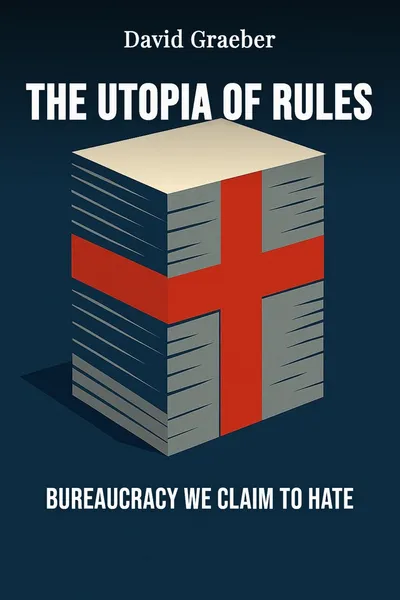
The Utopia of Rules
Bureaucracy we claim to hate
Description
In 2006, the anthropologist David Graeber spent several weeks trying to obtain power of attorney over his dying mother's affairs. She had suffered a series of strokes and could no longer sign her own name. What followed was a spiral of forms, notarizations, faxes, and one document that had to be signed by a person who was, by that point, physically unable to sign anything. Graeber — a man who would soon help coin the phrase "We are the 99 percent" — found himself, a professional radical, defeated by a bank's photocopier. He noticed something odd about his own reaction: not just rage, but a strange sense that the whole ordeal was somehow beneath comment, too stupid to be worth analyzing.
That intuition became a book. The Utopia of Rules, published in 2015, gathers Graeber's essays on a subject he thought his own discipline had bizarrely neglected: bureaucracy. The oddity, he argued, is not that we live drowning in paperwork. It is that almost nobody defends it, almost everybody complains about it, and yet it keeps growing. The political right promised to cut red tape and expanded it. The political left promised humane institutions and produced forms. Both the market and the state, supposedly opposites, generate the same beige infrastructure of applications, permits, and PINs.
So the complaint that unites us — left, right, employee, customer, patient — hides a puzzle. If we all hate bureaucracy, why does it flourish? Graeber's answer refuses the easy ones. It isn't simply inefficiency, or lazy officials, or capitalism, or socialism. Something in the arrangement satisfies us, even as it exhausts us, and pretending otherwise is how it keeps winning.
The question we’re asking : If everyone claims to loathe bureaucracy, why does it keep expanding on all sides?What we’ll see : An anthropologist's account of what paperwork actually does, who it protects, and why its logic feels oddly comforting.
Table of contents
01 Chapter 1 — The paperwork nobody admits to wanting
Graeber begins with a frustration everyone shares and few examine. We treat bureaucratic hassle the way we treat weather — inevitable, tedious, not really a subject. Social theory, he points out, has plenty to say about revolution, capital, desire, and identity, and almost nothing to say about the afternoon lost to a call center. The most bureaucratized society in history had, by his account, stopped even trying to think about bureaucracy. That silence is the first thing worth noticing.
The standard story is that bureaucracy is what the state does and markets are the cure. Graeber, drawing on decades of anthropology, calls this a fantasy. The rise of the free market in the nineteenth century did not shrink officialdom; it multiplied it. Banks, insurers, credit agencies, and corporations run on paperwork every bit as much as any ministry, and increasingly the two are hard to tell apart. The private sector did not liberate us from forms. It outsourced the forms to us.

02 Chapter 2 — Structural violence in triplicate
The word that recurs across the book is one people rarely associate with a photocopier: violence. Graeber's claim is deliberately blunt. Bureaucratic situations are ones in which the threat of physical force is never far away, even when it never appears. Refuse to fill out the form, ignore the summons, decline to prove who you are, and eventually someone with a uniform and the power to detain you will arrive. The paperwork is polite precisely because the force behind it does not need to raise its voice.
This is what he means by structural violence — arrangements of inequality that are ultimately backed by the capacity to hurt people, even if the hurting stays offstage. A poor woman navigating a benefits office, a migrant at a border, a tenant facing eviction: each meets a wall of documents, and behind the documents stands the state's monopoly on legitimate force. The forms are not an alternative to coercion. They are its administrative surface, the paperwork coercion generates as it processes human beings into cases.
03 Chapter 3 — The dead zones of the imagination
One of the book's sharpest ideas is that bureaucracy makes people, on both sides of the counter, dumber. Graeber calls these encounters "dead zones of the imagination." The person filling out the form has to imagine, in exhausting detail, what the official is thinking and what will satisfy the rule. The official, protected by the rule, has to imagine almost nothing about the person. Interpretive labor runs in one direction only, and the direction runs downhill, toward whoever has less power.
He ties this to a broader disappointment about the modern world. We were promised flying cars, moon bases, cures — the futures of mid-century imagination. Instead we got extraordinary machinery for moving information around and, with it, an explosion of administration. Graeber's provocation is that this was not an accident of technology but a choice about where to point it. Bureaucratic capitalism excels at generating reports, metrics, and compliance regimes, and is strikingly bad at the kind of open-ended, uncertain research that produces genuine novelty.
04 Chapter 4 — Rules, games, and the pleasure of the fixed
Step back from the forms and Graeber offers an unexpected place to look for the appeal of bureaucracy: games. A game, he observes, is a rare zone of pure freedom precisely because it is a zone of total rules. Within the lines of the pitch or the edges of the board, everything is clear. You know exactly what counts as winning, exactly what is allowed, exactly where you stand. Ordinary life offers no such clarity. It is a mess of ambiguous obligations and unwritten expectations that never resolve.
Bureaucracy, on this reading, is the fantasy of turning all of life into a game — a domain where the rules are explicit, applied identically to everyone, and free of the terror of the arbitrary. That is a deeply attractive prospect, and it explains why even people who despise paperwork will, in the next breath, demand a clearer procedure, a written policy, a form to fill out. We want the arbitrariness gone. We reach for rules to banish it, without noticing that we are building the very cage we complain about.
05 Conclusion
Graeber never did get the power of attorney sorted in time; his mother died in the middle of the paperwork. The small story is the whole argument in miniature — a real human situation, urgent and particular, ground against a wall of documents that could not, by design, take it in. He came out of it not with a policy proposal but with an anthropologist's refusal to accept that the ordeal was beneath notice. The stupidest experiences, he suspected, often hide the most.
Related books