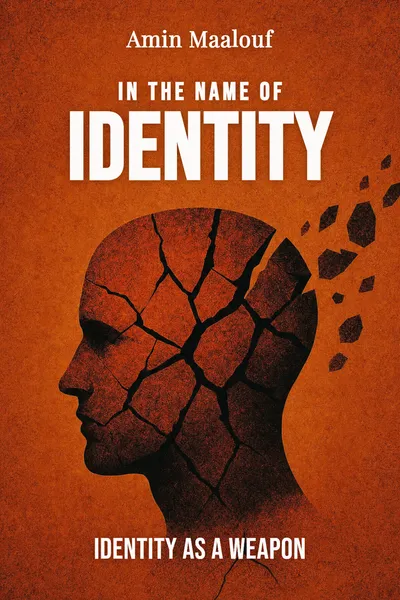
In the Name of Identity
Identity as a weapon
Description
Amin Maalouf was born in Lebanon in 1949, into a family that was Catholic in a mostly Muslim country, Arabic-speaking in a region where that language carried a particular weight, and eventually French-writing in a culture that was not his own by birth. He left Beirut in 1976 when the civil war made his profession as a journalist untenable, and settled in France. For years, people asked him a question he found impossible to answer cleanly: deep down, do you feel more French or more Lebanese? The questioners always expected one word. He never had one.
That small social friction became the seed of a short book, published in 1998 under the title Les Identités meurtrières — in English, In the Name of Identity. Maalouf is a novelist, not a philosopher, and the book reads like someone thinking out loud rather than building a system. But its argument cuts hard. The violence he had watched tear apart his own country, and the massacres filling the news of the 1990s, kept coming back to the same mechanism: people being reduced, or reducing themselves, to a single label — a religion, a nation, an ethnicity — and then killing in its name.
The book arrived in the decade of Bosnia, Rwanda, and sharpening debates about immigration across Europe. Maalouf refused the comfortable positions on offer. He would not say identity is a dangerous illusion we should outgrow, and he would not say every community must defend its purity. He wanted something harder to hold: a way of belonging to several things at once, honestly, without betrayal.
The question we’re asking : Why do belongings that should enrich a person so often turn into something people are ready to kill and die for?What we’ll see : How Maalouf reframes identity as plural and singular at once, and why under pressure it hardens into something lethal.
Table of contents
01 Chapter 1 — The question nobody knew how to answer
The book opens with that recurring question — French or Lebanese? — and Maalouf's refusal to split himself in two. He always answers both, and the answer never satisfies. People hear it as evasion, as if a man who claims two homelands has really chosen neither. But he insists the opposite is true. It is precisely the two together, in their friction and their overlap, that make him who he is. Lop off either half and you do not get a simpler, truer Maalouf. You get no Maalouf at all.
From this stubborn little scene he draws his first move. The trouble, he says, is not the questioner's rudeness but a shared assumption buried underneath it: that identity is something you have one of. A core. A deepest layer. A single essence that all the rest merely decorates. Ask it of anyone, he notes, and they feel pressed to rummage inside themselves for the one belonging that supposedly outranks the others — the real me beneath the circumstances.

02 Chapter 2 — Not a mosaic, a single face
Having insisted that identity is plural, Maalouf immediately guards against a misreading. He does not mean a person is a patchwork, a loose bundle of separate cards one shuffles depending on the room. That image, convenient as it sounds, misses something. A human being is not several half-persons stapled together. Each of us is one, and that oneness is real. The paradox he wants to hold is that identity is made of many belongings and is, at the same time, utterly singular.
The way he squares it is elegant. Every belonging we carry is colored by all the others. A Christian in Lebanon is not the same as a Christian in France or in Poland; the faith is inflected by the country, the century, the neighbors, the wounds. An Arab who writes in French carries an Arabic that a monolingual speaker never could. The elements do not sit side by side like tiles. They soak into one another. What results is not a collection but a compound — one face, assembled from ingredients that exist nowhere else in that exact dose.
03 Chapter 3 — When one belonging swallows the rest
Here the book sharpens into its central claim. Identity becomes murderous, Maalouf argues, at the moment one belonging swells up and devours all the others. A man who was also a father, a neighbor, a lover of music, a speaker of two tongues, narrows until he is nothing but his religion, or nothing but his nation, or nothing but his tribe — and once a person is reduced to a single allegiance, he can be mobilized, and he can be made to kill.
The reduction usually happens under threat. When a community feels attacked — its language scorned, its faith insulted, its dignity trampled — people reach for the belonging that is under fire and clutch it tighter. In calm times a Yugoslav might have thought of himself in a dozen ways; when the killing started, he was pressed to be only Serb or only Croat or only Muslim, and the other belongings fell silent. Fear does the narrowing. The more a group feels menaced, the more fiercely it clings to the one marker it believes is being erased, and the more ready it becomes to strike first.
04 Chapter 4 — The tribe at the edge of the village
Stepping back, Maalouf situates all of this inside the great disorientation of his time: globalization, and the fear it breeds. The world is converging — one dominant language of commerce, one stream of images, one tide of goods — and many peoples feel their own way of being swept toward the margins. A man can sense that his language will not survive his grandchildren, that his faith is treated as backwardness, that modernity speaks with an accent that is not his and asks him to abandon himself to join it. That sensation, Maalouf argues, is the soil in which murderous identity grows.
His image is of the tribe pushed to the edge of the village. When people feel they are being asked to choose between their heritage and the modern world — between who they were and belonging to the present — many will choose heritage, defensively, bitterly, and turn the belonging that is slighted into a fortress. The reaction looks like a leap into the past. It is really a response to a present that offered them no dignified place. Progress experienced as humiliation produces exactly the clenched, singular identities that go on to kill.
05 Conclusion
The book ends where it began, with a man asked to name his deepest self and declining to. By now the refusal has a weight behind it. To answer French or Lebanese with a single word would be, in Maalouf's terms, to perform the very reduction he has spent the book warning against — to let one belonging silence the rest, the first small step down the road that leads, at its far end, to people killing in the name of a label. He would rather remain the awkward answer, both at once, uncategorizable.
Related books