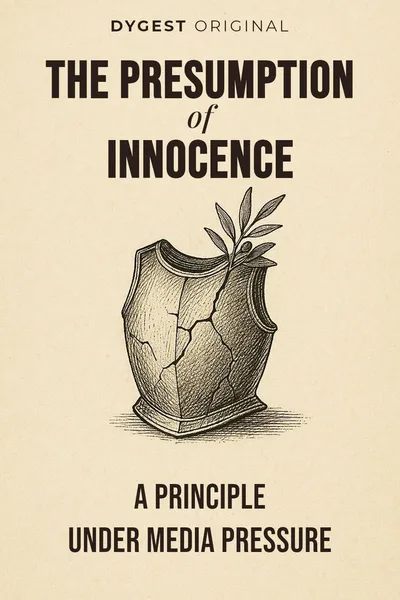
The Presumption of Innocence
A principle under media pressure
Description
In 1789, the French Declaration of the Rights of Man and of the Citizen put it in Article 9: every person is presumed innocent until declared guilty. The English common-law version is older still, worked out across centuries of courtrooms rather than written in a single line. It reached its most quoted modern form in 1935, when a British judge named Viscount Sankey called the duty of the prosecution to prove guilt "the golden thread" running through the whole web of criminal law. The idea sits in the Universal Declaration of Human Rights, in the Fifth and Fourteenth Amendments as read by American courts, in nearly every constitution written since. It is one of the few legal principles almost everyone claims to hold.
And yet it describes something we find genuinely hard to do. When we hear that someone has been arrested, charged, named in connection with a crime, the instinct is not to suspend judgment. The instinct is to form one. The presumption of innocence asks us to hold open a door that our minds want to close — to treat an accusation as a claim that still has to be proven, not as information about what happened. In a courtroom, that discipline is built into the rules. Outside one, there are no rules at all.
Which is where the principle meets its hardest test. A trial is slow, procedural, bounded by evidence. A story moves fast, and a name attached to a crime travels faster than any acquittal ever will. Long before twelve jurors reach a verdict, millions of people have already reached theirs — from a headline, a mugshot, a thread. The presumption survives in law. The question is what happens to it everywhere else.
The question we’re asking : What does the presumption of innocence actually require, and what happens to it once an accusation leaves the courtroom?What we’ll see : How a principle built to protect the accused holds up against the speed and certainty of public judgment.
Table of contents
01 Chapter 1 — A rule that runs against the grain
Start with what the presumption of innocence is not. It is not a claim that the accused is, in fact, innocent. The person in the dock may well have done it; the principle says nothing about that. What it establishes is a starting point for how the state is allowed to treat someone it has accused. Until guilt is proven to the required standard, the accused is to be handled, in law, as though they had done nothing. The presumption is a rule about who carries the weight, not a guess about the truth.
That matters because the natural human move is the opposite one. When a story reaches us with a villain already in it, we don't begin from neutrality and wait for proof. We begin from the accusation and ask the accused to talk us out of it. The presumption of innocence is deliberately counter-intuitive: it tells the most powerful party in the room — the state, with its police, its prosecutors, its machinery — that it must do the proving, and that doubt is to be resolved in favour of the person with the least power.

02 Chapter 2 — What the burden of proof actually buys
The presumption only means anything because it comes attached to a second rule: the burden of proof. Someone has to establish guilt, and in a criminal case that someone is always the prosecution. The accused does not have to prove innocence, explain themselves, or testify at all. Silence cannot be read as an admission. The entire apparatus is arranged so that if the state fails to make its case, the accused walks — not because they are vindicated, but because the state did not clear the bar it was required to clear.
And the bar is set high on purpose. In criminal law the standard is proof beyond reasonable doubt — not beyond all doubt, which is impossible, but to the point where no reasonable alternative explanation remains. Compare that to a civil case, where one party need only show that its version is more likely than not. The gap between those two standards is the gap between losing a lawsuit and losing your liberty. The criminal standard is deliberately demanding because the thing at stake — punishment by the state — is the heaviest thing a legal system can do to a person.
03 Chapter 3 — The accusation that convicts before the verdict
The pressure point is this: an accusation does damage on its own, before any court weighs in. To be charged is to be named, and to be named in connection with a crime is already a kind of sentence. Jobs are lost, reputations collapse, relationships end — all on the strength of a claim that has not yet been, and may never be, proven. The law can declare someone innocent at the end of the process. It cannot give back the two years in which everyone around them behaved as though they were guilty.
This is where the presumption shows its limits as a social fact rather than a legal one. Inside the trial, the machinery holds. Outside it, there is no judge to enforce the burden of proof, no standard of beyond reasonable doubt, no instruction to the public to keep an open mind. There is only the accusation, moving at speed, and a crowd that treats being charged as roughly equivalent to being convicted. The formal verdict, when it arrives, often arrives to a room that has already emptied.
04 Chapter 4 — The courtroom and the newsroom have different rules
Step back and the real stress on the presumption of innocence is not legal but cultural. The principle was engineered for one specific room, governed by one specific set of rules, overseen by someone with the power to enforce them. The newsroom, the timeline, the group chat — these are rooms too, and they decide questions of guilt constantly. But they run on the opposite settings. Where the court demands proof before judgment, public attention rewards judgment before proof. Where the court resolves doubt in favour of the accused, the crowd resolves it in favour of the better story.
"Trial by press" is the usual name for the collision, though the phrase is older than the media that now power it. The worry is not new — courts have long fretted that lurid coverage could poison a jury pool, and some jurisdictions still restrict what can be reported before a verdict precisely for that reason. What has changed is the scale and the speed. A verdict reached by millions of strangers, on partial information, hours after an arrest, is a different kind of force than a sensational newspaper ever was. The formal trial still happens. It increasingly happens after the informal one has already returned its sentence.
05 Conclusion
The golden thread that Viscount Sankey described in 1935 is still there, holding exactly where it was designed to hold. Inside a criminal trial, the state must prove guilt beyond reasonable doubt, the accused need prove nothing, and every real doubt bends toward the person in the dock. As a piece of legal architecture, the presumption of innocence is as sound now as it has ever been. Courts enforce it daily, and the systems that drop it — where accusation alone is enough to condemn — are precisely the ones we recognise as unjust.
Related books