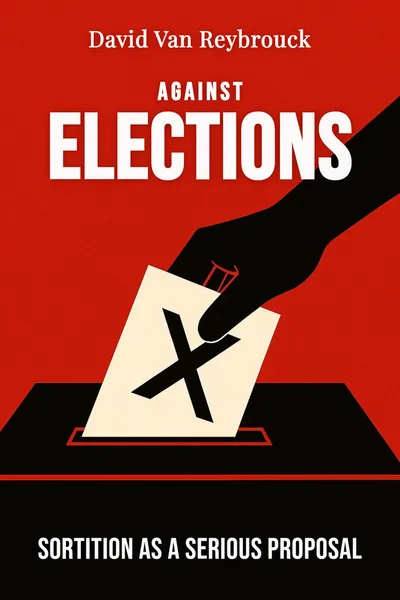
Against Elections
Sortition as a serious proposal
Description
In 2013, a Belgian cultural historian named David Van Reybrouck published a slim, impatient book with a title that reads like a provocation: Against Elections. He was writing out of a specific national frustration — Belgium had just spent 541 days without a government, a record-breaking stalemate after the 2010 elections left the parties unable to form a coalition. But the diagnosis he reached went far beyond one small country's political dysfunction. Something, he argued, was wrong with the machinery itself.
The symptoms were familiar everywhere. Voter turnout sliding, party membership collapsing, trust in politicians scraping historic lows, and a widening sense that the people who govern and the people who are governed no longer speak the same language. The usual response, Van Reybrouck noticed, is to double down: more referendums, more elections, more frequent chances to vote. He wanted to ask a different and far more unsettling question — whether the problem might be the election itself.
Because here is the part that tends to stop readers short. For most of the history of democratic thought, elections were not considered democratic at all. They were understood as a tool of aristocracy. The idea that a legitimate government could be staffed by ordinary people chosen at random — by lot — was once mainstream, practiced for centuries, and then quietly forgotten. Van Reybrouck's book is an attempt to remember it, and to take it seriously as something we might do again.
The question we’re asking : If elections are breaking down everywhere at once, what if the problem is not how we vote but that we vote at all?What we’ll see : How a frustrated historian traced the democratic malaise back to the ballot box itself — and dusted off an ancient alternative that is quietly being tested again.
Table of contents
01 Chapter 1 — The disease nobody wants to name
Van Reybrouck opens with a condition he calls, borrowing the clinical register deliberately, democratic fatigue syndrome. The signs are easy to list and hard to argue with. Across Western democracies, fewer people bother to vote, and those who do increasingly swing between protest parties, populists, and abstention. Party membership, which once ran into the millions, has thinned to a fraction. Surveys that ask whether people trust politicians return numbers that would alarm anyone running an ordinary institution.
What strikes him is the gap between two things we are told simultaneously. On one hand, democracy has never been more popular as an ideal — almost nobody, anywhere, argues openly for a return to monarchy or dictatorship. On the other hand, the actual practice of democracy inspires less and less enthusiasm. People believe in democracy and cannot stand the way it currently works. That tension, he argues, is the real story, and most reform proposals miss it entirely.

02 Chapter 2 — A system that was never meant to be democratic
The historical core of the book is a claim that sounds almost like a trick until the evidence piles up: elections and democracy are not the same thing, and for most of recorded political thought they were understood to be opposites. In classical Athens, the democracy that gave us the word, the overwhelming majority of public offices were filled not by voting but by drawing lots. Citizens were selected at random to sit on councils, staff courts, and run the day-to-day business of the city. Election was reserved for a handful of specialist roles, such as generals, precisely because those required expertise.
The logic was explicit. To the Athenians, voting was aristocratic because it let the wealthy, the well-connected, and the eloquent rise to the top — it selected for distinction, which is exactly what democracy, rule by the whole citizenry, was meant to resist. Drawing lots, by contrast, treated every citizen as equally capable of governing. Aristotle stated the principle flatly: the appointment of magistrates by lot is democratic, and election is oligarchic. This was not a fringe view but common sense among those who thought seriously about self-rule.
03 Chapter 3 — The case for drawing lots
Having unsettled the assumption that democracy requires elections, Van Reybrouck turns to the constructive argument: that sortition, selecting ordinary citizens by lot to deliberate and decide, deserves to be taken seriously as a working method, not an antiquarian curiosity. The claim is not that we should abolish voting overnight, but that a legislature or advisory body drawn by lot would have real virtues that elected ones structurally lack.
The first virtue is representativeness in a literal sense. A chamber of randomly selected citizens, if the sample is large enough, looks like the population — the same spread of income, age, education, region, occupation. Elected assemblies, by contrast, skew heavily toward the wealthy, the highly educated, the professionally ambitious, the kinds of people willing and able to run campaigns. A body chosen by lot is a statistical mirror; an elected one is a self-selected filter.
04 Chapter 4 — When citizens actually sit down to decide
What lifts Against Elections above a thought experiment is that the method has been tried, and the results have outrun the skepticism. Van Reybrouck points to a handful of real experiments in which randomly selected citizens were given hard problems and the resources to solve them. In British Columbia in 2004, a Citizens' Assembly of ordinary residents, chosen largely by lot, spent nearly a year studying electoral reform and produced a detailed proposal — reaching, on a technical question, a sophistication that surprised the professionals. The Netherlands and Ontario ran comparable experiments.
Closest to home for Van Reybrouck was the Irish case. Beginning around 2012, Ireland convened citizen bodies mixing allotted members with politicians to deliberate on constitutional questions. Their recommendations fed directly into the referendums that legalized same-sex marriage and, later, liberalized Ireland's abortion laws — questions so divisive that the ordinary political class had avoided them for decades. Ordinary people, given time and good information, worked through exactly the material that paralyzes campaign-driven politics.
05 Conclusion
Van Reybrouck began with a country frozen for a year and a half, unable to form a government through the ordinary electoral machinery. He ends somewhere unexpected: not with a call to vote harder or reform the ballot, but with a modest, radical suggestion that we recover a method democracies used for most of their history and abandoned by accident. Drawing lots, he insists, is not nostalgia. It is a live technique, already working in Vancouver, Dublin, and elsewhere, waiting to be scaled.
Related books