

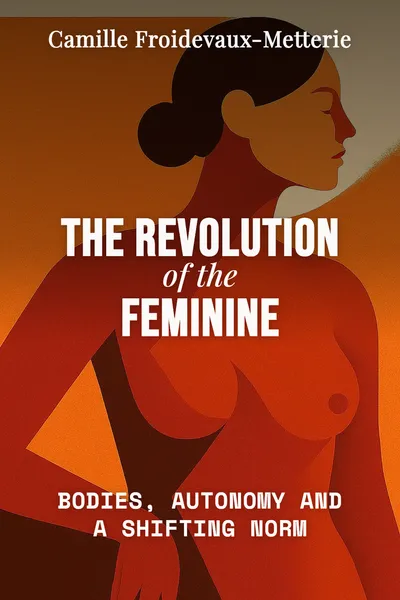
The Revolution of the Feminine
Bodies, autonomy and a shifting norm
Description
For most of Western philosophy, the body was the thing to get past. Descartes wanted a thinking subject detached from its flesh; a long tradition after him treated the mind as the seat of the person and the body as its unruly vehicle. Camille Froidevaux-Metterie, a French philosopher, starts from a simple observation that undoes a lot of this: the subject has never been disembodied, and women in particular have always been assigned to their bodies — reduced to them, judged by them, defined by their capacity to carry and nurse and please. If philosophy kept the body at arm's length, lived experience never had that luxury.
Her book, The Revolution of the Feminine, published in France in 2020, reads the past few decades as a turning point in that long story. Something shifted — slowly through the twentieth century, then sharply in the 2010s — in how women relate to their own bodies. The menstruating body, the sexual body, the aging body, the body that gives birth: areas once kept quiet, left to private shame or clinical euphemism, moved into open speech. Froidevaux-Metterie treats this not as a wave of oversharing but as a philosophical event, the moment the female body stops being an object looked at and starts being a self that speaks.
What she's after is less a history of feminism than a phenomenology of it — a careful account of what it feels like, from the inside, to reclaim a body that was never fully one's own. The stakes are large, because if she's right, we're watching one of the oldest arrangements in the culture come apart, and we don't yet have the full vocabulary to describe what replaces it.
The question we’re asking : What changes when women stop being assigned to their bodies and start inhabiting them on their own terms?What we’ll see : How a philosopher traces the long arrangement that tied the feminine to the flesh, and the recent turn that is quietly rewriting it.
Table of contents
01 Chapter 1 — The body philosophy left out
Froidevaux-Metterie builds her argument on a quarrel she has with her own discipline. The great modern account of the self, from Descartes onward, is built around a mind that thinks and a body that merely carries it around. The person, on that picture, is essentially a consciousness; the flesh is incidental, something to be managed or transcended. It is a tidy story, and she thinks it is false — or at least that it was only ever available to half the population.
Because the arrangement was never symmetrical. Men got to be minds; women were made bodies. Across centuries of theology, medicine and law, the feminine was tied to reproduction, to menstruation, to the capacity to attract and to nurse. A woman was understood through what her body could do and how it looked doing it. Simone de Beauvoir had already caught this in The Second Sex in 1949, when she described woman as the one defined relative to man, immanence against his transcendence — stuck in the flesh while he went out and acted on the world.

02 Chapter 2 — From the hidden body to the visible one
The clearest sign of the shift, for Froidevaux-Metterie, is what has moved from silence into speech. Take menstruation. For most of modern history it was the thing managed in private, advertised in commercials with blue liquid and the word itself carefully avoided. Within roughly the last decade that discretion has cracked. Periods are discussed openly, menstrual poverty has become a public policy question, and in Scotland, for instance, free provision of sanitary products became law in 2020. A bodily reality once coded as shameful became something a woman could simply name.
The same movement runs through the other chapters of bodily life she examines. Pregnancy and childbirth, long described in the smoothed-over language of medicine and maternal bliss, have been recovered as experiences women narrate themselves — the pain, the ambivalence, the strangeness of a body remaking itself, but also its power. Breastfeeding, abortion, miscarriage, the postpartum body: each has moved from euphemism toward first-person account. The tone changes everything. Spoken from outside, these were conditions. Spoken from inside, they become experiences a subject has.
03 Chapter 3 — When pleasure became political
Nowhere is the reversal sharper, in her telling, than around sexuality. The long arrangement cast female sexuality as something that existed for someone else — oriented toward male desire, toward reproduction, toward being wanted rather than wanting. Pleasure was an afterthought at best, a scandal at worst. A woman's body was a site of other people's satisfaction before it was a site of her own.
Froidevaux-Metterie treats the reclaiming of female pleasure as one of the load-bearing pieces of the whole revolution. It is not a minor matter of private satisfaction. It is a shift in who the body is for. When women name their own desire, map their own anatomy, insist that their pleasure counts as an end rather than a means, they overturn one of the oldest asymmetries in the culture. The spread of frank talk about the clitoris, about what women actually want, about sex as something done with rather than to them — this is politics conducted at the level of the flesh.
04 Chapter 4 — Consent as the new grammar
If the revolution has a single organizing idea, for Froidevaux-Metterie, it is consent — though not in the thin, legalistic sense of a box ticked before an encounter. Consent in her account is larger than a rule. It is a whole way of understanding the relation between a person and her body, and between bodies and each other. It is, in effect, a new grammar: the terms in which relations are now expected to be conducted.
The old arrangement had no real place for it. When the female body was assigned, looked at, and understood as existing for others, there was nothing to consent to — the question did not arise, because the body was not treated as the woman's to grant or withhold in the first place. Consent becomes thinkable only once the body is understood as inhabited, as belonging to a subject who can say yes and mean it, and say no and be heard. That is why it sits at the center of everything she describes, from pleasure to childbirth to the refusal of violence.
05 Conclusion
The book ends more or less where philosophy began, with the question of what a subject is — but having moved the answer into the body it was so long kept out of. Froidevaux-Metterie's wager is that the changes of the past decade, easy to dismiss as a passing noise of confession and complaint, amount to something structural: the female body passing from object to subject, from a thing assigned and looked at to a self that speaks, desires, and decides. The menstruating body, the pleasured body, the aging body, the body that refuses — these are the same reclamation told in different registers.
Related books











