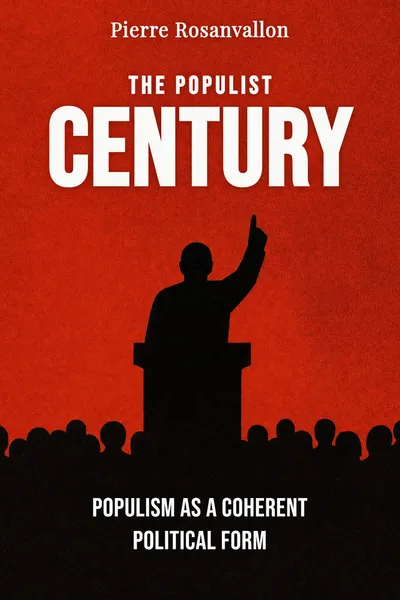
The Populist Century
Populism as a coherent political form
Description
In 2020, the French historian Pierre Rosanvallon published a short, dense book with a title that sounds almost like a headline: The Century of Populism. He had spent decades studying how democracies actually work — how representation, trust, and the very idea of "the people" get built and unbuilt. And he had grown tired of the way populism was talked about. Commentators treated it as a mood, a symptom, a fever chart of anger, something that would pass once the economy recovered or the demagogues aged out. Rosanvallon's wager runs the other way. Populism, he argues, is not noise around democracy. It is a coherent way of imagining democracy, with its own theory of the people, its own idea of representation, its own relationship to time and to power.
That claim is more unsettling than the usual hand-wringing. If populism were only resentment, we could answer it with better policy or calmer speech. If it is a form — an internally consistent political grammar — then it competes with liberal democracy on the same ground, offering a rival answer to the same founding question: who are the people, and how do they rule? Rosanvallon takes populist movements seriously enough to reconstruct their logic from the inside, the way one would map any ideology.
What emerges is neither a takedown nor an apology. It is an anatomy. Rosanvallon assembles the scattered pieces — a certain image of the people, a preference for the leader over the assembly, a taste for the immediate over the deliberated — and shows how they hang together into something that deserves the name of a political culture, not merely an outburst.
The question we’re asking : Is populism a passing symptom of angry times, or a coherent political form with a logic of its own?What we’ll see : How one historian reassembles the scattered instincts of populist politics into a single grammar — and what that grammar quietly does to democracy.
Table of contents
01 Chapter 1 — A word everyone uses and nobody defines
Rosanvallon starts by clearing the ground, because the word populism has become almost useless. It gets thrown at figures who share little beyond making the establishment nervous — a left insurgent and a nativist strongman, a Latin American caudillo and a European referendum campaign, all filed under the same label. Used that way, it means little more than "politics I dislike." His first move is to refuse both the dismissal and the vagueness. Populism, he insists, has content. It is not the absence of a doctrine; it is a doctrine, even if its adherents rarely write it down.
The reason it looks incoherent, he suggests, is that it lives in practice before it lives in theory. Populist movements act out their convictions in rallies, slogans, and confrontations long before anyone systematizes them. A liberal reads the disorder and concludes there is nothing to read. Rosanvallon reads the same disorder and finds a structure — the way a linguist finds grammar in speech that no speaker could formally explain.

02 Chapter 2 — The people as one, whole and wronged
The heart of the populist form, for Rosanvallon, is a particular image of the people. In it, the people is not a plurality of citizens who disagree, negotiate, and vote in shifting coalitions. It is a single body — unified, homogeneous, essentially of one mind. Where liberal democracy assumes conflict as its normal condition and builds institutions to manage it, populism assumes underlying unity and treats visible conflict as the work of usurpers who have hijacked the true popular will.
This unified people is also a moral people. It is not merely a majority; it is the authentic core of the nation, virtuous by definition, standing against a corrupt elite that has captured the state and betrayed it. The line does not run left against right or rich against poor in the ordinary sense. It runs vertically: the pure many below, the parasitic few above. Everything the elite does — its expertise, its procedures, its cosmopolitan manners — becomes evidence of the betrayal rather than of competence.
03 Chapter 3 — The strongman, the referendum, and the immediate
If the people is one and already knows what it wants, representation changes meaning entirely. It stops being a process of building a majority out of competing interests and becomes a matter of incarnation. Rosanvallon shows how the populist leader claims not to represent the people in the ordinary delegated sense but to be the people, to embody its will directly in a single person. The leader's authority does not come from a program to be debated; it comes from a bond, a felt identity between the man and the mass.
This is why the populist leader distrusts the intermediary bodies that liberal democracy relies on. Parties, parliaments, independent courts, a free press, expert agencies — all of them sit between the leader and the people, and all of them, in the populist reading, distort the direct relationship. They are not safeguards; they are obstacles. The preferred instruments are the ones that bypass mediation: the mass rally, the plebiscite, the referendum that reduces a tangled question to a single yes or no and calls the answer the voice of the nation.
04 Chapter 4 — When suspicion becomes a program
Having reconstructed the form, Rosanvallon steps back to the question that gives his book its weight: what does populism actually do to democracy? His answer is subtle, and it is the reason he refused to treat populism as mere pathology. Populism is not an invader from outside the democratic city. It grows from within it, feeding on something real — the permanent gap between the promise of popular sovereignty and the disappointing experience of being governed by distant institutions. Populism did not invent that gap. It offers the most seductive account of it.
This is the connection to his own long project. Rosanvallon had spent years describing how healthy democracies depend on what he calls counter-democracy: the ordinary, useful suspicion citizens direct at power — watching it, judging it, holding it to account. A functioning democracy needs distrust. The problem is what happens when distrust stops being a corrective and becomes the whole content of politics. Populism, in his reading, is precisely that: the moment when suspicion of the elite hardens from a democratic reflex into a full worldview, an organizing principle rather than a check.
05 Conclusion
Rosanvallon returns, in the end, to where he began — to the word itself, and to the temptation to use it as a shrug. His whole effort has been to make that shrug impossible. To call something the century of populism is to concede that we are dealing with a durable political form, not a passing storm, and that it will keep offering its answer to democracy's oldest question long after any particular leader is gone.
Related books