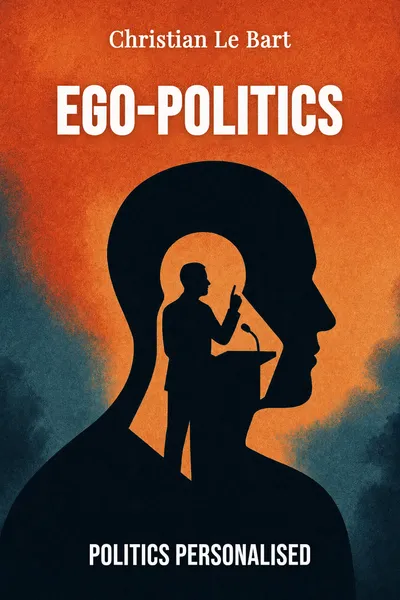
Ego-Politics
Politics personalised
Description
On a French television set in the early 2000s, a politician is asked, in the middle of a segment on pensions or Europe, what music he listens to in the car. He answers without hesitation, maybe a little pleased to be asked. Nobody finds the question strange anymore. The sociologist Christian Le Bart spent years watching this kind of scene accumulate, and in Ego-Politics he gives the shift a name: a political life increasingly organized around persons rather than positions, around the self of the elected rather than the ideas he carries. The music-in-the-car question is not a detour from politics. It has quietly become part of it.
Le Bart is not writing a lament about the good old days of serious debate. He is a sociologist of political communication and of the ordinary language of power, and what interests him is a slow structural movement — the way the individual, the singular, the intimate, the biographical have moved from the margins of political life to its center. A candidate now arrives with a face, a story, a temperament, a set of likeable details, and the program trails somewhere behind. This is not decadence. It is a logic, with its own rules and its own costs, and it has reorganized how we recognize a politician in the first place.
What makes the book worth reading is that it refuses the easy contempt. Personalized politics is not simply politicians being vain or voters being shallow. It answers something real — a demand for authenticity, a suspicion of abstract ideology, a world where institutions inspire less trust than individuals. Le Bart follows that logic patiently to see where it leads, and what it leaves standing.
The question we’re asking : What happens to political life when the person of the candidate becomes the main thing we are asked to judge?What we’ll see : How a politics once built on programs and parties slid toward faces, stories and selves — and what that movement costs the structures underneath.
Table of contents
01 Chapter 1 — The candidate before the program
Le Bart starts from a simple observation that is easy to miss because it has become the water we swim in: when we talk about politics now, we mostly talk about people. Not the pension reform but the minister defending it. Not the budget but the temperament of the one who signs it. The press covers rivalries, ambitions, comebacks and falls. Voters are invited to say whether they find a candidate sincere, likeable, solid — rarely whether his analysis of unemployment holds up. The person has moved in front of the position, and the position increasingly reads as an attribute of the person.
This is a reversal from an older arrangement. In the classic model Le Bart describes, a politician was the bearer of something larger than himself: a party, a doctrine, a social bloc, a program worked out collectively. He mattered as a representative, a mouthpiece, an incarnation of a cause that would outlive him. The individual was almost an inconvenience — too much personality risked distracting from the line. What counted was the coherence of ideas and the discipline of the organization behind them.

02 Chapter 2 — When convictions became confidences
The next step Le Bart traces is intimacy. It is not enough for a politician to have a face; he is now expected to have an inside. The media invite him to talk about his childhood, his doubts, his wounds, his family, his tastes. The question about car music belongs to this register. So do the magazine spreads at home, the confessions about a difficult father, the tears that are no longer a scandal but a proof. The private has become a resource, and withholding it starts to look like something to hide.
Le Bart reads this as the arrival of authenticity as the governing value. The suspicion that hangs over political speech — that it is calculated, scripted, hollow — creates a hunger for anything that seems to escape calculation. The intimate detail promises exactly that. If a man tells you what moved him as a boy, surely that part at least is real. The confidence works as a guarantee of sincerity, a way of saying: behind the politician there is a human being, and you can trust the human being even when you distrust the politician.
03 Chapter 3 — The self as the last thing left to believe
Why does the self carry so much weight now, and not the party, not the doctrine, not the movement? Le Bart situates ego-politics inside a much broader cultural movement that he, following a long sociological tradition, calls the rise of the individual. Across the second half of the twentieth century, Western societies learned to value singularity, self-expression, personal authenticity in nearly every domain — work, love, consumption, belief. The injunction to be oneself, to find one's own path, to not be reducible to a role, became a kind of common sense. Politics did not escape it.
In a world organized around individuals, the collective bodies that used to anchor political identity lose their grip. Fewer people define themselves first as workers, Catholics, or militants of a party. They define themselves as singular persons with their own trajectory. A politics addressed to classes and camps starts to sound dated; a politics addressed to individuals, promising to recognize each in his difference, fits the moment. The candidate who presents himself as a full person, not a party cog, is speaking the same language his audience speaks about themselves.
04 Chapter 4 — The party that no longer holds the center
Here Le Bart lets the argument widen toward its real stakes. The institution most exposed by ego-politics is the party. Parties used to be the factories of political life. They selected candidates, trained them, disciplined them, supplied the doctrine, carried the memory, held the apparatus between elections. A politician was in large part a product of his party — and dependent on it. The party was the collective that preceded and survived any individual passing through it.
When the person moves to the center, that relationship inverts. The candidate no longer needs the party the way he once did; increasingly the party needs the candidate — his face, his popularity, his ability to draw attention and votes. The organization becomes a vehicle, a label, a platform to be used, rather than a body to belong to. Le Bart notes how leaders now build movements around their own names, bend structures to fit their persons, and treat the historic apparatus as something to be captured rather than served. The hierarchy between the individual and the collective has quietly flipped.
05 Conclusion
Return to the man on the television set, asked about his car music and happy to answer. He is not failing at politics; he is doing politics as it now works. He offers a self because a self is what the moment asks him to offer, and because the party behind him can no longer offer much in its place. Le Bart's achievement in Ego-Politics is to take this scene seriously instead of mocking it — to show that the slide toward persons is not a lapse in taste but a coherent response to a society that trusts individuals more than it trusts institutions, and authenticity more than it trusts doctrine.
Related books