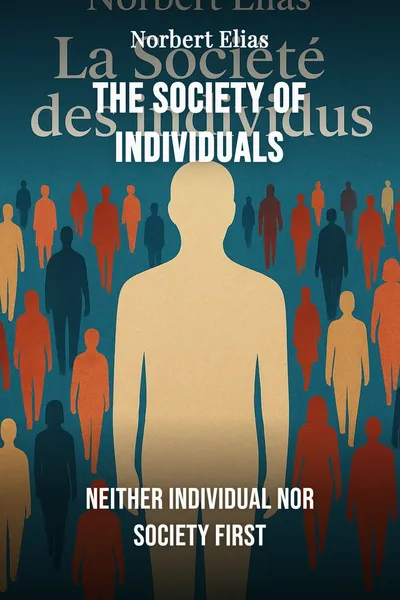
The Society of Individuals
Neither individual nor society first
Description
Norbert Elias liked to describe a scene that everyone recognizes. A person walks down a busy street, weaving between strangers, adjusting their pace, catching a stranger's eye and looking away — a thousand tiny calibrations performed without a thought. Each of us feels, in that moment, entirely alone inside our own head. And yet not one of those movements makes sense without everyone else on the pavement. The walk is private and social in the same breath. Elias spent a lifetime insisting that we have no good language for this, and that the poverty of our language does real damage to how we think.
The book that carries the argument, The Society of Individuals, was written across four decades. Elias drafted the first part in the late 1930s, added to it in the 1950s, and completed it near the end of his life; it appeared in full only in 1987, three years before he died at ninety-three. The delay is almost fitting for a thinker who spent most of his career on the margins of academic fashion, sociology's great late bloomer, only widely read once the disciplines he refused to choose between finally caught up with him.
His target is a habit of mind so ingrained we barely notice it: the sense that "the individual" and "society" are two separate things, and that one of them must come first. Either people are real and society is just a name for a lot of them, or society is the real force and people are its products. Elias thought both answers were built on the same mistake, and that the mistake shapes everything downstream — how we picture freedom, belonging, and what we owe each other.
The question we’re asking : If a person is neither the raw material of society nor its finished product, what exactly is the relationship between the one and the many?What we’ll see : How Elias dismantles the opposition between person and group, and rebuilds it as a single moving relationship he called the we-I balance.
Table of contents
01 Chapter 1 — The false choice we keep making
Start with the two answers Elias found everywhere. The first says the individual is the bedrock. Society is nothing but a collection of separate people, a convenient word for a crowd; strip away the label and what remains are real, self-contained persons who happen to live near one another. The second flips it: society is the genuine reality, a system with its own weight and momentum, and the individual is more or less its output, shaped and stamped by forces that were there before any particular person arrived.
Both positions feel intuitive, and both, Elias argued, quietly assume the same picture. They imagine the person as a sealed container — a self with an inside and an outside, a wall between me and everyone else. The disagreement is only about which side of the wall matters more. Once you accept the wall, you are stuck choosing. You become either the individualist who treats society as a fiction, or the collectivist who treats the individual as an illusion. Neither can explain the person on the pavement.

02 Chapter 2 — Where the self ends and society begins
Push on the wall and it starts to look less solid. Take language, the most intimate tool of thought. Nobody invents their own; we inherit words that were shaped by generations of strangers, and we can only think in them. The most private inner monologue is conducted in a medium that is entirely social. The same holds for the feelings that seem most our own — shame, pride, restraint, the flinch of embarrassment. Elias had shown in his earlier work on manners that these are not fixed instincts but sensibilities that shifted over centuries, drilled so deep they now feel like nature.
So where, exactly, does the self stop and society start? Elias's answer is that the question has no clean line because there is no wall to draw it on. A person is not a container with a social coating. A person is a knot of relationships, formed from the inside out by connections to others — parents, rivals, teachers, employers, whole networks stretching far beyond anyone they will ever meet. The word he used for this was figuration: the shifting web of interdependent people, each pulling on and pulled by the others, that any individual is always part of.
03 Chapter 3 — The knot no one designed
If society is a web of interdependence, one feature of it mattered to Elias above all: nobody planned it, and nobody runs it. Every person in a figuration is pursuing their own aims — a job, a marriage, an advantage, a quiet life. Out of the collision of all those separate intentions something emerges that none of them intended and none can control. A market, a court, a nation-state, a rise or fall in the general sense of what is acceptable. The pattern has a logic, but it is nobody's logic.
This is Elias's answer to a question that had haunted social thought: how can society be real and orderly if no one designed it? His reply is that order without a designer is exactly what interdependence produces. The more people are linked, the longer the chains of action connecting them, the more each person's fate depends on choices made by others they will never see. A trader ruined by a distant decision, a family shaped by laws passed before they were born — these are not exceptions. They are what it means to live inside a dense web.
04 Chapter 4 — The changing balance of we and I
The deepest move in Elias's book is to make all of this historical. If the self is a knot in a web, and webs change, then the very texture of being a person changes too. What it felt like to say "I" for a medieval peasant, bound to a village and a lord, is not what it feels like for someone today who can move continents, change careers, and imagine their life as a project of their own making. The self is not a constant that history acts upon. The self is one of the things history makes.
Elias captured the shift with a phrase that gathers the whole argument: the we-I balance. Every person carries both a sense of themselves as an individual and a sense of belonging to a we — a family, a tribe, a class, a nation. Neither ever disappears. What changes is the weight between them. In tightly bound communities the we dominated; a person could barely conceive of themselves apart from the group. Over the long arc Elias traced, the I side has swelled, until many now experience their we-memberships as loose, optional, even burdensome, and treat the solitary I as the real and natural core.
05 Conclusion
Return to the person on the crowded street, weaving through strangers, alone and surrounded at once. Elias's whole argument is an attempt to take that ordinary experience seriously instead of forcing it into a false choice. The walker is not a sealed self who merely happens to be near others, and not a puppet moved by society's strings. They are a living crossing point of relationships, singular precisely because of everything that runs through them. The solitude and the connection are not in tension; they are the same life seen from two sides.
Related books