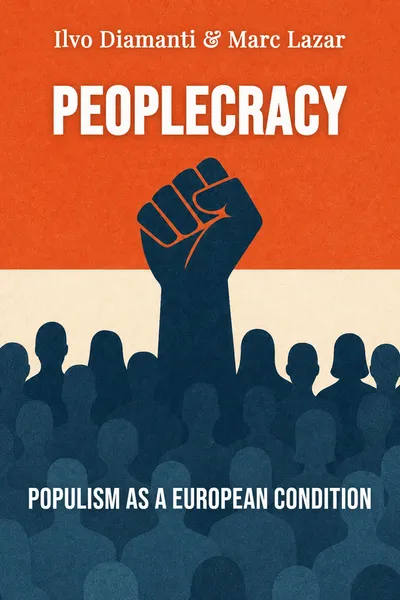
Peoplecracy
Populism as a European condition
Description
Somewhere in the early 2010s, a word that used to end political conversations started beginning them. For decades "populist" was a slur you threw at an opponent to say he flattered the crowd instead of governing it. Then, almost without anyone noticing the switch, it became a description — of a movement, a mood, a way of winning elections that kept working. Ilvo Diamanti and Marc Lazar, two sociologists who have spent careers watching Italy and France from either side of the Alps, coined a term for what was happening: peoplecracy. Not the death of democracy, not its betrayal, but a mutation of it — a regime where "the people" becomes the only legitimate source of power, invoked directly, against everyone who claims to represent it.
Their wager is comparative. Marine Le Pen and Matteo Salvini, Beppe Grillo's Five Star Movement and the Brexit vote, Viktor Orbán and the Spanish indignados — read one country at a time, these look like separate accidents, each with its local villain and its local grievance. Read across Europe, a pattern surfaces. The same appeal to a pure people against a corrupt elite, the same distrust of intermediaries, the same impatience with the slow machinery of parliaments and parties. Peoplecracy argues that populism is not a foreign infection carried by a few demagogues. It is something the European democracies grow from inside themselves.
That is the uncomfortable part. It is easy to treat populism as an aberration to be quarantined, a fever that will break once the economy recovers or the right leader comes along. Diamanti and Lazar suggest it is closer to a chronic condition — woven into how we now experience representation, media, and the promise that the people should rule. Which raises a harder question than "how do we beat them?"
The question we’re asking : Is European populism a passing crisis to be waited out, or a durable mutation of democracy itself?What we’ll see : How two sociologists read the continent's populist surge as one condition rather than a scatter of national accidents — and what the established parties did next.
Table of contents
01 Chapter 1 — A word that lost its insult
Diamanti and Lazar begin with the word itself, because the word carries a history most people have forgotten. Populism is not new. Its lineage runs back to the Russian narodniki of the nineteenth century and the American People's Party of the 1890s, farmers and workers who organized against banks and railroads in the name of ordinary folk. For a long stretch of the twentieth century, though, "populist" survived mainly as an accusation. To call a rival a populist was to say he was unserious, that he told the crowd what it wanted to hear and would pay for it later. The word lived in the mouths of the people it was aimed against.
What the two authors track is a reversal. Somewhere over the past two decades the label stopped being purely toxic. Movements began to wear it, or at least to stop flinching at it, because the thing it described — speaking for the people against the elites — had become electorally powerful rather than shameful. Beppe Grillo, the Italian comedian who built the Five Star Movement, turned contempt for the political class into a platform. The accusation had become a program.

02 Chapter 2 — Not a party but a climate
If populism were only a cluster of parties, it could be counted, contained, and in good years defeated at the ballot box. Diamanti and Lazar argue it is bigger than its parties — it is a climate, an atmosphere that settles over a whole political culture and changes the air everyone breathes. You can lose an election to a populist party and still live in a populist climate, where distrust of institutions, suspicion of experts, and impatience with representatives have become the default settings of public life.
They locate the sources of this climate in changes that have nothing specifically to do with any demagogue. The weakening of the old mass parties that used to channel people's loyalties and translate their anger into programs. The decline of the trade unions and churches that once structured political belonging. The arrival of a media ecology — television first, then the internet and social networks — that lets a leader address the people directly, without the mediation of an organization. Each of these developments, on its own, erodes the intermediaries that stood between the citizen and power.
03 Chapter 3 — The people, singular and sovereign
At the center of peoplecracy sits a particular idea of the people — and here the authors do their sharpest work. In a normal democracy, "the people" is a plural, messy thing: millions of individuals with conflicting interests, organized into parties and interest groups that argue, compromise, and lose gracefully. Populism replaces that plural with a singular. There is one people, unified, with a single will, and that will is being thwarted by those who claim to represent it. The job of the leader is not to negotiate among competing interests but to express the one true voice directly.
This is where populism and democracy pull apart even as populism speaks democracy's language. Both invoke popular sovereignty; the difference is what they do with it. Democracy institutionalizes the people's power, slowing it down, dividing it, checking it against rights and procedures and minorities. Populism wants that power immediate and whole, freed from the institutions that temper it. The courts, the constitution, the independent press, the European bureaucracy — all become obstacles between the people and its rightful rule, and therefore suspect.
04 Chapter 4 — When the mainstream starts to borrow
The most unsettling part of the book is not about the populists at all. It is about everyone else. Diamanti and Lazar argue that the deepest effect of the populist surge is not measured in the seats populist parties win but in how the established parties change in response. Faced with movements that keep drawing votes, the mainstream does not simply hold the line. It adapts. It borrows. And in borrowing, it spreads the very thing it set out to contain.
The authors trace several responses, none of them clean. Some centrist leaders try to out-tough the populists on their signature issues, immigration above all, hoping to win back voters by stealing the theme — and end up legitimizing the frame they meant to defeat. Others build cordons sanitaires, refusing all cooperation with populist parties, which can wall them off but also feeds the narrative of a closed elite ganging up against the people's choice. Still others absorb the style itself: the direct-to-camera address, the scorn for party machinery, the promise to govern against the establishment, delivered by people who are the establishment.
05 Conclusion
Peoplecracy ends roughly where it began, with that unstable word. Diamanti and Lazar do not predict the triumph of the populists, nor their collapse. They describe instead a democracy that has absorbed the populist challenge into its own metabolism — where the appeal to a pure people against a corrupt elite has become a resource any politician can reach for, and where the intermediaries that once absorbed conflict keep thinning out. Across Italy, France, Britain, Hungary, Spain, the particulars differ wildly; the grammar, they argue, is strikingly shared.
Related books