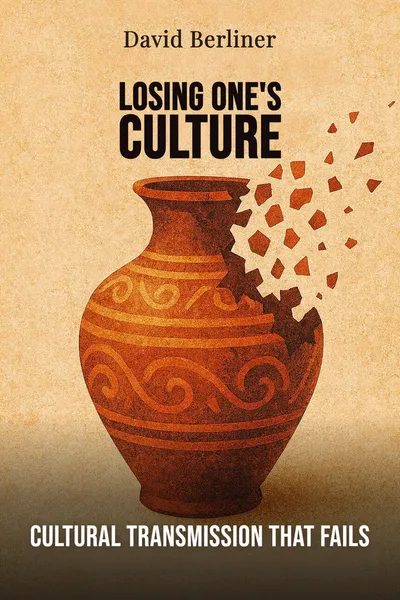
Losing One's Culture
Cultural transmission that fails
Description
Somewhere in central Laos, in the old royal city of Luang Prabang, an anthropologist listens to the same sentence over and over. The temples are losing their meaning. The young monks no longer know the rituals. Something is slipping away, irretrievably, right now, in front of everyone. The man collecting these complaints is David Berliner, a Belgian anthropologist who spent years in Laos and in Guinea, among the Bulongic of the coastal forest, listening to communities describe their own culture as something that was draining out of their hands. The strange part was not the grief. The strange part was how often the people grieving had never possessed the thing they mourned.
Berliner called this feeling exo-nostalgia — a longing for a past one has not personally lived, a heritage one never actually held. In Luang Prabang, UNESCO World Heritage status had arrived in 1995 and turned the town into a stage where the loss of tradition was both lamented and, paradoxically, performed for visitors. In Guinea, the last initiates of a secret men's cult had died without passing on what they knew, leaving younger generations to inherit not the knowledge but the certainty that knowledge had been lost. The culture everyone agreed was vanishing had, in a sense, already vanished before they were born.
This is the knot Berliner pulls at in Losing One's Culture. Transmission — the handing-down of knowledge, rites, ways of being from one generation to the next — is supposed to be how cultures survive. He spent his career watching it fail, and watching people build whole emotional and political worlds on top of that failure. The failure, it turns out, is not an accident at the edge of culture. It may be closer to how culture actually works.
The question we’re asking : What happens to a community when the handing-down of its own heritage breaks — and why does the sense of loss so often outlive the thing that was lost?What we’ll see : A long fieldwork among people mourning cultures they never held, and what their grief reveals about heritage, memory, and the uses of the word authentic.
Table of contents
01 Chapter 1 — The anthropologist who kept hearing about loss
Berliner did not set out to study loss. Like many anthropologists, he arrived to study a living tradition and found instead a community talking about a dead one. In Guinea, among the Bulongic, he had come for the Bulong, an initiatory men's society that had once structured the passage into adulthood. By the time he got there, the Bulong was gone. The older men who had been through it were dying or dead, and they had decided, deliberately, not to pass it on. Islam had spread, colonial and then postcolonial authorities had pressed, and the elders judged the old rites incompatible with the world their grandchildren would live in. So they let it lapse.
What fascinated Berliner was the gap this left. The younger Bulongic had never been initiated and never would be. Yet they spoke of the Bulong constantly, with a mixture of regret, reverence, and vagueness, as the thing that had made them who they were — a thing none of them had experienced. They were heirs to an absence. The culture was present only as the shape of its own hole, a silhouette of something no living person could describe from the inside.

02 Chapter 2 — The guardians who never learned what they guard
The word that organizes modern loss is heritage — patrimoine, in Berliner's French. It is a word that performs a quiet sleight of hand. It takes something fluid and ongoing, a way of living, and converts it into an object: a thing to be inventoried, protected, listed, handed down intact. Once culture becomes heritage, it can be managed. And once it can be managed, a whole apparatus appears to manage it — ministries, NGOs, and above all UNESCO, which since the 1970s has turned the safeguarding of the world's cultural treasures into a global enterprise.
Berliner watched this apparatus up close in Luang Prabang, and what he saw complicated the usual story. UNESCO heritage status was supposed to preserve the town. In practice it froze a particular image of the town, the one most legible to outsiders, and set the terms by which locals were now meant to be authentic. Rules governed building facades, roof lines, the look of the streets. The living city had to perform the heritage city. Preservation and transformation turned out to be the same gesture.
03 Chapter 3 — Nostalgia for what was never lived
At the center of the book sits Berliner's sharpest idea: exo-nostalgia. Ordinary nostalgia is longing for your own past, the home you left, the childhood you can't return to. Exo-nostalgia is longing for a past that was never yours — a golden age, a lost tradition, an authenticity you can only have heard about. The young Bulongic mourning the initiation they never underwent are its clearest case. So is the Western traveler grieving the disappearance of pristine cultures he arrived too late to see.
What interests Berliner is that this feeling does genuine work. It is not merely sentimental or confused. Exo-nostalgia binds people to a community across the break in transmission. When you cannot inherit the practice, you can still inherit the longing for it, and the longing becomes its own form of belonging. The Bulongic are Bulongic, in part, because they share a specific grief. The loss is what they have in common. It holds the group together where the old rite no longer can.
04 Chapter 4 — When authenticity becomes a resource
Step back from the fieldwork and a larger pattern comes into focus, the one Berliner's whole study circles. The word doing the heaviest lifting in all these scenes is authentic. The authentic tradition, the authentic monk, the authentic village untouched by tourism. We tend to treat authenticity as a property that things either have or lack, as if you could test a ritual for it. Berliner's cases suggest it is nothing of the kind. Authenticity is a claim people make, a label fought over, assigned, and withheld — and crucially, a resource.
Once heritage exists as an object, its authenticity has value, and that value can be converted into other things. In Luang Prabang, authenticity brings tourists, which brings money, which reorganizes who holds power in the town. UNESCO's stamp is, among other things, an authentication, and authentication is never neutral: it blesses one version of the past and quietly disqualifies the rest. The people best placed to speak for the authentic tradition gain standing; those whose practices look too modern, too hybrid, too alive, lose it. The question of what counts as real culture is also a question of who gets to decide, and who benefits from the decision.
05 Conclusion
Back in Luang Prabang, the sentence Berliner kept hearing still hangs in the air: something is slipping away. He never resolves it, because there is nothing to resolve. The town is not simply being saved or simply being lost; it is being continuously remade by everyone with a stake in it — monks, residents, tourists, conservators, the officials who grant and withhold the label of the real. The grief over a vanishing culture and the business of preserving it turn out to be the same activity seen from two angles, and both are busy producing the thing they claim merely to protect.
Related books