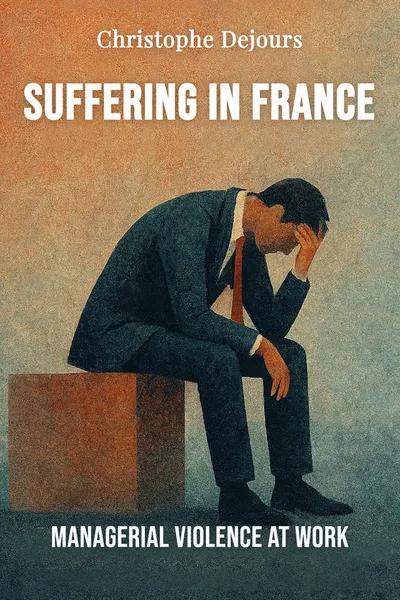
Suffering in France
Managerial violence at work
Description
In the mid-1990s, a French psychiatrist and psychoanalyst named Christophe Dejours sat down to write about something that, officially, was not supposed to exist. He had spent decades listening to workers — factory hands, nuclear-plant operators, nurses, executives — and he kept hearing the same thing underneath their words. Not fatigue, not boredom, but suffering. Real, structured, often hidden suffering tied directly to the way their work was organised. The result, published in 1998 as Souffrance en France, landed in a country that was just beginning to put words like "burnout" and "harassment" into ordinary conversation, and it did not offer comfort.
Dejours's argument cut against the reflex of the moment. The temptation, then as now, was to explain workplace cruelty by pointing at bad individuals: the toxic boss, the sadistic manager, the one rotten apple. Dejours refused that story. The suffering he described was produced by systems, not monsters — by evaluation methods, quality procedures, performance metrics, the whole quiet apparatus of modern management. And more unsettling still: it was sustained by the cooperation of perfectly ordinary, often kind people who, somehow, kept the machine running.
What made the book endure is that it did not stop at diagnosis. Dejours wanted to understand how decent people come to tolerate, administer, and even justify the suffering of others — including their own. He borrowed the uncomfortable vocabulary of political philosophy, the language usually reserved for atrocities, and turned it on the open-plan office and the factory floor. The move was deliberate, and it was meant to sting.
The question we’re asking : How does an organisation produce suffering without any single person deciding to cause it — and why do so many of us go along with it?What we’ll see : Dejours walks us from the hidden reality of real work to the mechanisms of modern management, and finally to the quiet forms of consent that keep the whole thing standing.
Table of contents
01 Chapter 1 — The complaint everyone filed, the one nobody made
Dejours built his career on a discipline he helped found: the psychodynamics of work. Instead of treating the workplace as a backdrop to private neuroses, he treated it as a central scene of mental life — a place where identity is won or broken. From the 1980s onward, he and his colleagues listened, closely and at length, to what workers actually said about their days. And what emerged was a gap between the official account of work and the lived one.
On paper, everyone was fine. The surveys were reassuring, the productivity numbers held, the meetings ended on time. Yet in the interviews, something else surfaced: a low, persistent distress that workers rarely named out loud, partly because they had no sanctioned words for it, partly because naming it felt dangerous. Complaining marked you as fragile, as someone who could not cope. So the suffering stayed private, metabolised into silence, into cynicism, into the sense that this was simply what adult life demanded.

02 Chapter 2 — Working well means breaking the rules
To understand the suffering, Dejours insisted, we first have to understand what real work is. And real work, in his account, is never the simple execution of a plan. Between the official procedure and the actual task lies a gap that no instruction manual can close. Machines fail in unexpected ways, situations arise that no rule anticipated, the real world refuses to match the flowchart. To do the job well, workers have to improvise, bend the prescribed method, invent small solutions on the spot.
This is the paradox at the heart of his analysis. Genuine competence consists largely in knowing when and how to depart from the rules. The skilled worker is the one who quietly works around the official procedure to make things actually function. Everyone on the floor knows this. The trouble is that this intelligence is invisible — it never appears in the official record, because officially the rules are being followed. The worker takes the risk, fixes the problem, and says nothing, because to reveal the workaround would be to confess to breaking protocol.
03 Chapter 3 — The managers who sleep fine
If suffering was spreading, who was administering it? Dejours turned to those in the middle and upper layers of organisations — the managers charged with imposing targets, enforcing evaluations, and executing restructurings that they often knew would wound the people beneath them. He was not interested in cartoon villains. He was interested in how normal professionals carry out harmful orders and keep their self-respect intact.
The engine, he argued, was a particular reading of economic necessity. By the 1990s a certain doctrine had hardened into common sense: global competition left no choice, the numbers were sovereign, and whatever the market demanded had to be done. Framed this way, a manager imposing brutal objectives was not cruel; he was merely realistic, merely competent, merely doing his duty in a world that permitted no softness. Cruelty was relabelled as professionalism, and the relabelling did its quiet work on the conscience.
04 Chapter 4 — The ordinary machinery of consent
Here is where Dejours makes his most uncomfortable move, and where the book steps beyond the office into something larger. The question that haunts Souffrance en France is not really "who are the cruel ones?" It is "why do the rest of us cooperate?" Because managerial violence does not survive on the will of a few hard men. It survives on the daily consent of the many — the colleagues who look away, the teams that enforce the metrics on each other, the whole quiet chorus of people who disapprove in private and comply in public.
Dejours saw this consent as the true scandal, and the true engine of organisational suffering. Fear explains part of it: the dread of losing one's place keeps dissent swallowed. But he pushed further. He argued that people actively work to justify the system they serve, to convince themselves that the injustice is acceptable, because the alternative — seeing clearly that one is complicit in harming others — is intolerable. We rationalise so that we can keep going. The lie we tell ourselves is the price of remaining inside.
05 Conclusion
Souffrance en France began with a silence — the distress that workers carried and could not name — and it ended by naming the thing that kept that silence in place. Not a conspiracy, not a handful of sadists, but the patient, distributed cooperation of normal people doing their jobs. Dejours traced the whole arc: from the hidden intelligence of real work, through the management systems that punished it, to the moral anaesthesia that let decent professionals administer harm and the collective consent that let everyone else absorb it.
Related books