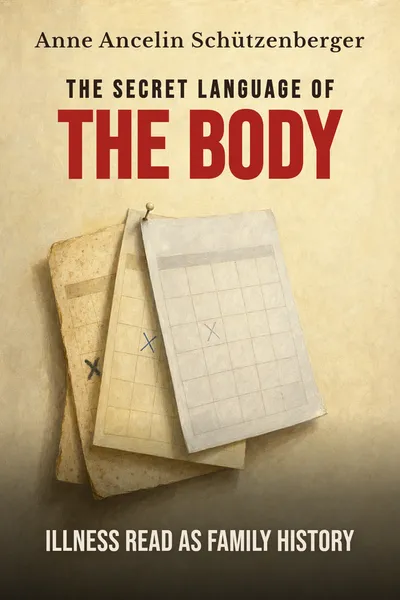
The Secret Language of the Body
Illness read as family history
Description
Anne Ancelin Schützenberger was in her consulting room when a patient mentioned, almost in passing, that she dreaded her forty-sixth birthday. The woman could not say why. Schützenberger, a French psychologist and group-therapy pioneer who had worked alongside Jacob Moreno and knew Carl Rogers, asked her to draw a family tree — not the tidy kind with names and branches, but one annotated with dates, illnesses, accidents, deaths. And there it was. The patient's mother had died at forty-six. So had her grandmother. The number the woman feared was not a random anxiety; it was an appointment that three generations seemed to keep.
Cases like this became the raw material of Schützenberger's work, and eventually of her books, including the one that gathers her clinical observations about the body and inherited history. Her claim, developed over decades of practice, was deceptively simple: we are less free than we think. Dates repeat. Ages of death cluster. Symptoms arrive on anniversaries nobody consciously remembers. The body, in her reading, keeps a ledger the mind has misplaced — and illness can be one of the entries.
She called the field she helped shape psychogénéalogie, and it sits at an uneasy crossroads: part clinical intuition, part family saga, part a wager about what travels down a bloodline that genes alone can't explain. It drew a devoted following and a steady stream of skeptics, often for the same reasons. What she was describing is strange, intimate, and hard to prove — which is exactly what makes it worth reading carefully before deciding what to make of it.
The question we’re asking : Can an illness be read as a message from a family's past rather than a private accident of biology?What we’ll see : How a therapist came to hear old family stories inside present-day symptoms, and what that way of listening both illuminates and risks.
Table of contents
01 Chapter 1 — The woman who listened to dates
Schützenberger did not start out looking for ghosts in family trees. Born in 1919, she trained in psychology and became one of the people who brought group therapy and psychodrama to France after the war, working in the lineage of Moreno. She spent years treating cancer patients, which is where her attention first drifted toward the question of timing. Why did a relapse arrive in a particular month? Why did a patient fall ill at the same age a parent had died? She began keeping track, and the coincidences stopped feeling like coincidences.
Her method took the shape of a tool she called the génosociogramme — a family tree, but one where the therapist records the emotional weight alongside the facts. Not just who married whom, but who died young, who was never spoken of, which births followed which deaths too closely, which dates kept recurring across generations. Laid out on paper, a life that felt like a sequence of private choices could suddenly look like a pattern inherited from people the patient had never met.

02 Chapter 2 — The invisible loyalty that binds
To explain why the past would reach forward like this, Schützenberger leaned on an idea she took from the Hungarian-American therapist Iván Böszörményi-Nagy: invisible loyalty. His insight was that families run on a hidden ledger of obligations and debts, a sense of what is owed between generations that nobody writes down and nobody quite escapes. We stay loyal to our families in ways we never chose and often can't see — and that loyalty can shape a life more firmly than any conscious decision.
In Schützenberger's hands, this became the engine of transmission. A grandfather who went bankrupt and died in disgrace leaves behind more than a story; he leaves an unsettled account. A grandchild, with no knowledge of the facts, might sabotage his own success at the same age, as if squaring a balance he was never told about. Loyalty here is not affection. It is a kind of gravitational pull toward the family's unfinished business, a sense that one has no right to a fate the ancestors were denied.
03 Chapter 3 — When the body carries what nobody said
The move that defines this particular book is the one from the mind to the body. It is one thing to say a buried family story shapes a mood or a choice. It is another to say it shows up as a physical illness — a cancer, an ulcer, a paralysis, a chronic pain with no organic cause that medicine can find. This is where Schützenberger's work is boldest and where it draws the most fire.
Her reasoning runs through the body as a language. When something cannot be spoken — grief that was forbidden, a secret that must be kept, a loyalty that cannot be named — it does not evaporate. It finds another route to expression. The symptom, in this reading, is a sentence the body writes when the mouth is sealed. A woman's recurring throat trouble becomes the silenced testimony of an ancestor who was never allowed to speak; an illness that strikes at a particular age becomes the echo of a death the family never processed.
04 Chapter 4 — Reading a life as a story told in advance
Step back, and Schützenberger's project is really a quarrel with the modern idea of the self-made individual. We tend to narrate our lives as our own — our choices, our illnesses, our timing. Psychogenealogy insists we are chapters in a longer book, that some of what we take for personal destiny was authored before we were born. There is something clarifying in that. It restores a sense of continuity that modern life tends to flatten, and it takes seriously the way grief and silence actually move through families over decades.
But the same quality that makes the idea compelling is where it runs into trouble, and this book shows the strain clearly. The evidence is almost entirely retrospective. The therapist starts from a present symptom and works backward until a matching event appears in the family history — and in a large enough tree, across enough generations, a striking date or a resonant death can nearly always be found. The method, in other words, is built to confirm itself. What would it look like for a genogram to show no meaningful pattern? The approach rarely tells us.
05 Conclusion
The woman who feared forty-six eventually sat with Schützenberger over the family tree, traced the deaths of her mother and grandmother, and spoke aloud the pattern no one had ever named. In the telling, as Schützenberger recounts such cases, the fear loosened its grip. Whether what shifted was a buried loyalty or simply the relief of putting a frightening coincidence into words, the method had done its characteristic work: it turned a mute dread into a story a person could hold and examine.
Related books