Playing and Reality
Play as the space where the self forms
Description
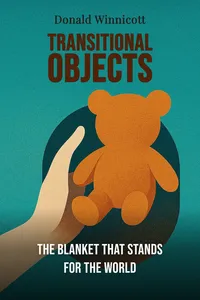
Watch a small child fall asleep and you will often find a scrap of blanket or a worn soft toy pressed against the face. Take it away to wash it and the house erupts. The object cannot be substituted; a clean identical one will not do. For most parents this is a familiar nuisance, filed somewhere between quirk and comfort. Donald Woods Winnicott, a London pediatrician who had seen thousands of children across decades of clinics, looked at that same scrap of blanket and saw something stranger and more important: the first thing a human being ever creates, and the first clue to how a self gets made.
Winnicott spent the first half of his life as a working children's doctor before he became one of the most original psychoanalysts of the twentieth century. He was not a system-builder. His ideas arrive as observations, almost offhand — a game, a smear of spit on the back of a hand, a baby reaching for a spoon. In 1971, the year he died, he gathered the essays that mattered most to him into a slim book called Playing and Reality. It reads less like theory than like a very attentive friend describing what he kept noticing in the consulting room.
What he kept noticing was that the most serious work a person ever does looks, from the outside, exactly like play. Not play as distraction, not play as rehearsal for adult life, but play as the place where a person first becomes real to themselves. The teddy bear is where it starts. The question is how a fraying piece of fabric could possibly carry that much weight.
The question we’re asking : How does the self take shape, and why does that process look so much like play?What we’ll see : A pediatrician's close attention to children at their most ordinary, and the surprising architecture of becoming a person that he found there.
Table of contents
01 Chapter 1 — The teddy bear that is neither inside nor outside
Winnicott gave the worn blanket and the beloved soft toy a name: the transitional object. It arrives somewhere in the first year, usually after the earliest months, and the child treats it with a devotion that is almost religious. It must smell right. It must not be changed. It gets dragged, chewed, loved into ruin, and no replacement is accepted. Parents sense instinctively that they are not allowed to interfere with it, and Winnicott thought that instinct was exactly correct.
What makes the object so peculiar is the question nobody usually bothers to ask: did the child find it, or make it? The blanket is plainly real — it exists, it was bought, it can be lost. Yet the child invests it with a meaning that comes entirely from inside. It is both discovered in the world and created by the mind, and the whole point, Winnicott insisted, is that we must never force the child to choose. The right question — "did you make this or find it?" — is precisely the question the child cannot be made to answer.

02 Chapter 2 — The space between fantasy and the world
The transitional object, for Winnicott, was only the first instance of something much larger. The intermediate zone it opens up does not close when the child outgrows the blanket. It widens. That same in-between space — not purely inner, not purely outer — becomes the place where play happens, and play, in his account, is where a person lives most fully alive.
He meant this quite literally. When a child plays, they are not escaping reality and they are not merely coping with it. They are working in a third area, where inner images and outer objects meet and can be handled together. A stick becomes a sword, a row of cushions becomes a boat, and the child knows and does not know that it is pretending. The cushions are real; the voyage is invented; the play is the overlap. It is absorbing precisely because it is neither fantasy nor fact but a space the child controls, where the terms of reality can be tried out without the full weight of consequence.
03 Chapter 3 — Play comes before culture, not after
Most of us assume culture is the grown-up thing — art, religion, literature, the serious achievements people turn to once childish games are behind them. Winnicott flipped the order. He placed the whole cultural life of adults in the same intermediate zone where the baby loved its blanket and the child sailed its cushion boat. A concert, a novel, a shared belief, a joke: these live, he argued, in exactly the space between inner experience and outer reality that play first opens.
The claim is less abstract than it sounds. When we lose ourselves in a film, we know the screen is a screen and we feel the story as real; we are neither hallucinating nor coldly observing. When a believer prays, when a reader weeps over a character who does not exist, when a crowd falls silent at a symphony — all of this depends on the human ability to hold something as real and not-real at once, to inhabit a space that is personal and shared at the same time. That ability is not learned late. It is the grown form of what the baby managed with a piece of felt.
04 Chapter 4 — The mother who fails at the right pace
If the self forms in this intermediate space, the obvious question is who makes the space possible. Winnicott's answer became the phrase he is best remembered for: the good-enough mother. Not the perfect mother, not the devoted saint of the parenting magazines — the good-enough one. And the word that matters is enough.
At the very start, he thought, a mother adapts almost completely to her baby. She answers hunger, holds, soothes, arrives before distress becomes unbearable, so that the infant can live for a while in a kind of illusion — that the world simply provides, that wishing and getting are the same thing, that there is no hard gap between self and world. That illusion is not a mistake to be corrected early. It is the ground on which a self can safely begin, the sense of a world that can be trusted.
05 Conclusion
Come back to the scrap of blanket at the edge of sleep. By the end of Winnicott's account it is no longer a quirk to be managed but the visible tip of something enormous — a child's first creation, the first bridge across the gap between self and world, the opening of a space in which, for the rest of their life, they will play, make, believe, and feel the world as real. The parent who lets the dirty blanket stay dirty is, without knowing it, protecting the place where a person is coming into being.
Related books