
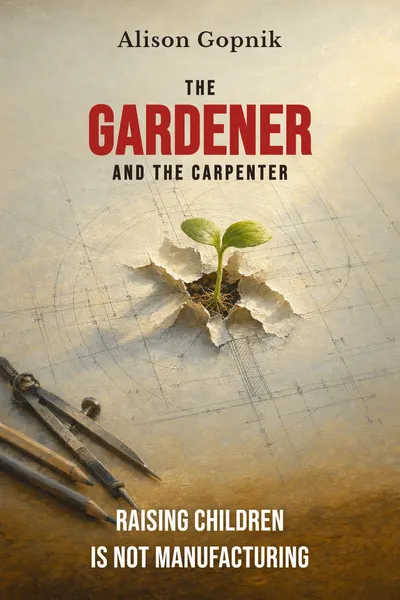
The Gardener and the Carpenter
Raising children is not manufacturing
Description
At some point in the late twentieth century, a strange thing happened to the English language: parent became a verb. For most of human history, mothers and fathers raised children, loved them, fed them, worried about them — but nobody parented. The grammatical shift looks small, almost invisible. It carried an assumption that would reorganize how millions of people spend their evenings, their money, and their anxiety. If parenting is something you do, then it must have a method, a technique, measurable results. And if there are results, there must be a right way to get them.
Alison Gopnik, a developmental psychologist at Berkeley who has spent decades studying how young children actually learn, noticed the cost of that assumption. She watched well-meaning adults treat the raising of a child the way one might treat a project at work — with goals, metrics, and the quiet dread of failing to hit them. In her 2016 book The Gardener and the Carpenter, she set out to say, with the authority of someone who studies babies for a living, that this whole framing rests on a mistake. Not a moral mistake. A factual one, about what children are and what childhood is for.
The title is the argument in miniature. A carpenter shapes raw material into a planned object; a gardener creates the conditions in which living things flourish in ways she cannot fully predict or control. Gopnik is not offering ten tips for calmer mornings. She is proposing that one of these two images is simply wrong about human development — and that the wrong one has become the default setting for an entire educated generation of anxious, loving, exhausted adults.
The question we’re asking : If raising a child is not a matter of building a particular adult, what is it a matter of — and what does the science actually say we are doing when we do it?What we’ll see : Why one widely-shared image of what it means to raise a child collides, hard, with what developmental research has learned about how young minds grow.
Table of contents
01 Chapter 1 — The word that turned parent into a verb
Gopnik dates the shift carefully. The verb to parent barely existed before the 1970s; the word parenting was rare before then too. What filled the gap afterward was an entire industry — books, classes, apps, consultants — organized around the premise that there exists a set of techniques which, correctly applied, produce a particular kind of successful child. The promise is seductive precisely because it sounds like competence. Work hard, learn the method, get the outcome. It is the logic of the office and the workshop, transposed onto a baby.
The trouble, she argues, is that this logic quietly smuggles in a model of the relationship. Under the parenting model, the adult is a kind of skilled laborer and the child is the work product. Success is measured by how closely the finished adult matches the specification: the right school, the right temperament, the right résumé. Love becomes, almost without anyone noticing, a means to an end. We love the child in order to produce a good outcome — and the good outcome is the proof that we loved them correctly.

02 Chapter 2 — The carpenter's workshop, and why the wood keeps slipping
The carpenter is Gopnik's name for the model she wants to retire. A carpenter starts with a plan and some raw material, and the whole skill of the trade lies in imposing the plan on the material — measuring, cutting, sanding until the chair looks like the drawing. If the chair comes out wobbly, the carpenter did something wrong. Control is the whole point. A good carpenter leaves as little to chance as possible.
Transfer that to a child and you get a familiar figure: the parent who schedules enrichment, optimizes screen time, worries that a missed developmental window will leave a permanent gap in the finished product. Every choice is freighted, because every choice is supposedly shaping the final object. Gopnik is sympathetic to these parents — she was one — but she insists the metaphor misleads at the root. Children are not inert wood. They push back, change direction, want things the plan never accounted for.
03 Chapter 3 — What a garden actually does
The gardener, by contrast, does not build anything. She makes a protected, nourishing, variable space and then accepts that what grows there will be partly out of her hands. A good garden is not a tidy one; it is a resilient, diverse, slightly messy ecosystem that can survive weather the gardener cannot predict. The gardener's job is to create conditions, not products — rich soil, enough light, protection from the worst storms — and then to tolerate, even welcome, the wildness of what emerges.
Gopnik argues this is a far more accurate picture of what parents actually provide. Children do not need a technician executing a plan; they need a secure, stable, loving relationship that gives them a safe base from which to explore. The security is not a means to a later outcome. It is the thing itself — the soil. From within that safety, children do the developmental work that no adult can do for them: they play, they imitate, they experiment, they test the world and each other with a restlessness that looks, from the carpenter's anxious vantage, a lot like chaos.
04 Chapter 4 — The long game that research keeps confirming
Step back from the two metaphors and Gopnik's larger claim comes into view: childhood itself is an evolutionary strategy, and we have been misreading what it is for. Human children have a longer, more helpless, more protected childhood than any other animal. That is expensive — all those years of an adult feeding a creature who contributes nothing. Evolution does not tolerate expensive things that do no work. So the long human childhood must be doing something, and the something, Gopnik argues, is learning. The extended period of protected immaturity is precisely the window in which the species runs its experiments.
Seen this way, the variability that so alarms the carpenter is the whole mechanism. A species that could only reproduce fixed, optimized adults would be fragile the moment the environment shifted. Instead, human development is built to generate difference — to produce a wide range of minds, play-tested against reality, some of which will fit futures the parents could never have anticipated. Childhood is how our species hedges its bets. The young are not unfinished adults waiting to be completed; they are, in Gopnik's framing, the research-and-development division of humanity.
05 Conclusion
The book ends more or less where the title begins: with two images of what it means to raise a child, and the quiet insistence that we have been living inside the wrong one. The carpenter measures success by the finished object and suffers every time the wood refuses the plan. The gardener tends the soil, protects against the storms, and lets the strange, specific life in front of her become whatever it is going to become. One of these figures is exhausted and afraid. The other is doing something that looks, from a distance, a great deal like love.
Related books