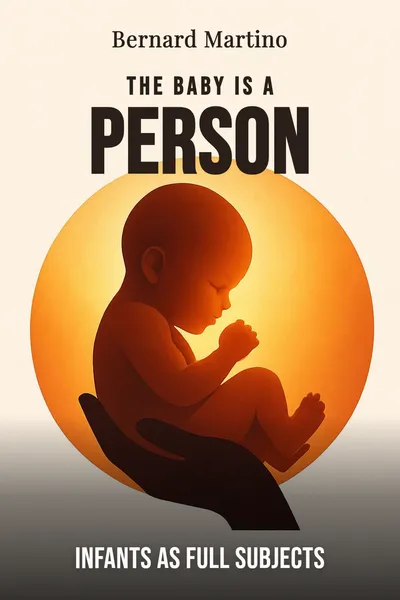
The Baby Is a Person
Infants as full subjects
Description
For a long stretch of the twentieth century, the newborn was treated as a kind of unfinished creature — a bundle of reflexes that ate, cried, slept, and waited to become a person later. Hospitals operated on that premise. Babies were whisked away at birth, kept behind glass, fed on fixed schedules, and sometimes operated on with minimal pain relief because the prevailing wisdom held they couldn't really feel, couldn't really see, couldn't really register what was happening to them. The crying was noise, not speech. The gaze was reflex, not attention.
Then, across the 1970s and 1980s, a wave of researchers started looking more carefully — and what they found cut against nearly everything the old model assumed. The newborn could distinguish its mother's voice within days. It could imitate a facial expression hours after birth. It preferred faces to random patterns, sweet to bitter, the smell of its own mother's milk to a stranger's. The competence was there from the start, far earlier and far richer than anyone had credited. This is the terrain Bernard Martino gathered in his book, pulling together the work of pediatricians, psychologists, and obstetricians who had each, from their own corner, arrived at the same conclusion.
The claim in the title is deceptively plain. The baby is a person — not a person-to-be, not a promissory note on future personhood, but a subject already here, already perceiving, already in relation. Taking that seriously turns out to be less a scientific curiosity than a quiet revolution in how we welcome a human being into the world.
The question we’re asking : What does it actually mean to say a newborn is already a full person, and what did the research show that overturned the old picture?What we’ll see : How a generation of researchers redrew the newborn's inner life — and what happened to the way we give birth and care once that picture took hold.
Table of contents
01 Chapter 1 — The competent newborn
The old picture of the newborn was, in large part, a picture of absence. The eyes didn't focus, the ears barely registered, the pain pathways weren't wired yet — or so it was assumed. A baby was something that would gradually acquire the equipment of a human being, and in the meantime it was handled as a small organism with needs rather than a someone with experiences. Martino's book opens by dismantling that assumption piece by piece, drawing on the clinicians and experimenters who had quietly proven otherwise.
Take vision. The newborn doesn't see sharply across a room, true — but at roughly eight to twelve inches, which happens to be the distance to a nursing mother's face, it sees well enough to study it. And it doesn't look randomly. Shown a schematic face versus a scrambled version of the same features, the infant lingers on the face. Something in it is already tuned to the human, oriented toward the thing that matters most for a creature that survives entirely through the care of others.

02 Chapter 2 — A person who talks before words
If the newborn perceives and responds, the next question is whether it communicates — and here the book is at its most striking. Long before a single word, the infant is already in dialogue. The crying that the old model heard as undifferentiated noise turns out to be graded, variable, addressed. There is the hunger cry, the pain cry, the cry of fatigue, and mothers learn to tell them apart surprisingly fast. The baby is saying something, and the saying is aimed at someone.
Researchers filming mother-and-infant pairs frame by frame found something more intricate still. The exchange of looks, sounds, and small movements between them is timed — the baby gazes, the mother answers, the baby responds to the answer, and a rhythm builds that looks, slowed down, remarkably like a conversation taking turns. Nobody taught the infant this choreography. It brings the capacity to it, ready to enter the back-and-forth that language will later inhabit.
03 Chapter 3 — What the baby already knows about us
The research Martino assembles keeps circling back to one point: the newborn is not a blank slate onto which the world writes, but an organism arriving with a fierce orientation toward other humans. Its senses are not generic instruments pointed at the environment at large. They seem weighted toward people — toward faces, toward voices, toward the particular mother whose heartbeat and rhythms it has been steeped in for months before birth.
Smell carries some of the clearest evidence. A nursing newborn, offered pads worn by its own mother and by another, turns toward its mother's. It knows her scent, and it knows it early, having built the recognition in the first days of feeding and holding. Taste shows a comparable discernment: the infant prefers sweetness, recoils from bitterness, and registers these differences with facial expressions an adult reads instantly. There is a somebody in there having reactions.
04 Chapter 4 — When the nursery changed its mind
Ideas about the infant's inner life might have stayed in the laboratory. What makes Martino's account matter is that they didn't — they walked into the maternity ward and rearranged it. Once the newborn was understood as a person already perceiving and already in relation, the routines built on the opposite assumption started to look not just outdated but harmful, and practice began to shift accordingly.
The most visible change was contact. Separating mother and baby at birth, standard for decades, gave way to laying the newborn on the mother's skin in the first minutes — the skin-to-skin that is now ordinary and was once unthinkable. Fathers, long kept outside, came into the room. Feeding on the baby's cue replaced feeding by the clock, because a creature that signals its needs is a creature worth listening to rather than scheduling. Each of these was a practical answer to the same recognition: there is someone here who registers how we arrive.
05 Conclusion
Bernard Martino's book gathered what had been scattered across disciplines into a single, insistent claim: the newborn arrives as a full subject — perceiving, discriminating, reaching for relationship, and protesting when left unanswered. The crying was speech, the gaze was attention, the imitation was a bridge thrown across to another person in the very first hours. What the research overturned was not a detail but the whole frame, replacing a creature-in-waiting with someone already present and already counting on us.
Related books