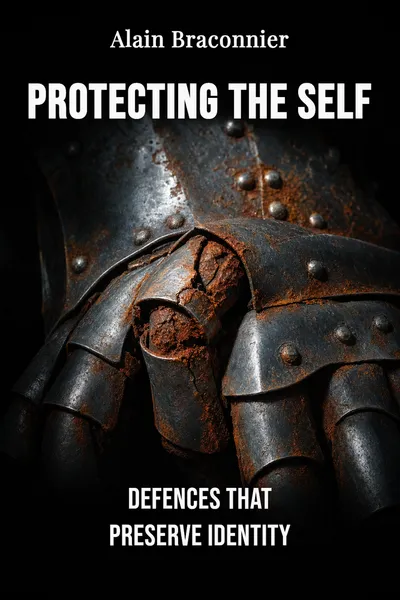
Protecting the Self
Defences that preserve identity
Description
Picture the small lie we tell ourselves after a rejection — it wasn't the right job anyway, we weren't that interested. Or the way a grief gets held at a distance for days, as if the news hadn't quite arrived. Or the colleague who insists everyone else is hostile while staying serenely unaware of his own sharp edges. These are not failures of character. According to the French psychiatrist and psychoanalyst Alain Braconnier, in his book Protecting the Self, they are the ordinary machinery by which a mind keeps itself whole. Defences, in this reading, are not something to be ashamed of. They are what lets us get up the next morning.
Braconnier belongs to a long clinical tradition — Freud named the mechanism, his daughter Anna Freud catalogued it, later analysts refined it — but his angle is warmer than the textbooks. He is less interested in listing pathologies than in showing how the healthy self defends itself every day, usually without noticing. Denial, projection, humour, sublimation: these are not symptoms. They are tools, and most of us handle them with surprising skill. The self, in his account, is something we are perpetually protecting, the way a body keeps its temperature steady without ever consulting us.
What makes the book quietly unsettling is that it refuses the easy line between the sane and the troubled. The same manoeuvre that saves us in a crisis can, if it hardens, become the thing that traps us. A defence is good or bad not for what it is but for whether it can still move. That single idea — flexibility as the real measure of mental health — runs underneath everything, and it reorganises how we read our own small evasions.
The question we’re asking : What are psychic defences actually for, and when does something that protects us start to imprison us instead?What we’ll see : How the mind guards its own coherence — from the crude early reflexes to the supple strategies of a healthy adult, and the point where protection quietly turns to confinement.
Table of contents
01 Chapter 1 — The mind's quiet bouncers
Braconnier starts from a simple observation: reality is more than the mind can take in all at once. Loss, humiliation, fear, desire that has nowhere to go — these press on us constantly, and if we felt their full weight the moment they arrived, we would be overwhelmed. The psychic defence is what stands between the self and that flood. It is an automatic operation, mostly unconscious, that filters, softens, delays, or reshapes what threatens to destabilise us. We don't decide to deploy it. It fires before we know there was anything to defend against.
The concept has a lineage. Freud used the word early on, then let it widen into his theory of repression — the pushing of unbearable material out of awareness. Anna Freud, in the late 1930s, gave the field its first real inventory, describing a whole repertoire of mechanisms the ego uses to manage anxiety. Braconnier draws on this history but resists its clinical chill. His insistence is that defending oneself is not a disorder. It is a sign that a psyche is doing its job. A mind with no defences at all would not be enlightened; it would be raw, flooded, unable to function.

02 Chapter 2 — Denial, projection, and the art of not looking
At the lower rungs sit the defences that work by distorting reality outright. Denial is the baldest: the refusal to register a fact that is plainly there. The patient who hears a serious diagnosis and continues, calmly, as though nothing has been said. The person who keeps setting a place at the table for someone who has died. Denial buys time the mind cannot yet afford to spend. It is not stupidity — it is a stay of execution, a way of holding the unbearable at arm's length until some part of us can begin to absorb it.
Projection is the next move, and in some ways the more interesting. Here the self takes a feeling it cannot tolerate as its own — hostility, envy, desire — and relocates it onto someone else. It is not that I am angry; it is that everyone around me is aggressive. It is not that I am tempted; it is that others are constantly trying to tempt me. Braconnier notes how convincing this is from the inside. The person projecting is not lying. They genuinely experience the disowned feeling as coming from outside, which is exactly what makes projection so hard to see in oneself and so corrosive in relationships.
03 Chapter 3 — The mature defences — where strength hides
Higher up the ladder, the defences change character. They no longer deny or distort reality so much as metabolise it — turning difficulty into something the self can actually use. This is where Braconnier locates real psychic health, and his treatment of it is the generous heart of the book. The mature defences are not about looking away. They are about looking squarely and still coming out intact.
Sublimation is the model case. Here an impulse that cannot be satisfied directly — aggression, grief, sexual energy — gets redirected into work, art, caregiving, sport, something socially valuable and personally sustaining. The painter who makes something out of heartbreak, the surgeon whose precision channels an old aggressivity into healing: these are not people avoiding their feelings. They are people who have found a form for them. Nothing is denied; the raw material is transformed rather than refused.
04 Chapter 4 — When the armor stops coming off
If the book has a single pivot, it is this: no defence is bad in itself. Even denial has its hour. What matters is whether the defence can still move. Braconnier keeps returning to flexibility as the real criterion of health — not which mechanisms we use, but whether we can put them down when the danger passes. A defence is meant to be a response to a situation. The trouble starts when it becomes a permanent setting, firing regardless of whether there is anything left to fear.
This is where protection quietly turns into confinement. The denial that spares us in the first hours of a loss becomes, months later, a refusal to live. The projection that protects a fragile self-image hardens into a worldview in which others are forever to blame, and relationships wither around it. The humour that once gave distance curdles into a reflex that keeps every real feeling at bay. The mechanism hasn't changed; what has changed is that it no longer answers to reality. It has stopped coming off.
05 Conclusion
The small lie after a rejection, the grief held at arm's length, the colleague convinced the hostility is all around him — none of these are flaws to be rooted out. They are the self keeping itself coherent, doing quietly and automatically what it has to do to stay whole. Braconnier's achievement is to return a kind of dignity to our evasions, to show that the mind's defences are a form of intelligence rather than weakness. We are all, always, protecting something.
Related books