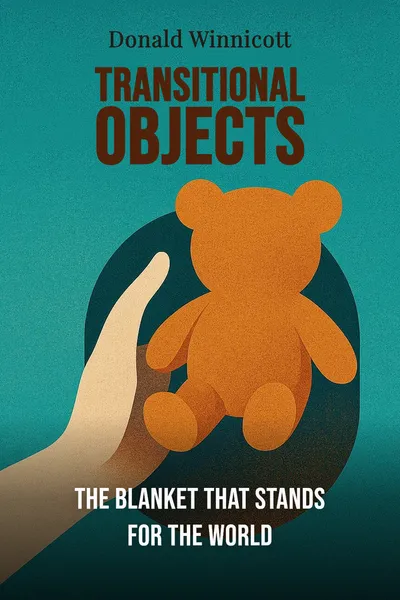
Transitional Objects
The blanket that stands for the world
Description
Somewhere there is a blanket that has been washed, mended, dragged across floors, and carried through airports until it is barely a rectangle anymore. Its owner — once two, now maybe forty — would notice its absence before almost anything else in the house. A parent who tried to swap it for an identical new one learned the hard way that it does not work: the child wants this one, the specific one, with its exact smell and its exact fraying. We tend to file this under cute. The pediatrician and psychoanalyst Donald Winnicott, working in London through the middle of the last century, filed it under something far stranger and more important.
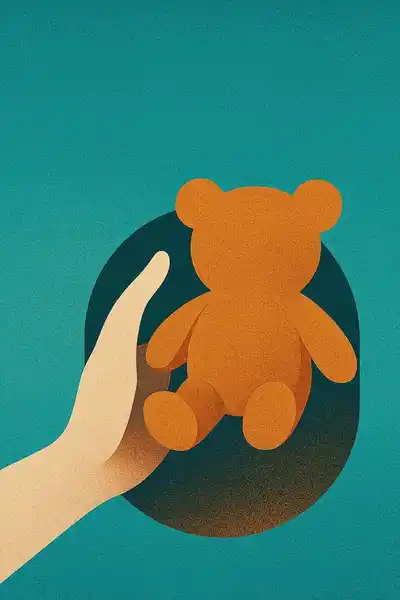
Winnicott had seen thousands of babies and mothers in his clinics, and he kept noticing the same thing: at a certain age, somewhere between four months and a year, a child adopts a first possession. A corner of a sheet, a soft toy, a word hummed before sleep. The child needs it, fiercely, especially at the border between waking and dreaming, at the border between being with the mother and being alone. He gave this first possession a name that has outlived almost everything else he wrote. He called it the transitional object.
The name sounds clinical, but what it points to is anything but. Winnicott thought this grubby, beloved thing was doing one of the hardest jobs a human being ever faces, and doing it before the child can even speak. He thought the blanket was how a small person first negotiates the gap between themselves and everything that is not themselves — the whole world, basically, held in one hand. And he thought that if we understood the blanket, we would understand a great deal about where imagination comes from, and why we never quite grow out of needing it.
The question we’re asking : What is the ragged blanket actually doing for the child, and why does it matter long after childhood ends?What we’ll see : How Winnicott read a universal childhood habit as the first solution to the oldest human problem — being one thing in a world made of others.
Table of contents
01 Chapter 1 — The teddy bear that cannot be thrown away
Winnicott came to this through decades of ordinary clinical observation rather than through theory. As a pediatrician before he trained as an analyst, he had watched countless infants settle to sleep, and he noticed a pattern too consistent to ignore. Babies in the first months soothe themselves with their own bodies — a thumb, a fist, the edge of a hand. Then, often toward the end of the first year, something from outside the body gets recruited into the same job. A blanket, a napkin, a particular soft animal. It becomes the thing that must be there at bedtime, during illness, at any moment of being left.
What struck him was how seriously the child took it. This was not a casual preference. The object had to be the actual object, not a replacement. It could be loved almost to destruction, hugged and also bitten and dragged, and the child insisted it stay as it was — including its accumulated smell, which parents learn never to wash out entirely. A fresh one simply is not it. The thing had acquired a reality that no substitute could carry.

02 Chapter 2 — Not quite me, not quite the world
To answer that, Winnicott asked us to picture the very beginning. A newborn, in his account, does not yet experience the mother as a separate person. When the baby is hungry and the breast appears, the baby has, in effect, created the breast — need and satisfaction arrive together so seamlessly that there is no gap in which to notice an outside world at all. For a brief period, a good-enough mother sustains this illusion almost perfectly, meeting needs so promptly that the infant feels, quite literally, omnipotent. The world obeys.
That illusion cannot last, and it is not supposed to. Gradually the mother fails, in small, tolerable ways — she arrives a little late, she is briefly unavailable, she becomes a person with her own rhythms rather than a seamless extension of the baby's wishes. Winnicott called this graduated disillusionment, and he thought it was one of the most important things a parent does, precisely by not doing it too fast. The child discovers, in bearable doses, that there is a world out there that is not under its command.
03 Chapter 3 — The place where play happens
Winnicott gave this border region a name too. He called it the intermediate area of experience, or transitional space — a zone that is neither purely inner reality nor purely external fact, but a third thing that draws on both. The blanket is the first inhabitant of this space. Play is what happens there. When a child builds a world out of blocks and populates it with intentions, or talks for hours to an animal that cannot answer, the child is working in exactly the region the transitional object first opened.
And this, he argued, is where psychological life actually grows. The child who can play is a child who can bring inner images into contact with outer materials and let them meet. Play is not a pause from the serious business of developing; it is the serious business. It is how the self learns to relate to a world it does not control, by setting up a protected arena where the world can be handled on the child's own terms. The transitional object is the portable, pocket-sized version of that arena.
04 Chapter 4 — Why the object is allowed to stay dirty
Here is where Winnicott steps back, because the strangest part of his account is not how the object arrives but how it leaves. The transitional object, he observed, is almost never mourned. The child does not break with it in grief, the way one grieves a lost toy. Instead it is gradually, quietly decathected — it loses its charge, gets left in a drawer, stops being asked for. It is not forgotten and not thrown away. It simply, over years, becomes not quite needed, and nobody notices the exact day.
Winnicott's claim is that the object is not lost because its function spreads out. The transitional space it opened does not close; it widens to fill, in his words, the whole cultural field. The blanket is relinquished only because the entire intermediate area between inner and outer experience — the space of play — expands to take in art, music, imaginative life, religion, the whole realm of things that are neither hallucinated nor merely factual but held, communally, in between. We never stop living in that region. We just stop needing a single object to anchor it.
05 Conclusion
Return to the blanket, washed thin and carried for years. What Winnicott saw in it was a small person solving the largest problem there is: how to be a separate self in a world that will not obey you. The infant begins in an illusion of total control, loses it in bearable stages, and reaches for a first possession that is both found and invented — a thing to hold while learning that the people it loves can leave and return, that absence can be survived, that meaning can be made in the gap. The object does its work and then fades, not because it failed but because it succeeded.
Related books