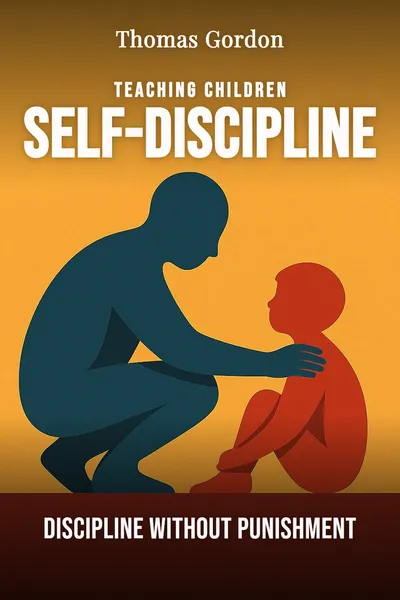
Teaching Children Self-Discipline
Discipline without punishment
Description
In the early 1960s, a clinical psychologist named Thomas Gordon started running evening classes for parents in Pasadena, California. He had worked with Carl Rogers, absorbed the idea that people grow best when they feel genuinely heard, and wondered whether ordinary mothers and fathers could learn the same skills a good therapist used. The classes became Parent Effectiveness Training, and over the following decades they spread to dozens of countries and millions of families. Late in his career, Gordon returned to the single question that had nagged at the whole project: what do we actually mean when we say we want disciplined children?
His answer, set out in Teaching Children Self-Discipline, was uncomfortable for most of us. Gordon argued that the word discipline carries two meanings we quietly blend together. One is the inner capacity to govern oneself — to wait, to focus, to keep a promise when nobody is watching. The other is control imposed from outside, enforced by someone bigger. We say we want the first. Almost everything we do, he claimed, teaches the second. And the tools we trust most to get there — the time-outs, the gold stars, the raised voice, the withdrawn privilege — belong entirely to the second.
That gap is the subject of the book. Gordon was not writing a manifesto for letting children do whatever they please; he had spent his life watching permissiveness fail just as reliably as authoritarian control. What he wanted was a third option that most families had never been shown, one that treated conflict between parent and child not as a contest somebody has to win.
The question we’re asking : If the rewards and punishments we rely on don't actually build self-discipline, what does — and what are we really teaching instead?What we’ll see : How Gordon separates the two disciplines, dismantles the tools we trust, and offers a way through conflict in which no one has to lose.
Table of contents
01 Chapter 1 — The two kinds of discipline we keep confusing
Gordon opens by slowing down a word we use without thinking. Discipline, he points out, started as a noun before it became a verb. A disciple was a learner; discipline was a body of knowledge someone chose to take on. Only later did it drift toward its harsher sense — the thing a parent or a teacher does to a child who has stepped out of line. We now hear both meanings at once, and the slippage does real damage, because it lets us believe that controlling a child is the same thing as helping that child learn control.
The distinction he draws is between self-discipline and what he calls externally imposed discipline. Self-discipline is internal, chosen, and durable: it keeps working when the authority figure leaves the room. Imposed discipline is a relationship between a controller and a controlled, and it lasts exactly as long as the controller's presence and power. A child who tidies his room only when his mother is standing in the doorway has learned something — but not self-discipline. He has learned the geography of surveillance.

02 Chapter 2 — Why rewards and punishment stop working
Most of our discipline toolkit, Gordon argues, runs on power, and power in families has a short shelf life. When children are small, parents hold an enormous advantage in size, resources, and knowledge, and rewards and punishments work impressively well. The trouble is that the advantage shrinks every year. By adolescence the child has her own money, her own mobility, her own friends, and her own capacity to inflict costs in return. The parent who built the relationship on power finds, right when the stakes are highest, that the power has quietly drained away.
Punishment draws most of his attention, because it is both common and, in his reading, reliably counterproductive. It does not teach the behavior we want; it teaches avoidance of getting caught, resentment toward the punisher, and a repertoire of coping moves — lying, hiding, blaming, withdrawing. Gordon catalogs these as predictable responses to any exercise of coercive power, not as signs of a bad child. A punished child spends her energy managing the punisher rather than examining her own conduct, which is precisely backwards from what self-discipline requires.
03 Chapter 3 — The method where nobody loses
Having cleared the ground, Gordon offers his alternative, which he calls the no-lose method, or Method III. The name is set against two familiar defaults. In Method I, the parent wins and imposes the solution; the child complies and resents it. In Method II, the child wins and the parent gives way; the parent resents it. Both leave one party defeated. Method III refuses the contest entirely and treats a conflict as a shared problem the two people solve together, looking for an outcome that genuinely works for both.
The engine of the method is a process rather than a trick, and it leans on two skills Gordon had taught for years. The first is active listening — reflecting back what the child is feeling and wanting until the child feels understood, which lowers the defensiveness that makes real negotiation impossible. The second is the honest I-message: the parent names the concrete problem the child's behavior causes and the feeling it produces, without attacking the child's character. "I can't concentrate on the call with the noise" lands very differently from "you're being selfish."
04 Chapter 4 — When obedience costs more than it buys
Step back from the techniques and Gordon's deeper argument is about what power does to a relationship over time. Every act of control, he suggests, spends down a finite account. It may buy obedience today, but it withdraws from the trust, candor, and influence that a parent will need far more when the child is sixteen than when she is six. The authoritarian home often looks successful precisely during the years when the costs are invisible, and discovers the bill only when the child is old enough to stop paying.
The most expensive loss, in his telling, is honesty. Children who live under coercive power learn to manage the powerful rather than confide in them. They say what keeps the peace, hide what would bring trouble, and route their real lives around the parent entirely. The parent who most wants to protect a teenager finds himself the last to know anything that matters, having trained the child, over years of punishment, that disclosure is dangerous. Control doesn't just fail to build character; it closes the channel through which a parent might still have some say.
05 Conclusion
The parent classes Gordon began in a California living room were built on a single, stubborn bet: that the skills a good counselor uses are the same ones an ordinary family needs, and that they can be learned. Teaching Children Self-Discipline is the late, distilled form of that bet applied to the hardest corner of family life — the moment of conflict, when the temptation to reach for power is strongest. His answer is to put down the reward and the punishment and to treat the child as a person with needs as real as our own.
Related books