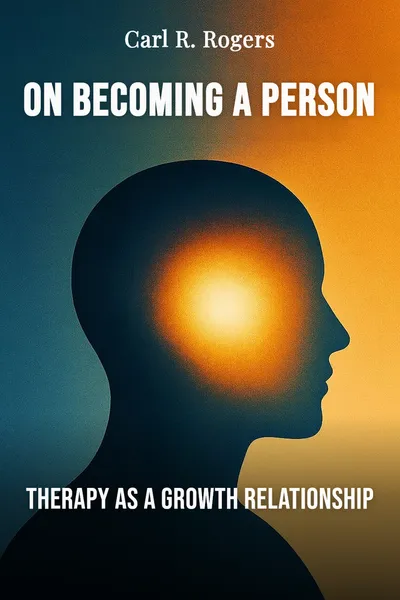
On Becoming a Person
Therapy as a growth relationship
Description
In 1961, a sixty-year-old psychologist named Carl Rogers gathered a decade of lectures and papers into a book he called On Becoming a Person. By then he had spent years as a clinician, first with troubled children in Rochester, later at Ohio State, Chicago, and Wisconsin, watching thousands of hours of what happened when one person sat across from another and tried to help. What he noticed ran against most of what his training had told him. The expert diagnosing the patient, prescribing the fix, steering the session toward a predetermined cure — that whole posture, Rogers came to think, was often the thing blocking the change it was meant to produce.
The book's quiet provocation is that healing is not something a therapist does to a client. It is something that happens between them, when a particular kind of relationship is in place. Rogers had been building this view for years under the name client-centred therapy, and later the person-centred approach. The therapist's job, as he described it, was not to interpret, advise, or correct, but to create conditions — a climate so safe and so free of judgment that the person sitting there could stop defending themselves long enough to hear what was actually going on inside.
It sounds almost too simple, which is exactly why it unsettled a profession built on expertise. If the relationship is the active ingredient, what becomes of all the technique? Rogers spent the book answering that, drawing not on grand theory but on transcripts, case notes, and his own second-guessing. The claim he kept circling back to was both modest and enormous: given the right human conditions, people move on their own toward becoming who they are.
The question we’re asking : If a therapist isn't there to diagnose or fix, what is the relationship actually supposed to do?What we’ll see : How Rogers rebuilt therapy around a handful of conditions, and the bet about human nature hiding underneath them.
Table of contents
01 Chapter 1 — The therapist who stopped steering
Rogers came up inside a discipline that assumed the professional knew best. The diagnostic tradition treated the client as a case to be read, classified, and corrected. The therapist asked the probing questions, spotted the hidden pattern, and guided the person toward the insight the therapist had already located. Rogers had trained in exactly this mode, and for a stretch of his early career he practised it. What changed his mind was not an argument but a steady accumulation of hours in the room, watching his cleverest interventions land flat while something else, harder to name, did the real work.
The turning point he returns to in the book is almost embarrassing in its ordinariness. A mother he was counselling about her son made no progress as long as Rogers pursued his careful analysis of the boy's problems. Only when he gave up, admitted they seemed to be getting nowhere, and asked whether she might want help for herself, did the conversation finally open. She had been waiting, in effect, for him to stop steering. The lesson he drew was uncomfortable for an expert: it is the client who knows what hurts, which direction to go, what matters.

02 Chapter 2 — Three conditions, no technique
If therapy is a relationship rather than a procedure, the obvious question is what makes the relationship work. Rogers's answer is the backbone of the book: a small set of attitudes in the therapist that, when genuinely present, let change happen. He was emphatic that these are not tricks or moves to be performed. A therapist faking warmth, or mimicking empathy as a technique, produces nothing — clients sense the gap immediately. The conditions have to be real, which is what makes them hard.
The first is congruence, or genuineness. The therapist is not playing a role, not hiding behind a professional mask. Whatever they are feeling in the moment is available to them and, where helpful, can be acknowledged honestly. Rogers thought this transparency mattered enormously: a person can only lower their own defences across from someone who isn't defended. The second is empathic understanding — the effort to sense the client's private world as if it were one's own, without ever losing the 'as if.' Not sympathy, not agreement, but an accurate feel for what things mean from the inside, fed back so the person knows they have been understood.
03 Chapter 3 — What a person becomes when it's safe
The title of the book points at an outcome, not a starting state. Becoming a person is a process, and Rogers spent considerable effort describing what he actually saw happen to people inside the relationship he was defending. The movement had a recognizable direction, even if it looked different for everyone. People arrived defended, performing a self they thought was required, estranged from their own feelings. Over time, in the safety of acceptance, the performance relaxed.
The first thing that tends to loosen is the mask. Clients stop trying to be what they imagine they ought to be and begin, often hesitantly, to encounter what they actually feel. Rogers described a growing openness to experience — anger, tenderness, fear admitted into awareness instead of held at arm's length. A person who has spent years deciding feelings are dangerous starts to find they can be lived through rather than defended against. With that comes a quieter, steadier self-trust.
04 Chapter 4 — The wager inside unconditional regard
Step back from the consulting room and a larger claim comes into view, one Rogers never quite disguised. His whole approach rests on a bet about human nature. If you can heal a person simply by accepting them, trusting them, and getting out of the way, then people must be, at some deep level, trustworthy — tending toward growth when the conditions allow, rather than toward chaos that needs to be managed. Unconditional positive regard is not just a clinical technique. It is the practical expression of an optimism about what human beings are.
This put Rogers at odds with much of the intellectual weather of his time. Freud's inheritance held that beneath the surface lay drives that civilization had to restrain; a good deal of psychology assumed the self needed correcting, conditioning, controlling. Rogers staked out the opposite ground. Left in a climate of genuine acceptance, he argued, the human organism does not run wild — it moves toward becoming more whole, more social, more itself. The directive, correcting posture of the expert was, on this view, a symptom of distrust.
05 Conclusion
Rogers had started out as the expert in the room, armed with diagnoses and interpretations, and spent a career discovering that his expertise was often what stood in the way. The mother who only opened up once he stopped analysing her son stayed with him as the small case that undid the large theory. What replaced it was not a looser method but a more demanding one — genuineness, empathy, and an acceptance that asks nothing in return. On Becoming a Person is his attempt to show that these are not soft preliminaries to the real work. They are the work.
Related books