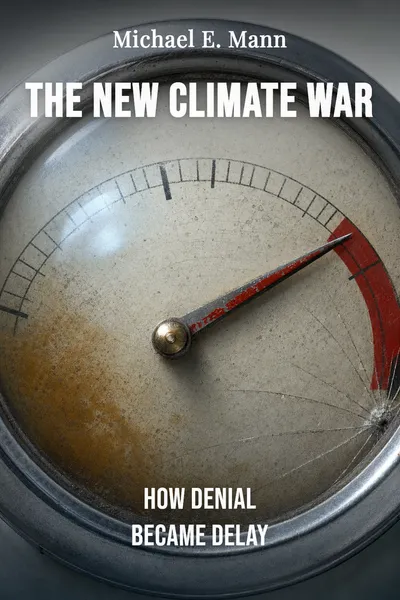
The New Climate War
How denial became delay
Description
For roughly three decades, the fight over climate change looked like a fight over facts. Does the planet warm? Are humans behind it? A well-funded network of think tanks, lobbyists and paid contrarians worked hard to keep those questions open in public — long after they had closed in the scientific literature. Michael E. Mann knew that machinery from the inside. A climatologist at Penn State, he became a lightning rod in the late 1990s for the "hockey stick" graph, a reconstruction of a thousand years of temperature that showed a sharp modern spike. For his trouble he got subpoenas, hacked emails, death threats, and a front-row seat to how the denial industry actually operated.
Then, somewhere in the 2010s, the ground shifted. Denying the science outright had become embarrassing — the heat waves, the fires, the floods were arriving on schedule, and the polls moved with them. But the interests that had funded denial did not simply concede and go home. In "The New Climate War," published in 2021, Mann argues they changed weapons. The goal was never really to win the argument about physics. The goal was to protect a status quo worth trillions of dollars, and there is more than one way to do that.
That is the reframing at the heart of the book. If the enemy can no longer sell you the idea that there is no problem, the next best thing is to keep you from doing anything effective about it — to delay, to divide, to make the whole thing feel like your personal failing rather than a system's. Mann, who has spent his career being attacked, writes here less as a victim than as a strategist mapping the battlefield.
The question we’re asking : Once denying the science stopped working, how did the opponents of climate action keep winning anyway?What we’ll see : How the war over climate shifted from doubt to delay — and what Mann says it takes to fight back.
Table of contents
01 Chapter 1 — The lie that stopped working
For most of Mann's career, the strategy on the other side was straightforward: manufacture doubt. The template came from tobacco, and the players sometimes literally overlapped. If you could keep the public believing scientists were still arguing about whether smoking caused cancer — or whether carbon dioxide warmed the planet — you bought decades of business as usual. A famous internal tobacco memo put it plainly: doubt is our product. Fossil-fuel interests borrowed the line and the tactics both.
Mann lived at the sharp end of this. After the hockey stick graph appeared in the late 1990s and made its way into a major United Nations climate report, he became a target. His inbox filled with threats. His emails were stolen and combed for anything that could be spun into scandal — the episode that came to be called Climategate around 2009. Investigations cleared him and his colleagues repeatedly, but the point was never a fair verdict. The point was noise, delay, and the suggestion that where there was smoke there must be fire.

02 Chapter 2 — The playbook that replaced it
The replacement, Mann argues, is not one tactic but a cluster of them, all aimed at the same result: keep meaningful action off the table while appearing to take the issue seriously. He gives them names, because naming them is half the defense. There is deflection, which shifts the burden from polluters to individuals. There is division, which sets potential allies against each other. There is delay, dressed up as prudence. And there is doomism, which insists it is already too late, so why bother.
Doomism gets particular attention, and it is the most counterintuitive weapon in the set. We tend to assume despair is the opposite of denial — the reaction of people who take the science all too seriously. Mann's point is that despair and denial land in exactly the same place: paralysis. If nothing can be done, then nothing needs to be attempted, and the fossil-fuel status quo is safe either way. Some of the loudest doom, he suggests, is amplified by the very interests that benefit from surrender.
03 Chapter 3 — The finger pointed at us
Of all the tactics Mann dissects, the one he circles back to hardest is deflection — the quiet reengineering of climate change from a systemic problem into a personal one. Recycle. Fly less. Watch your footprint. None of these are bad in themselves. The trouble is where the framing came from and what it accomplishes.
Consider the carbon footprint. The concept was popularized in the mid-2000s through a slick advertising campaign by BP, one of the largest oil companies on earth, complete with an online calculator so each of us could tally our personal guilt. Mann treats this as a small masterpiece of misdirection. A company whose entire business is extracting and selling fossil fuels persuaded the public that the real culprit was the consumer's lifestyle. The move mirrors an older one from the beverage industry, which spent decades framing litter as a matter of individual carelessness rather than corporate packaging.
04 Chapter 4 — Winning the war we're actually in
Step back from the individual tactics and a single logic connects them. Once a fact becomes impossible to deny, power does not defend itself by attacking the fact. It defends itself by managing the response — by steering where our attention, our guilt and our energy get spent. Mann's real subject is not the atmosphere; it is that maneuver. The shift from denial to delay is what defeat looks like for an old strategy and reinvention looks like for the interests behind it.
This is why he insists the fight is now political rather than scientific. The science, in his telling, is won. What remains contested is agency — who is held responsible, and what counts as an adequate answer. And here the very act of naming the tactics does work. A deflection you can see coming loses much of its force. Doomism, once you recognize whom it serves, stops feeling like clear-eyed realism and starts looking like a trap. Mann is essentially handing readers a field guide to their own manipulation, on the theory that a manipulation exposed is a manipulation weakened.
05 Conclusion
The scientist who spent years absorbing threats over a graph ends up, in this book, sounding less like a defendant than a general. Mann's argument is that the enemy quietly conceded the old war — the one about whether climate change is real — and opened a new one on friendlier terrain. On this terrain the weapons are not lies but redirections: make people despair, make them blame themselves, make them fight each other, make them wait. The status quo wins by all of these, and it barely has to say anything untrue to do it.
Related books