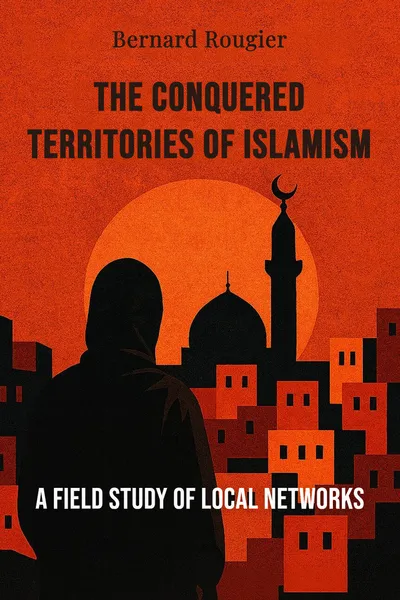
The Conquered Territories of Islamism
A field study of local networks
Description
In the early 2010s, a team of researchers led by the political scientist Bernard Rougier spent several years inside a handful of French working-class neighborhoods — in the northern suburbs of Paris, around Marseille, in parts of Lyon and the Essonne. They were not chasing the next attack or interviewing former jihadists in prison. They were doing something less dramatic and, in the end, more disruptive: mapping who prayed where, who sold which books, which gym the young men trained at, which preacher's recordings circulated on which phones. The result, published in 2020 under the title The Conquered Territories of Islamism, read less like a warning than a survey — a patient inventory of a social fabric most people had never seen described in that detail.
Rougier's wager was that the usual way of talking about radicalization missed the point. France had spent years after 2015 debating the lone attacker, the mind that "tipped," the psychological profile that could be flagged and caught. Rougier and his colleagues argued that the interesting unit of analysis was not the individual at all. It was the network — the overlapping institutions, the local entrepreneurs of piety, the slow construction of a parallel world in which a certain reading of Islam became the organizing grammar of a whole district. Radicalization, in this telling, was less an event inside a head than an environment one grew up inside.
The book landed in the middle of a French argument that was already loud, and it made that argument louder. Within weeks it was being cited in parliamentary debate and torn apart in the academic press — not only for what it claimed about the neighborhoods, but for how it had gone about looking at them. What does it actually mean to say a territory has been "conquered"? And can a field study settle a fight that was never only about the field?
The question we’re asking : What does Islamist influence look like when you map it on the ground rather than inside a single radicalized mind?What we’ll see : A close look at how a dense local network takes hold street by street, and the fierce dispute over whether such a map can be read the way its authors read it.
Table of contents
01 Chapter 1 — The ecosystem, not the lone wolf
The central move of the book is a shift of scale. After 2015, the French conversation about jihadism fixated on the individual — the young man who disappeared to Syria, the attacker whose "signals" had been missed, the psychology of rupture. Rougier and his team found that framing almost useless for understanding what they were seeing on the ground. The people they studied had rarely radicalized in isolation. They had grown up inside something.
That something is what the book calls an ecosystem: a set of institutions, figures, and spaces that reinforce one another and, together, produce a shared worldview. A teenager does not read one incendiary pamphlet and convert overnight. He attends a mosque where a certain preacher holds authority, trains at a gym run by someone from the same milieu, buys books at a shop stocking the same literature, watches the same online lectures his friends watch. Each node is modest on its own. The density is the point.

02 Chapter 2 — Mosques, gyms, bookshops: the physical grid
The most striking parts of the book are the ones that read like fieldwork. The researchers did not theorize the ecosystem from a distance; they walked it. They catalogued specific places in specific neighborhoods — the Fosse-aux-Loups area in Clichy-sous-Bois, districts of Aubervilliers and Saint-Denis, zones around Marseille — and traced the ties between them. The map that emerges is physical before it is ideological: a grid of addresses that talk to each other.
The mosque is one anchor, but rarely the only one, and often not the official one. What matters more are the spaces around it — the prayer rooms that split off after a doctrinal quarrel, the associations that run tutoring or sports, the halal businesses whose owners share the milieu's references. A gym appears again and again in the book, because it does several kinds of work at once: it gathers young men, it offers discipline and a sense of worth, and it lets an informal authority form away from any institution that might supervise it.
03 Chapter 3 — Breaking from the Republic, one institution at a time
The word in the title — conquered — is a claim about direction, not just density. The networks the book describes are not static subcultures content to exist alongside everyone else. Rougier argues they are engaged in a slow contest for institutions, pulling one space after another out of the common world and into a parallel one governed by a different norm. The process is gradual and mostly legal, which is exactly why it is hard to name and harder to counter.
The mechanism he describes is pressure applied at the seams. A local association shifts its programming. A sports club quietly adopts new rules about mixing. A merchant stops serving what he once served. A school faces demands about menus, swimming lessons, the content of a biology class. Each demand, taken alone, can be read as ordinary pluralism. Read together, across a district, they trace a line — the steady redrawing of what is acceptable, until the ambient norm of a neighborhood no longer matches the norm of the Republic that surrounds it.
04 Chapter 4 — What a field map can and cannot settle
The reception of the book turned, in the end, on a question the fieldwork could not answer by itself: what does a map prove? Rougier and his team had documented a dense network and a real dynamic of institutional capture in specific neighborhoods. The dispute was over the inference — whether the grid they described warranted the language of conquest, and whether a study built on well-chosen sites could speak to the country as a whole.
Critics inside the discipline, among them sociologists who had long studied French Islam, raised a methodological objection that is familiar wherever fieldwork meets politics: a researcher who goes looking for a network will find a network. Choose the neighborhoods where the dynamic is strongest, follow the ties that connect, and the density you report is partly an artifact of where you pointed the camera. Absent a baseline — how typical are these sites, how do they compare with districts where nothing of the kind took hold — the vivid map risks standing in for a measurement it never made.
05 Conclusion
What Rougier and his colleagues delivered was, at bottom, an inventory — addresses, ties, brokers, the physical architecture of a worldview built one institution at a time. Its strength is its concreteness: after this book it was harder to say that nothing was happening in the neighborhoods it walked, because the pages were full of specific places doing specific work. Its vulnerability is the same concreteness, scaled up by a title that promised conquest where the fieldwork had shown a dense and advancing network in chosen sites.
Related books