
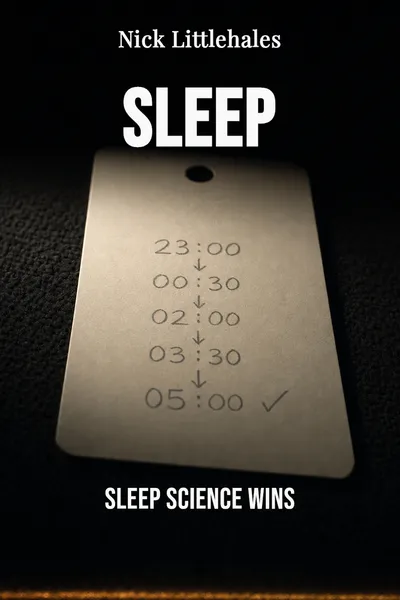
Sleep
Sleep science wins
Description
In the late 1990s, a mattress-industry salesman named Nick Littlehales wrote to Alex Ferguson at Manchester United with an odd proposition. He wanted to look at how the players slept. Not their training, not their diets — their nights. Ferguson, then the most demanding manager in English football, let him in. Littlehales examined bedrooms, hotel arrangements, travel schedules, and the beds themselves, and found a squad of elite professionals who prepared everything about their bodies except the eight hours they spent horizontal. From that first visit grew a second career: over the next two decades he advised football clubs, Olympic cyclists, and rugby teams on the one variable nobody had thought to coach.
His argument, laid out in the book Sleep, is quietly provocative. We treat rest as something that either happens to us or doesn't, a lottery we blame on stress or a bad mattress. Littlehales treats it as a set of behaviours that can be measured, adjusted and improved — the same way an athlete works on sprint mechanics. He is careful, too, about what he isn't: not a doctor, not a sleep-lab scientist, but a practitioner who took the research and turned it into a routine a tired professional could actually follow on a Tuesday night in a chain hotel.
The book sits at the meeting point of two things that rarely talk to each other: peer-reviewed sleep science and the grubby, jet-lagged reality of high-performance sport. What comes out is less a lullaby than a manual, built on a handful of principles that scale down surprisingly well from a Premier League dressing room to an ordinary bedroom.
The question we’re asking : What does a sleep coach for elite athletes actually change, and does the method hold up once you take it off the training ground?What we’ll see : How a mattress salesman turned rest into a coachable skill, and the small, testable habits he built the method on.
Table of contents
01Chapter 1 — The man who fixed footballers' nights
Littlehales did not arrive at football through medicine or physiology. He came through the mattress business, where he had spent years understanding sleep surfaces, postures and the mechanics of a good bed. That commercial background is central to his story, because it meant he approached the problem from the object outward — the pillow, the room, the schedule — rather than from the brain inward. When he started asking clubs how their players slept, he found a strange gap. Teams optimised nutrition to the gram and recovery to the minute, then sent players home to whatever bed and bedtime they happened to have.
The Manchester United visit set the template. Littlehales looked at practical, fixable things: room temperature, light, the size and firmness of beds, and above all the chaos of the travel calendar. Footballers play evening matches that end near eleven, adrenaline still high, then face early flights and time-zone shifts across Europe. Their days are engineered around performance; their nights were left to chance. He began redesigning that neglected half of the twenty-four hours.

02Chapter 2 — Cycles, not hours
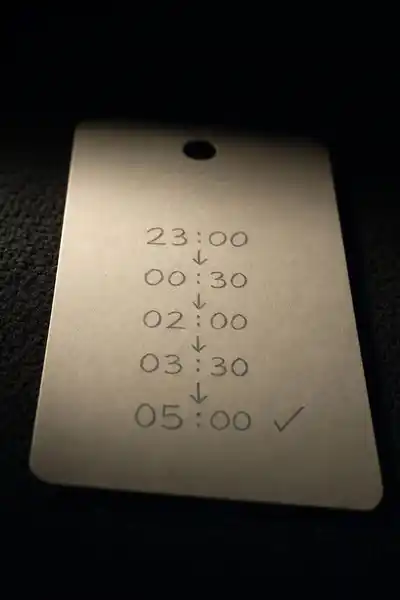
The first thing Littlehales asks people to unlearn is the number eight. The eight-hour night is a cultural default, not a biological law, and treating it as a pass-or-fail target does real harm: miss it and you lie awake anxious about missing it. He proposes a different unit of measurement, one borrowed straight from sleep physiology — the roughly ninety-minute cycle. We move through stages of lighter and deeper sleep and back again in these repeating waves, and waking at the end of a cycle feels very different from being dragged out of the middle of one.
So instead of counting hours, he counts cycles. Five cycles is about seven and a half hours; four is six. His recommendation is to aim for a weekly total — around thirty-five cycles across seven nights — rather than to demand five every single night. That shift matters psychologically. A short night stops being a failure and becomes a debit you can settle across the week. For an athlete whose match schedule makes consistent bedtimes impossible, planning by cycle rather than by clock is the difference between a workable routine and constant guilt.
03Chapter 3 — The seven keys around the pillow
Having reset the unit of measurement, Littlehales turns to the environment, and here his mattress-trade instincts show. He organises the practical advice into a set of what he calls key recovery indicators — roughly seven controllable factors around sleep. They are deliberately mundane, and that is the point: nothing here requires a prescription or a lab, only attention to things most people never audit.
Light comes first, because it is the master switch. The body reads daylight and darkness to set its internal clock, so his routine front-loads natural light in the morning and strips artificial light — screens especially — from the wind-down before bed. Temperature follows: a cool room and a body that has shed the day's heat sleep better than a warm one. Then the pre-sleep and post-sleep routines, the buffer zones on either side of the night that let the brain change gear rather than slamming from stimulation straight into the dark.
04Chapter 4 — Rest is a skill, not a virtue
Step back from the pillows and the ninety-minute cycles, and what Littlehales is really doing is moving sleep out of one category and into another. For most of modern life, rest has sat in the moral column: something you either deserve or should be ashamed of, a sign of discipline when you skip it and weakness when you need it. Sport, of all places, was the worst offender — a culture that celebrated the player who trained through exhaustion and mistrusted the one who prioritised his bed. His method quietly dismantles that. Sleep becomes a variable you engineer, not a virtue you display.
That reframing is the real win the headline points to. Once rest is a coachable input rather than a lottery, it stops being the thing you feel guilty about and becomes the thing you audit, plan and protect — exactly as an athlete treats hydration or strength. Littlehales's genius was less scientific than rhetorical: he found the language that let competitive people take rest seriously. Marginal gains gave sleep a seat at the table it had never been offered, and the results in cycling and football gave the argument evidence rather than sentiment.
05Conclusion
The salesman who wrote to Alex Ferguson never became a scientist, and Sleep never pretends otherwise. It is a practitioner's book, the record of what happened when someone took the research seriously enough to build a routine out of it and then tested that routine on people whose careers depended on recovering fast. The cycles, the fixed wake time, the seven keys around the pillow — none of it is exotic, and all of it is arranged so a tired professional can follow it without a lab or a prescription.