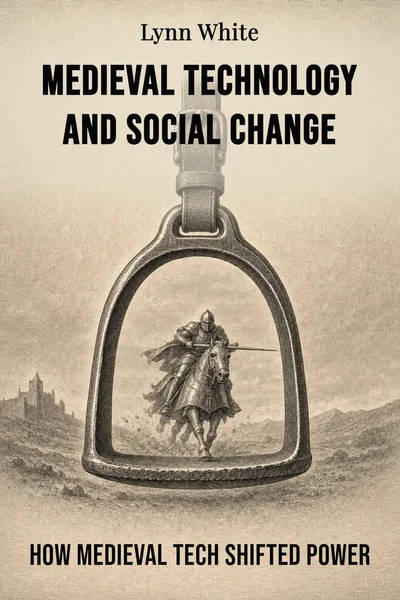
Medieval Technology and Social Change
How medieval tech shifted power
Description
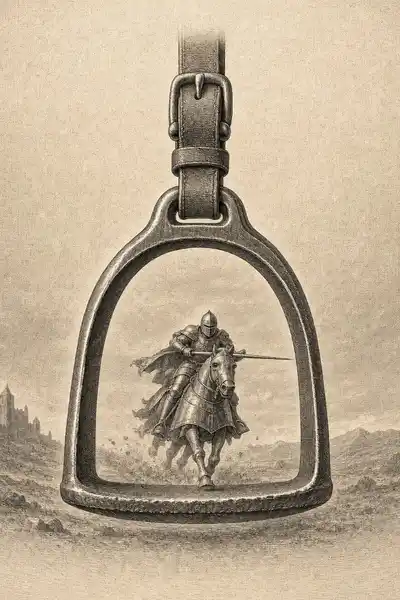
In 1962, a medievalist named Lynn White Jr. published a slim book that proposed something faintly outrageous for its time: that a piece of foot-gear had helped invent feudalism. The claim ran through the opening chapter of Medieval Technology and Social Change, and it turned on the stirrup — two loops of metal hanging from a saddle. White argued that once a rider could brace his feet, he could couch a lance under his arm and strike with the full weight of horse and man behind it. A new kind of warfare followed. And a new kind of warrior, expensive to equip and mounted, needed land and labor to sustain him. From the leather loop, White traced a line to the armored knight and the society built to keep him in the saddle.
That was only the opening move. Across three dense essays, White pushed the same instinct into the fields and the workshops: the heavy plow that broke the wet clay soils of northern Europe, the harness that let horses pull without choking, the water mills and windmills and cranks that began, quietly, to substitute machinery for muscle. His subject was not battles or kings but gear — the humble hardware that most historians had walked past on their way to charters and chronicles.
The book landed hard. Some historians embraced it; others spent years disputing the stirrup timeline. Either way, White had done something durable. He made technology a serious character in medieval history, not a footnote to it, and he asked whether the tools a society picks up quietly rearrange who holds power within it.
The question we’re asking : Can the tools a society picks up quietly rearrange who holds power within it?What we’ll see : How White read gear — from a metal loop to plows and mills — as a force that reshaped who ruled and who worked.
Table of contents
01Chapter 1 — The stirrup and the man on horseback
White opens where the book is most famous and most contested: with the stirrup. Before it, a mounted warrior was a fragile thing. He could throw a spear or slash downward, but a full-force thrust risked knocking him off his own horse. The stirrup changed the physics. With feet braced in metal loops and a high saddle behind him, a rider could tuck a lance tight under his arm and let the combined mass of horse and man deliver the blow. White called this mounted shock combat — the charging, couched-lance attack we now picture whenever we picture a knight.
The device itself was not European. It came out of Asia, probably reaching the Frankish world in the early eighth century. White's boldest stroke was to tie its arrival to a specific political moment. He argued that Charles Martel, the Frankish leader, seized on the new cavalry and needed a way to pay for it — mounted warriors were ruinously expensive, requiring horses, armor, and years of training. So, on White's reading, Martel began seizing church lands and granting them to followers on condition of mounted service. Land in exchange for fighting on horseback: something close to the skeleton of feudal obligation.

02Chapter 2 — The plow that remade the northern earth
The second essay leaves the battlefield for the field, and it is in many ways the sturdier argument. Southern Europe, with its light dry soils, had long been farmed with a simple scratch-plow that broke the surface without turning it. That tool was useless against the heavy, wet, root-tangled clays of the north. To open those soils you needed a different machine: a heavy plow with a coulter to cut the earth, a share to slice it, and a mouldboard to turn the furrow over entirely.
This plow was a serious piece of equipment. It was heavy, it needed a large team of oxen — often eight — and few peasant households owned enough animals to pull it alone. So White traced a social consequence directly from the tool. Farmers had to pool their beasts, which meant coordinating who plowed what and when, which fed into the cooperative structure of the northern village and its shared open fields. The machine's demands, in other words, pressed people into a particular way of living together.
03Chapter 3 — When machines learned to do the work
The final essay is the most sweeping and the most optimistic. Here White gathers the medieval West's growing appetite for machinery: the spread of water mills, the arrival of the windmill in the twelfth century, and above all the crank and the cam — devices that convert the steady turning of a wheel into other kinds of motion. These were the joints that let a mill do more than grind grain. Water power was harnessed to full cloth, saw wood, forge iron, crush ore. Muscle, human and animal, was being handed its notice.
What interested White was less the hardware than the attitude behind it. He argued that medieval Europe developed an unusual willingness to substitute machinery for labor, and he wondered where that impulse came from. Part of his answer was cultural, even religious: a Western Christianity that, unlike some traditions, did not regard manual work as beneath dignity or view nature as sacred and untouchable, and so felt free to bend natural forces to human use. This was a striking move — reading a civilization's machines as an expression of its deepest assumptions about work, nature, and the place of humans within it.
04Chapter 4 — The historian who read tools like documents
Step back from the stirrups and mills and the more interesting subject is White's method. Most history is written from words — charters, laws, letters, chronicles. White insisted that a spade or a gear-train was also a document, and often a more honest one, because nobody forged a plow to impress posterity. He read objects the way other scholars read texts, and Medieval Technology and Social Change is, at bottom, an argument that the material world deserves a seat at the table where the past gets explained.
That argument carried a quiet challenge to the usual cast of historical actors. Kings, popes, ideas, movements — these are the stuff of conventional narrative. White proposed that beneath them ran a slower current of technique, and that this current sometimes decided the outcome the great men only ratified. It is a materialist instinct, though White was no economic determinist; he was too interested in culture and belief for that. His picture was of a conversation between tools and the societies that held them, each pressing on the other.
05Conclusion
Lynn White Jr. never claimed to have proved that a stirrup built feudalism, and the sharper of his critics were right to press him on the details. But the book he wrote in 1962 did something that survives the quarrels over dates. It put tools at the center of the medieval story — the loop that braced a warrior, the plow that broke the northern clay, the mill that took work off human shoulders — and it asked, each time, how the thing made of metal and wood rearranged the people around it.
Related books