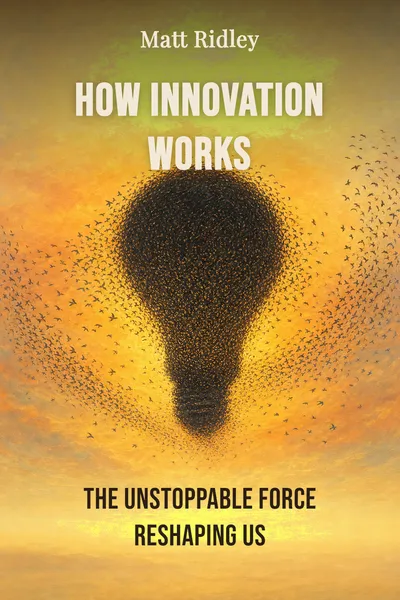
How Innovation Works
The unstoppable force reshaping us
Description
Ask who invented the incandescent light bulb and most of us say Thomas Edison. The honest answer is closer to twenty-one people, working across three continents over several decades, most of whom never met. Edison built a workable version in 1879, but so did Joseph Swan in England, and before both of them a long line of tinkerers had glowed filaments in vacuum tubes and watched them burn out. The light bulb, like almost every innovation Matt Ridley examines, had no single father, no eureka moment, no clean line from idea to object. It emerged, the way a species emerges, from a crowd of small improvements that nobody fully controlled.
This is the puzzle at the heart of How Innovation Works. Innovation is the reason a person alive today lives longer, eats better and travels further than a king did three centuries ago. It is the main event of the modern age. And yet we barely understand it. We can't summon it on command, we can't predict where it will strike, and we consistently credit the wrong heroes. Governments pour money into research and get little back; garages and market stalls produce revolutions nobody forecast. The gap between how much innovation shapes us and how little we grasp it is, for Ridley, the great unexamined story of our time.
His argument runs against the flattering myths. Innovation is not the lone genius, not the lightning strike, not the master plan. It is gradual, collective, and strangely resistant to being ordered into existence — while being, once conditions are right, almost impossible to stop. And it may explain far more about the anxieties of the present than the headlines we usually blame.
The question we’re asking : If no single person invents anything, and no government can order it, how does innovation actually happen — and why does it feel both unstoppable and out of our hands?What we’ll see : We follow Ridley through the tangled real story of how new things come to be, and what it means to live inside a force we can neither predict nor switch off.
Table of contents
01 Chapter 1 — The lightbulb had many fathers
Ridley's book is built from stories, and the first thing the stories dismantle is the myth of the inventor. Take the steam engine. We hand the credit to James Watt, but Thomas Newcomen was pumping water out of mines with steam decades before Watt improved the design, and Watt in turn depended on the ironmaster John Wilkinson's ability to bore a cylinder accurately. Take the jet engine, claimed almost simultaneously by Frank Whittle in Britain and Hans von Ohain in Germany, neither aware of the other. The pattern repeats so reliably that Ridley treats simultaneous invention as the norm, not the exception.
Why does the same idea keep arriving in several heads at once? Because innovation is less a flash of insight than a ripening. When the surrounding technologies and needs are in place, the next step becomes almost obvious, and several people take it together. This is why patent disputes are so bitter and so frequent: the law assumes a single first mover, but reality rarely provides one. The telephone reached the patent office in the hands of Alexander Graham Bell and Elisha Gray on the very same day in 1876.

02 Chapter 2 — Evolution, not revolution
If innovation has no single author, what kind of process is it? Ridley's answer is that it behaves like biological evolution. It proceeds by small variations, most of which fail, a few of which survive because they work slightly better than what came before. There is no designer with a blueprint, only relentless trial and error, selection and recombination. The new is almost always the old rearranged. The shipping container, one of Ridley's favourite examples, invented nothing technically new — it just standardised a metal box — yet it reshaped world trade more profoundly than most laboratories ever have.
This evolutionary character explains why innovation is so gradual and so continuous. Breakthroughs that look sudden in hindsight were, up close, long slopes of incremental gain. The improvement of the steam engine, the mobile phone, the search engine, the solar panel: each got cheaper and better in thousands of tiny steps, following curves so regular that engineers now expect them. Ridley notes that the cost of computing power, of sequencing a genome, of solar electricity, all fell along predictable lines nobody centrally planned.
03 Chapter 3 — The conditions that let it breathe
Ridley is blunt about what innovation needs, and it is not what most institutions assume. It needs freedom — freedom to experiment, to fail, to trade, to combine ideas without asking permission. It thrives where property is reasonably secure, where markets are open, where energy is cheap, and where people are allowed to try things that might not work. It withers under heavy regulation, monopoly, and the precautionary instinct that demands proof of safety before anything new is permitted. The places and periods of fastest innovation, he argues, are those that tolerated the most trial and error.
This puts him at odds with a comfortable story: that innovation flows chiefly from government science funding. Ridley is not against research, but he pushes back on the linear model in which pure science leads to applied technology leads to products. Often the arrow runs backwards — the steam engine came before the science of thermodynamics that explained it, and practical tinkerers frequently reveal what theory then rationalises. Much of the most transformative innovation, he insists, came from commerce and craft, not from grants and laboratories.
04 Chapter 4 — The engine nobody can steer
Step back and Ridley's larger claim comes into focus: innovation is the main event of the modern age, the deep current beneath the surface politics we spend our anxiety on. He is willing to say something provocative here — that the upheavals we attribute to particular leaders or votes are better understood as symptoms of technological and economic change than as its cause. Populist revolts, disrupted industries, dislocated communities: these are, in his reading, the friction of an economy being remade faster than the people inside it can adjust. The headlines name politicians; the engine underneath is innovation.
This is why the book insists on innovation's double face. The same force that has driven living standards up, extended lifespans, and lifted billions out of poverty also churns up livelihoods, hollows out old trades, and unsettles the settled. It is genuinely unstoppable — Ridley calls it inevitable and inexorable once it gets going — precisely because no one is in charge of it. There is no committee to appeal to, no author to blame, no off switch. That is what makes it feel both like progress and like something happening to us rather than by us.
05 Conclusion
Return to the light bulb and its twenty-one fathers. What looked, from a distance, like a single stroke of genius turns out to be a crowd, a queue, a long slow ripening that no one directed and no one could have ordered on schedule. That, for Ridley, is the truth about nearly everything we call an invention. Innovation is gradual, collective, evolutionary, and strangely humble in its origins — the accumulation of small improvements by many hands, most of them forgotten, most of their attempts failed.
Related books