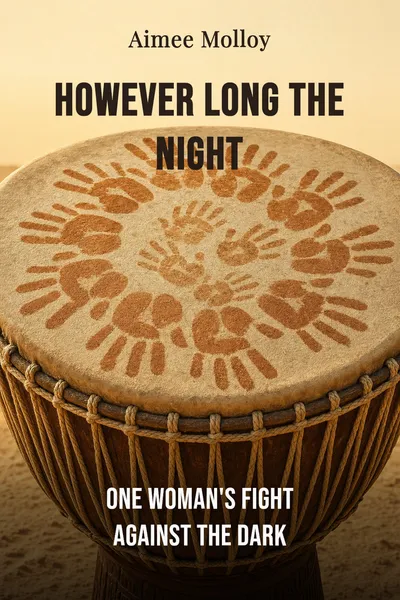
However Long the Night
One woman's fight against the dark
Description
Molly Melching was not supposed to stay. In 1974 she landed in Dakar as an American exchange student, planning to spend a stretch in Senegal and then go home to the Midwest and get on with a normal life. She did not go home. She learned Wolof, then Pulaar, moved into a working-class neighborhood, and over the next decades became something Senegal had almost no category for — a white American woman who thought and argued and joked in local languages, and who came to believe that the received wisdom about how to help was mostly backwards.
Aimee Molloy's book "However Long the Night" tells Melching's story, and through it the story of Tostan, the organization she founded in 1991. The title comes from a proverb Melching loved: however long the night, the dawn will break. What makes the book more than an admiring portrait is the thing Tostan is best known for — persuading thousands of Senegalese villages to abandon female genital cutting, a practice foreign campaigns had spent years condemning to almost no effect. Tostan did it without condemning anyone.
That is the puzzle the book circles. Outsiders arriving with money, moral certainty, and a plan tend to fail, sometimes spectacularly, sometimes while congratulating themselves. Melching's method looked almost like the opposite of a method: slow, in the local language, starting from what villagers themselves said they wanted. And it worked in a domain everyone had written off as immovable. The question is why the quiet approach reached further than the loud one.
The question we’re asking : How did one woman help thousands of villages abandon a centuries-old practice without ever telling them to?What we’ll see : A stranger's long apprenticeship in Senegal, the education program she built, and the way a single village's decision became a movement no one could stop.
Table of contents
01 Chapter 1 — The woman who arrived with nothing to give
Molloy is careful, early on, to strip away the flattering version of the story. Melching did not arrive in Senegal as a savior. She arrived as a student who quickly grew disillusioned with the aid world she saw around her — well-funded, well-meaning, and largely deaf. Foreign organizations flew in experts, drew up programs in French or English, and handed villagers solutions to problems the villagers had not been asked to describe. The results were the familiar ones: abandoned wells, unused clinics, training sessions no one attended twice.
What struck Melching was that the people everyone was trying to help were not consulted about anything. Decisions were made in offices in Dakar and capitals abroad, then delivered as instruction. The assumption underneath was that rural Africans lacked not resources but judgment — that they needed to be told. Melching, who by now spent her days in Wolof among people whose intelligence and humor were obvious to her, found the assumption both insulting and, more practically, the reason so little worked.

02 Chapter 2 — Tostan, and the language of the drums
Tostan means "breakthrough" in Wolof — the moment a chick breaks through its shell, or an idea breaks into understanding. Founded in 1991, the organization built a program unlike the lectures Melching had watched fail. It was a community education course, delivered over months in the village's own language, using the tools the village already used to teach itself: songs, stories, theater, dance, the rhythms of oral culture rather than the grammar of the seminar.
The content started where the participants started. Sessions covered problem-solving, hygiene, literacy, and numeracy — the practical things villagers themselves named as priorities. Human rights came into it, but not as a foreign lecture. The idea of dignity, of a person's right to health and to a voice, was introduced in a way that connected to what people already believed about how they should be treated. Women, who made up much of the class, began to articulate things they had felt but never had permission to say aloud.
03 Chapter 3 — How a village decides to change its mind
The turning point Molloy dwells on happened in the village of Malicounda Bambara. In 1997, the women who had gone through the Tostan program stood up and announced that their community would stop cutting girls. It was the first public declaration of its kind, and it landed like a small earthquake. Some Senegalese saw it as village women overstepping; others saw brave women naming a truth. The women themselves had reached the decision the slow way, through months of discussion among people they trusted.
Then came the obstacle that reveals why the practice had survived so long. A single village abandoning cutting could not simply stop, because cutting was tied to marriage. An uncut girl from Malicounda risked being seen as unmarriageable by families in neighboring villages who still cut. One community acting alone would sacrifice its own daughters' futures to make a moral point. The custom was held in place not by any single person's conviction but by the expectations of everyone around them.
04 Chapter 4 — When change spreads faster than anyone can plan
Step back from the villages and Tostan becomes a case study in how social change actually moves. The dominant instinct — among governments, campaigners, and donors — is that a harmful practice should be met head-on: outlaw it, condemn it, fund a message telling people to stop. Senegal had a law against cutting. The law, on its own, changed little, and in some places drove the practice underground, where it was harder to reach. Prohibition and shame gave people something to defend rather than something to reconsider.
What Molloy's account suggests is that practices like cutting are not held in place by individual belief but by collective expectation. Each family continues because it assumes the others will. Attack the practice from outside and you harden that assumption; every family feels judged and closes ranks. Tostan's method worked on the expectation itself. Once enough neighboring families could see that others were ready to stop, the reason to continue dissolved. The declaration was not the cause of change so much as the proof that it was safe.
05 Conclusion
The proverb that gives the book its title carries the whole argument in a sentence: however long the night, the dawn will break. Melching's night was long — decades of small work, learning languages, sitting in villages, resisting the pull to arrive with answers. The dawn, when it came, did not look like a foreigner's triumph. It looked like Senegalese women standing up in their own villages and Senegalese men walking dusty roads to persuade their neighbors, deciding together that their daughters deserved better.
Related books