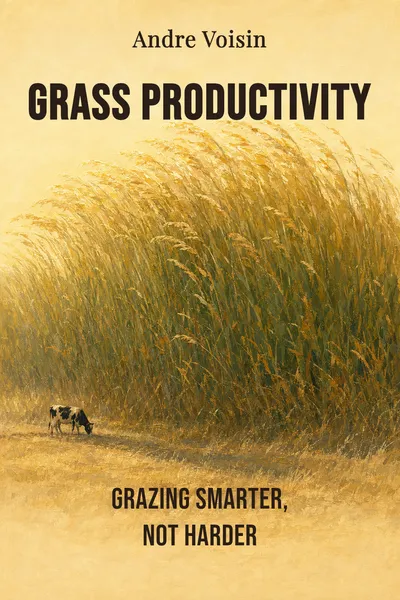
Grass Productivity
Grazing smarter, not harder
Description
In the 1950s, on a farm in Normandy, a biochemist turned cattle farmer named André Voisin started doing something odd. He watched his cows. Not casually — obsessively, notebook in hand, tracking which patches of grass they cropped and which they refused, how long they lingered, what a field looked like eleven days after they had left it versus twenty-one. Voisin had spent his professional life in a laboratory studying nutrition; now he was applying the same patience to a meadow. What he noticed was that a cow, left to roam a large pasture freely, is a surprisingly bad manager of grass. She bites the tender regrowth again and again while ignoring the older, coarser clumps entirely.
That single observation became the seed of a book, published in French in 1957 and translated as Grass Productivity, that quietly reorganized how a lot of the world thinks about pasture. Voisin's claim was almost embarrassingly simple: the grass, not the animal, is the crop being harvested. And a crop harvested at the wrong moment, too often or too soon, yields less and less until the field itself degrades. He called the alternative rational grazing — a system built not on how much land you own but on when the animal is allowed to bite.
What makes the book endure is that it treats a meadow as a working system with its own rhythms, and treats the farmer as someone who can either fight those rhythms or use them. Voisin was not selling effort. He was selling attention to timing — the difference between grazing harder and grazing smarter.
The question we’re asking : If the grass is the real crop, what does it take to harvest it without exhausting the field that grows it?What we’ll see : How one farmer's obsessive watching turned pasture from a backdrop into a managed, measurable system.
Table of contents
01Chapter 1 — The cow that eats standing in her own waste
Set a cow loose in a wide-open pasture and she does not graze evenly. She goes straight for the youngest, sweetest regrowth — the very shoots a plant needs to rebuild itself — and returns to them the moment they poke back up. Meanwhile the tall, aging grass she snubbed keeps growing coarse and unpalatable. Within weeks the field splits into two zones: overgrazed patches worn down to nothing, and neglected clumps nobody will touch. This was Voisin's founding scandal. Free access, which sounds generous, is actually a slow way of ruining a meadow.
The problem compounds because grass regrows on a curve, not a straight line. A plant cut to the ground has almost no leaf left to capture sunlight, so it recovers slowly at first, drawing on its root reserves. Then, once it has rebuilt enough leaf, it surges. Bite it again during that slow early phase and you catch it at its weakest, before it has replenished anything. Do that repeatedly and the roots shrink, the plant weakens, and productivity collapses. The animal that keeps returning to the same tender shoot is, in effect, harvesting the field to death.

02Chapter 2 — The two variables nobody was measuring
Voisin reduced the tangle of pasture management to a pair of durations that most farmers had never separated in their minds. The first is the time of occupation — how long animals stay on a given plot. The second, which he considered far more important, is the time of rest — how long that plot is then left alone before animals come back. His central rule followed directly from how grass regrows: the rest period must be long enough for the plant to complete its surge and rebuild its reserves before it is bitten again.
The trap he warned against was the second bite. If animals stay on a plot too long, they will crop the fresh regrowth on plants they already grazed a few days earlier — catching those plants during their weak recovery phase. So the occupation must be short, short enough that the animal leaves before the earliest-bitten grass has time to offer a tempting new shoot. Voisin put it plainly: the animal should never eat twice, in one occupation, from the same plant.
03Chapter 3 — When the paddock replaces the herdsman
Rational grazing needed a way to enforce the schedule, and the answer was fencing — enough of it to divide a pasture into a series of plots, or paddocks, through which the herd could be rotated. Animals graze one paddock briefly, move on to the next, and by the time they cycle back to the first, the grass has had its full rest. The rotation is not decorative; it is the mechanism that makes short occupation and long rest physically possible on the same piece of ground.
Voisin's timing helped here too. The spread of affordable electric fencing in the mid-twentieth century meant a farmer could subdivide land cheaply and move boundaries as the season demanded — tightening the plots in the spring flush when grass is abundant, widening them when growth slows. The fence became the instrument that translated Voisin's two durations into daily practice. It replaced the constant labor of a herdsman with a structure that did the managing on its own.
04Chapter 4 — The grass we walk past without seeing
Step back from the fences and the regrowth charts, and Voisin's real subject comes into focus. It is not really cows. It is the idea that productivity in a living system is governed by timing rather than by force. The same acre yields more or less depending entirely on when it is asked to give — and asking too often, too early, quietly bankrupts the very capital that produces the yield. Voisin's grass is an argument about how living things recover, and about the discipline of leaving them alone long enough to do it.
This reframes what a farmer actually manages. In Voisin's account, the animal is a harvesting machine and the grass is the crop, but underneath both sits the real asset: the plant's root reserves and the soil that feeds them. Overgrazing is not a matter of the herd eating too much overall; it is a matter of drawing down a reserve faster than it can be rebuilt. Once you see productivity this way, the field stops being a static backdrop and becomes something closer to an account with a balance that can be respected or overdrawn.
05Conclusion
The farmer with the notebook was, in the end, describing a partnership. The cow wants the best mouthful now; the grass needs time to rebuild; and between those two impulses stands a decision about occupation and rest that only the farmer can make. Voisin's rational grazing is simply that decision taken seriously — short bites, long recoveries, a rotation that lets the field catch its breath. What looked like a technique for cattle turned out to be a discipline of attention, tuned to a rhythm the animal cannot see and the calendar cannot fix.
Related books