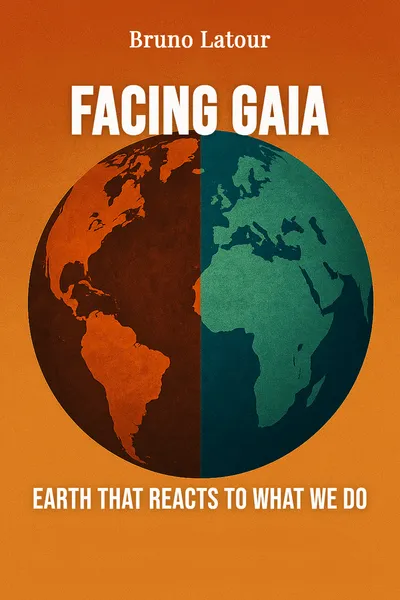
Facing Gaia
Earth that reacts to what we do
Description
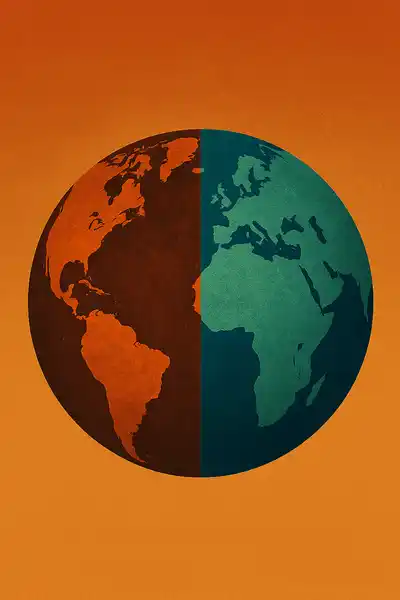
In 1965, a British chemist named James Lovelock was working for NASA on a question that sounds simple: how would you know if there was life on Mars? His answer was to look at the atmosphere. A dead planet settles into chemical equilibrium; a living one stays weirdly, stubbornly out of balance — Earth's air is full of oxygen and methane that should have cancelled each other out long ago. Something keeps topping them up. On the suggestion of the novelist William Golding, Lovelock gave that something a name borrowed from a Greek goddess of the earth: Gaia.
For decades the name carried baggage. It got adopted by people who heard in it a nurturing Mother Earth, a benevolent superorganism watching over her children — and dismissed by scientists who heard mysticism dressed up as biology. Bruno Latour, a French philosopher and sociologist better known for studying how laboratories actually work, spent his later years arguing that both camps had it backwards. In his 2015 book Facing Gaia, drawn from lectures he gave in Edinburgh in 2013, he tried to strip the word of its soft edges and hand it back its teeth.
Latour's wager is unsettling. The planet responding to what we burn, pave and emit is not a mother and not a machine. It is something we have no good vocabulary for — a force we are inside of, that reacts, that keeps no promises. And once we take that seriously, he argues, our oldest habit of thought quietly collapses: the idea that there is a stable stage called Nature on which human history plays out.
The question we’re asking : What are we actually facing when the Earth starts reacting to what we do?What we’ll see : How a strange scientific hypothesis becomes, in Latour's hands, a way of undoing the comfortable idea of nature as a backdrop.
Table of contents
01Chapter 1 — The word that came back to bite us
Latour begins with an admission: Gaia is a terrible name, and he uses it anyway. Terrible because it drags in the goddess, the New Age posters, the whole imagery of a planet that loves us. That reading, he insists, is the exact opposite of what Lovelock's science implies. Gaia is not a being with intentions. There is no maternal will keeping the temperature comfortable so that we can flourish. To hear affection in the word is to miss the point entirely.
Yet the scientific reflex — treat Gaia as one big self-regulating system, a kind of planetary organism with a set point — is, for Latour, just as misleading. That version smuggles in a designer, an engineer, a thermostat someone installed. It makes the Earth sound like a well-built machine that will always return to balance if left alone. And a machine, by definition, has an outside: a maker, a purpose, a plan. Gaia has none of these. There is no blueprint and no one at the controls.

02Chapter 2 — A planet with no thermostat and no goodwill
The most seductive misreading of Gaia is the one that sounds scientific: cybernetics. In this version, the Earth is a feedback system that holds its variables — temperature, oxygen, salinity — within livable limits, the way a heating system holds a room at a chosen degree. It's a comforting image, and Latour spends real effort dismantling it, because he thinks the comfort is where the danger hides. A thermostat has a target. It "wants" the room at twenty degrees. Gaia wants nothing.
The feedback loops are real, but there is no set point they are aiming for. When Earth's regulation shifts, it does not steer back toward a temperature that suits mammals in general and humans in particular. It settles wherever the tangle of interactions happens to settle — and that new state may be perfectly stable and perfectly hostile to us. The great extinctions were not the machine breaking down. They were the machine, if we insist on the word, running exactly as it always does, with no clause protecting any species that happens to be inconvenient.
03Chapter 3 — The Moderns and their two-world trick
To explain why we struggle so badly with all this, Latour turns to a story he had been telling for years about what he calls the Moderns. The founding move of modern thought, he argues, was to split the world in two. On one side, Nature: mute, law-governed, out there, the same for everyone, studied by science. On the other side, Society: values, politics, meaning, the noisy human realm of argument and choice. Two worlds, cleanly separated, each with its own experts.
That split did enormous work. It let us treat facts as settled and beyond debate — gravity does not take sides, chemistry does not vote — while confining conflict to the human arena, where opinions could clash without ever touching the solid ground of Nature underneath. Nature became the ultimate referee: silent, neutral, above the fray. When you wanted to end an argument, you appealed to it. Politics happened on the stage; Nature was the stage, and stages do not talk back.
04Chapter 4 — When the ground itself takes a side
Step back, and Latour's real target comes into view: not climate policy as such, but the very idea of nature as a backdrop — the neutral, silent stage we thought we were performing on. For most of modern history, whatever humans fought over, the physical world stayed put beneath the quarrel, a reliable floor that belonged to no one and answered to no argument. Facing Gaia is the announcement that this floor has become a participant. The scenery has opinions now, in the only sense that matters: it responds, and its responses redraw the terms of every human conflict.
That changes what politics even is. If the Earth is an actor rather than a setting, then it cannot be represented by science alone, handed over to experts who report neutral facts from beyond the human sphere. It has to be brought inside the arena where interests collide, where things are contested and negotiated. Latour speaks, half seriously, of a politics that would have to convene all the parties — including the non-human ones, the rivers and forests and atmospheres now making their weight felt — into the same fraught assembly. There is no outside from which to adjudicate anymore, because the outside has come in.
05Conclusion
Lovelock went looking for life on Mars and, by contrast, found something odd about home: a planet whose air stays out of balance because living things keep meddling with it. Half a century later, Latour picks up that same instability and turns it into a question about how we think. The Earth that keeps its own chemistry off-kilter is the Earth that now answers our carbon with heat, our concrete with floods — reacting, endlessly, to what we throw at it, on no schedule we set and toward no end we chose.
Related books