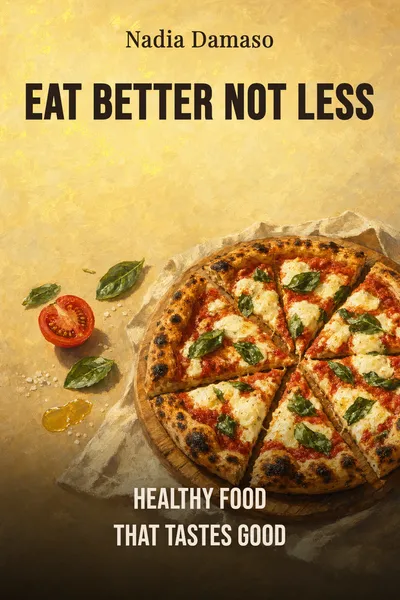
Eat Better Not Less
Healthy food that tastes good
Description
Sometime around 2014, a teenager from the Swiss canton of Graubünden started posting photographs of her breakfasts on Instagram. Nadia Damaso was studying at a hotel-management school, cooking in her family's kitchen, and plating bowls of banana ice cream and overnight oats with a care that felt out of proportion to the audience she had. The audience caught up fast. Within a couple of years the account had hundreds of thousands of followers, and a girl who had not trained as a chef found herself with a publishing deal and a book that would sell well beyond the German-speaking world that first picked it up.
The book was called Eat Better Not Less, and the title carried the whole argument. Damaso had spent her own adolescence inside the usual loop — eating little, feeling deprived, then eating badly, then starting over. What she landed on instead was almost embarrassingly simple. She stopped trying to eat less of everything and started trying to eat better versions of the things she already loved. Not a diet with an end date. A way of cooking she could keep doing on a Tuesday night after a long day, without a personal chef or a shelf of obscure powders.
That premise sounds soft until you cook from it. A recipe book that promises pizza, pasta, burgers and more than twenty desserts, and still calls itself healthy, is making a claim that most diet literature spends its energy denying. Damaso's bet is that the opposition between pleasure and health was never real — that it was a side effect of how we were taught to think about food, and that the kitchen, not willpower, is where it comes apart.
The question we’re asking : Can food be genuinely healthy and genuinely good at the same time, or is one always paid for with the other?What we’ll see : How a self-taught cook turned an Instagram feed into a working philosophy of eating — and what her chocolate, her pizza and her salads are quietly arguing.
Table of contents
01Chapter 1 — A nineteen-year-old who refused to choose
Damaso's starting point is personal, and she does not hide it. As a teenager she loved food and wanted to be healthy, and for a long time she treated those two desires as enemies. She tried eating less, the way most of us are told to, and discovered what restriction reliably produces: hunger, guilt, and the kind of craving that ends with a whole bar of chocolate at eleven at night. The pattern was not a failure of discipline. It was the predictable result of building a relationship with food on the idea of going without.
What changed was not a new rule but a new question. Instead of asking how little she could eat, she began asking how well she could eat — whether the meal in front of her was made of ingredients that left her feeling good an hour later, rather than heavy or hollow. The shift sounds minor on paper. In practice it reorganizes everything, because once the goal is quality rather than scarcity, dessert stops being a transgression and becomes part of the plan.

02Chapter 2 — The carbs and fats nobody told us to keep
The two great villains of popular dieting are carbohydrates and fat, and Damaso refuses to convict either. Her argument is not that they are harmless but that the category is too crude to be useful. Cutting carbs altogether treats a wholegrain bowl and a fistful of candy as the same crime, when the body does very different things with each. The honest move, she argues, is not subtraction but selection — choosing the carbs and fats that actually do something for you.
On the carbohydrate side that means leaning toward the slower, less processed end of the shelf. She cooks with spelt, with wholegrain flours, with oats and couscous and the kind of starch that keeps you full rather than spiking and dropping you within the hour. The point is not that white flour is forbidden; it is that there is usually a version that does the same job in a meal while leaving you better off, and once you know it, reaching for it stops feeling like sacrifice.
03Chapter 3 — Breakfast, dinner, and the salads that earn their place
The proof, in a recipe book, is on the plate, and Damaso starts the day with the dishes that win people over fastest. Banana ice cream — frozen banana blended until it turns to something genuinely creamy — is her signature, a dessert masquerading as breakfast that asks for no added sugar and no apology. Alongside it sits sweet couscous, oats in various guises, and bowls built to look like a treat precisely because, on her terms, they are one. The message of the first meal is set early: this is not the food of someone trying to suffer.
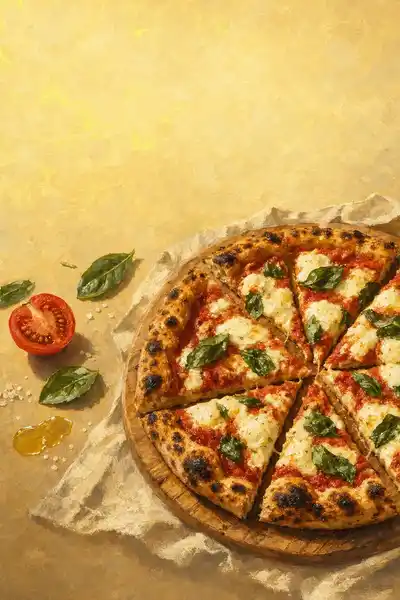
Dinner is where the book makes its boldest case. She does not offer pale substitutes pretending to be the real thing; she offers the real thing, made well. There is proper pizza and spelt tagliatelle, a pulled-chicken burger that holds its own against any pub version. And then, sitting beside them rather than replacing them, the lighter inventions — a cauliflower-crust pizza, salmon tacos — offered as genuine alternatives for the nights you want them, not as a verdict on the nights you don't. The choice is the point. Nothing is banned, so nothing has to be smuggled.
04Chapter 4 — What a recipe book quietly argues about food
Step back from the bowls and the burgers and Damaso's project is making an argument about the culture it grew up inside. She came of age in the era of the cleanse, the elimination diet, the food sorted into clean and dirty, allowed and forbidden. That whole framework runs on subtraction — health as a list of things you no longer get to have. Eat Better Not Less is built on the opposite verb. Its unit is not the thing removed but the thing swapped, the better version chosen in place of the worse one.
The difference matters more than it looks. Subtraction sets up a war between you and your appetite, and appetite, over a long enough timeline, always wins; that is why diets end and the weight returns and the guilt compounds. Substitution sidesteps the war entirely. You are not fighting the desire for pizza, you are answering it with a pizza built on a base that serves you. The craving is honored rather than denied, and a craving that gets honored stops running the show.
05Conclusion
The teenager posting breakfast photographs from a kitchen in Graubünden turned out to be making a more durable point than the format suggested. Eat Better Not Less reads, in the end, less like a diet and more like a settlement between two things people are told to choose between. Damaso loves food and wants to be healthy, and rather than rank one above the other she rebuilt her cooking until the conflict dissolved. The banana ice cream, the spelt tagliatelle, the cauliflower-crust pizza and the twenty-odd desserts are all variations on the same refusal — the refusal to accept that feeling good and eating well are sold separately.
Related books