
Core Archery
Bones over muscle in archery
Description
Watch a nervous archer at full draw and you can usually see the problem before the arrow leaves: the drawing arm quivers, the shoulder creeps up toward the ear, the whole frame is working hard to hold a position it can't quite hold still. Larry Wise, a coach who has spent decades on ranges and in his book Core Archery, starts from a plain observation. Muscles get tired, and tired muscles shake. Bone doesn't. A bone under compression simply holds. So the question he asks is not how to build a stronger shot, but how to build one that asks the muscles to do as little as possible.
That sounds almost lazy, and in a way it is meant to. Wise's whole system is a method for shifting the load off the parts of the body that fatigue and feel, and onto the parts that don't. The forearm, the shoulders, the back, the spine — arranged so the draw weight of the bow travels down a chain of structure rather than being clenched into place by effort. Get the alignment right, he argues, and holding a bow at full draw stops being a feat of endurance and becomes something closer to leaning on a doorframe.
What makes the book more than a posture lecture is how narrowly it defines success, and how ruthlessly it strips the process down to almost nothing. Wise is not interested in giving an archer fifty things to think about on the shooting line. He is interested in giving them two — and in making the second one nearly identical to the first.
The question we’re asking : How do you build an archery shot that holds steady on its own, without muscle doing the shaking?What we’ll see : How a coach rebuilds the shot around the skeleton, and boils the whole discipline down to two deceptively simple steps.
Table of contents
01Chapter 1 — The line the skeleton wants to hold
The premise of Core Archery is almost stubbornly physical. A bow at full draw is pulling back on the archer with real force — often twenty, forty, sixty pounds of it — and something has to resist that pull for the few seconds it takes to aim and release. Wise's argument is that the something should be bone, not muscle, because bone carries a load without tiring and without the small tremors that muscle produces the moment it has to hold a position steadily. The whole book proceeds from this single distinction, and most of its instruction is really about how to get the load onto the skeleton and keep it there.
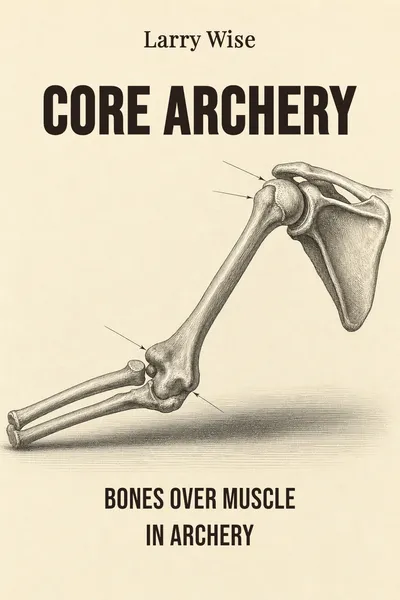
The key alignment Wise keeps returning to is the drawing arm and the shoulders. When the elbow of the drawing arm sits directly in line with the arrow and the string, the force of the bow passes straight through the forearm bones, into the shoulder structure, and across the back — a more or less continuous line of bone and joint. Set up that way, the muscles don't have to grip the position; they mostly guide it. Set up wrong, with the elbow high or the arm collapsed inward, the muscles are suddenly asked to make up the difference, and that is where the shaking starts.

02Chapter 2 — The shot, built from the ground up
Having set the principle, Wise builds the shot as a sequence, and the order matters because each stage sets up the next. It begins at the feet. Stance is where the skeleton first meets the ground, and a balanced, consistent stance gives the whole structure above it something stable to load against. From there he works upward: the posture of the torso, the set of the hips and spine, the position of the head. None of it is decorative. Each element is placed so that when the bow comes to full draw, the force has a clean path down through aligned structure to the floor.
The draw itself he treats as a movement into alignment rather than a haul. The archer raises the bow and pulls the string back not by yanking with the arm but by rotating the drawing-side shoulder blade toward the spine, letting the back muscles bring the elbow into that straight line behind the arrow. When it's done well, the arm feels almost passive — a hook on the string — while the larger, more patient muscles of the back do the positioning and the skeleton does the holding.
03Chapter 3 — Two steps, and only two
The most disarming thing about Core Archery is how few steps Wise thinks the whole endeavor really has. Strip away the detail and, in his framing, there are two. Step one: learn to shoot a ten — a single, perfectly executed shot into the center of the target, with the skeleton aligned, the muscles quiet, the anchor exact, the release clean. Step two: learn to repeat step one. That's it. Everything else in the book is service to those two sentences.
This is not a joke at the reader's expense, though it lands like one at first. It's a way of telling the archer where the real difficulty lives. Producing one good shot is a matter of understanding and setup, and most people can be taught it in an afternoon. Producing the same good shot two hundred times in a row, under fatigue, in wind, in competition, when it matters — that is the actual sport, and it is entirely about repeatability. By splitting the discipline this way, Wise puts almost all the weight on step two and makes clear that mastery is not about new tricks but about erasing variation.
04Chapter 4 — The muscle you never asked to trust
Step back from the arrows for a moment and Core Archery is making a quiet argument about how any fine skill gets reliable. The obvious instinct, when we want to do something well, is to try harder — to grip tighter, concentrate more, add effort. Wise's method points the other way. It treats effort as the enemy of consistency, because the parts of us that generate effort are exactly the parts that vary. His answer is to lean on structures that don't fatigue and don't feel: the bones, the joints, the alignment that holds whether you're calm or falling apart. In archery those structures happen to be literal. In most skills they are the equivalents — the setups, positions, and mechanics that hold steady while attention and willpower come and go.
05Conclusion
Come back to that nervous archer at full draw, the one whose arm was quivering under a weight it was clenching into place. Wise's book is, from start to finish, an argument for why that archer is working too hard and what to do instead. Find the line where the bones stack behind the arrow, let the back rotate the elbow into place, rest the hand rather than grip it, and the bow that felt heavy settles into a structure that holds it for you. The tremor was never a lack of strength. It was strength being used where structure should have been.