
Collision Low Crossers
Inside the Jets machine
Description
In the spring of 2011, a writer named Nicholas Dawidoff walked into the New York Jets' training facility in Florham Park, New Jersey, and more or less never left. Head coach Rex Ryan had agreed to something almost nobody in professional football agrees to: total access, for an entire season, to a world that guards its doors like a state secret. Dawidoff sat in on meetings, slept at training camp, stood on the practice field, rode the team buses, and lingered in the coaches' offices at two in the morning while grown men squinted at video for the thousandth time. He came out with a book, published in 2013, called Collision Low Crossers.
The title is a phrase from the Jets' defensive playbook, a bit of coded shorthand for a certain kind of pass pattern. It sounds like nonsense until someone explains it, and then it sounds like the most important thing in the world. That, in a sentence, is what the year taught Dawidoff. Football from the outside is a Sunday spectacle of collisions and scoreboards. Football from the inside is a language, a set of rituals, a hierarchy of exhausted specialists, and a collective machine that runs on far stranger fuel than winning.
What makes the book endure is that Dawidoff arrived as an outsider and stayed long enough to stop being one. He is, by his own admission, not a football insider — he's a writer who once profiled jazz musicians and ballplayers. So he notices what the initiated no longer see: the private jokes, the fear, the tenderness between men who spend their days rehearsing violence, the sheer volume of unglamorous labor behind a single Sunday afternoon.
The question we’re asking : What does a professional football team actually look like from the inside, once the cameras are off and the outsider is allowed to stay?What we’ll see : A year embedded with the New York Jets, and the strange, funny, stressful machinery of a world most fans only ever watch from the outside.
Table of contents
01Chapter 1 — The stranger who stayed for a year
The premise of Collision Low Crossers is almost absurd in retrospect. Professional football teams are among the most secretive organizations in American life, closer in temperament to intelligence agencies than to entertainment companies. Playbooks are guarded, injuries are lied about, and reporters are handled with a wariness bordering on hostility. And yet Rex Ryan, the Jets' loud and improbably warm head coach, decided to let a writer see all of it. Dawidoff got a desk, a parking spot, and a level of access that would make other franchises break out in hives.
What he did with that access was mostly to shut up and watch. He was there in April 2011 for the draft, when the organization argued for hours over which twenty-two-year-olds to bet its future on. He was there through the lockout that summer, through the grinding heat of training camp, through the season's early promise and its slow, painful unraveling. He learned the names of the equipment managers and the scouts and the assistant coaches nobody outside the building has ever heard of.

02Chapter 2 — A language built to withstand collision
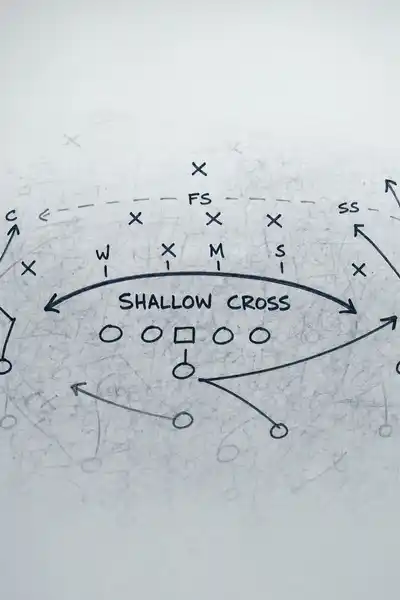
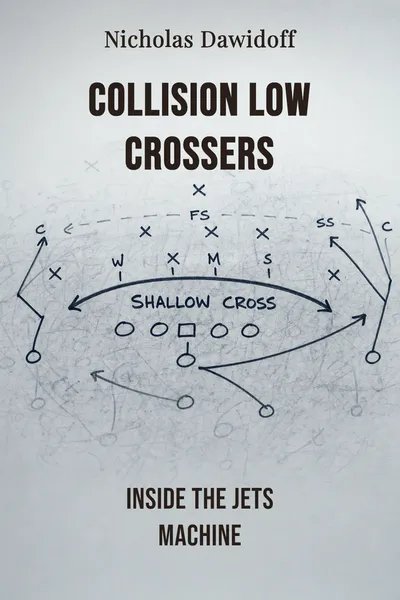
Step into a Jets meeting room and the first thing you notice is that nobody is speaking English, exactly. They're speaking football — a dense private dialect where a single call packs an entire choreography of eleven men into three or four words. The phrase that gives the book its title, collision low crossers, is one such instruction: a defensive directive telling a player to hit a receiver running a shallow crossing route. To an outsider it's gibberish. To a linebacker it's a complete sentence about where to stand, whom to hit, and when.
Dawidoff is alert to this the way a linguist would be, because language is how a football team organizes chaos. A play is a plan, and the plan has to survive contact with eleven opponents trying to destroy it. So the vocabulary is designed for speed and for secrecy at once — it has to be barked at the line of scrimmage in the two seconds before violence, and it has to mean nothing to the men on the other side listening for clues. The result is a tongue that has to be learned like any other, with its own grammar, its own idioms, its own regional dialects that shift from coach to coach.
03Chapter 3 — The men who never stopped watching film
If Collision Low Crossers has a beating heart, it's the coaches' offices late at night, lit by the flicker of game video played and replayed. Dawidoff came to understand that the actual work of professional football is not the games. It's the preparation — the staggering, obsessive, sleep-destroying labor of watching film, breaking down opponents, drawing up plans, and teaching them to players who then have to execute under fire. The Sunday game is only the exam. The week is the whole education.
He spends much of the book with the defensive assistants, especially Mike Pettine, the coordinator whose relationship with Ryan is one of the book's richest threads — collaborative, competitive, occasionally strained by the pressure of losing. These are men who arrive before dawn and leave near midnight for months on end, whose marriages and children exist in the margins, who measure their lives in third-down conversions. The culture rewards this monastic devotion and quietly punishes anyone who won't offer it. Sleeping in the office is not a sign of dysfunction here. It's a badge.
04Chapter 4 — What a football team really runs on
Strip away the shoulder pads and Collision Low Crossers becomes a study of how any large, high-stakes collective actually works — and how badly the myths we tell about such things miss the truth. The popular story of sports is a story of heroes: the quarterback who wills his team to victory, the coach whose genius decides games. Dawidoff's year inside the Jets is a patient dismantling of that story. What he finds instead is an organization, in the fullest sense, held together by hierarchy, specialization, and an enormous quantity of unglamorous shared labor.
The comparisons the book invites are telling. It has the tribal texture of Friday Night Lights, the data-and-judgment tension of Moneyball, and — surprisingly often — the mundane comedy of The Office. That last resemblance is the one people don't expect. A football facility is a workplace, with all the workplace's petty politics, cramped rooms, bad coffee, and gallows humor. The men in it are colleagues before they are gladiators, and much of their day is meetings, evaluations, and managing one another's egos. The violence of Sunday is real, but it sits atop a foundation of ordinary institutional life.
05Conclusion
The season Dawidoff chronicled did not end in glory. The 2011 Jets, expected to contend, missed the playoffs, and the building he'd come to know so well settled into the particular gloom of an organization that had fallen short. He left Florham Park the way he'd arrived — an outsider by profession — but carrying a year's worth of a language, a culture, and a set of faces the cameras never bother to find.