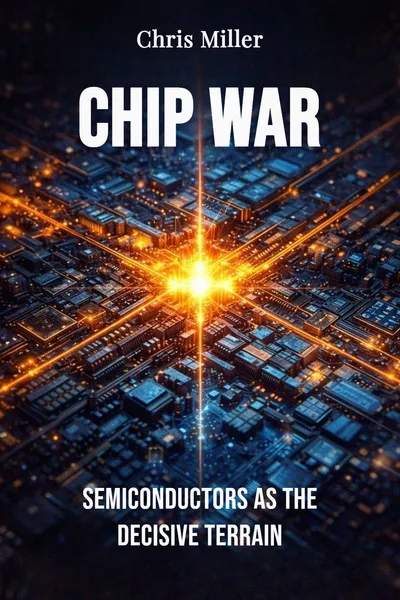
Chip War
Semiconductors as the decisive terrain
Description
In the late 1950s, at a young company in Dallas called Texas Instruments, an engineer named Jack Kilby stayed at his desk through the summer while his colleagues took vacation. He was new, he had no leave, and he used the quiet to solve a problem that had been slowing the whole electronics business: too many wires, too many soldered joints, too many parts that failed. In September 1958 he demonstrated a circuit built onto a single piece of semiconductor material. A few months later, in California, Robert Noyce arrived at a cleaner version of the same idea. The integrated circuit was born, and with it a way to fit an entire century's worth of computing onto slivers of silicon.
That invention is the starting point of Chris Miller's Chip War, but the book is not really a history of technology. It is a history of power. Miller, an economic historian, tracks how the tiny transistor became the most strategic object of the modern age — the thing that guides missiles, trains artificial intelligence, runs financial markets, and, increasingly, decides which countries get to lead the next few decades. The device that started as a Cold War advantage for the United States has become a global supply chain so tangled, and so concentrated, that a single factory outage can ripple through every industry on earth.
Miller's argument is that we have quietly built the whole world on a substance almost nobody thinks about, and that the map of who makes the best chips — and who cannot — now shapes the balance between great powers as directly as oil once did. The competition is no longer only commercial. It runs through export controls, sanctions, and the fate of one island off the coast of China.
The question we’re asking : Why has the semiconductor become the terrain on which the twenty-first century's rivalries are being fought — and where is that terrain most dangerously narrow?What we’ll see : How a Cold War invention became the world's most concentrated dependency, and why the fight over it now points at a single island.
Table of contents
01Chapter 1 — The engineers who miniaturized the century
Miller opens with the people who made the transistor small enough to matter. The integrated circuit that Kilby and Noyce arrived at in 1958 and 1959 was clever, but it was also expensive and, at first, without an obvious customer. What rescued it was the American government's appetite for miniaturization. The Apollo program and the Minuteman missiles needed guidance computers that were light and reliable, and integrated circuits were the only way to get there. In the early 1960s, NASA and the military bought nearly the entire output of the young chip industry, funding it into existence.
The commercial logic came next, and it came with a name. In 1965, Gordon Moore — Noyce's colleague, later co-founder of Intel — noticed that the number of components you could pack onto a chip was doubling at a steady pace, and predicted it would keep doing so. Moore's Law was less a law of physics than a promise the industry made to itself and then spent sixty years keeping. Each generation of chips would be roughly twice as capable as the last, at similar cost. That relentless doubling is why the phone in a pocket now outmuscles the computers that ran Apollo.

02Chapter 2 — How chipmaking left America and settled in Asia
The second movement of Miller's story is a geographic one. The United States invented the chip, but it did not keep making all of it. From the late 1960s onward, American firms began shipping the labor-intensive step of assembly to Asia — first to Hong Kong, then Taiwan, Singapore, South Korea. Wages were lower, governments were eager, and the work of packaging chips did not require the deepest technology. It was, at the start, a cost decision. Over decades it became something much larger.
Miller pays close attention to how governments treated chips as a matter of national strategy rather than ordinary commerce. Japan, in the 1970s and 1980s, poured coordinated state and corporate effort into memory chips and briefly overtook the Americans, badly frightening Silicon Valley and Washington. South Korea, led by Samsung, did the same a generation later. These were not free markets left to their own devices; they were industrial policy on a national scale, with governments betting that mastering semiconductors would lift an entire economy.
03Chapter 3 — The choke points that turned silicon into leverage
Once the supply chain had scattered across the globe, Miller shows, it revealed a set of choke points — narrow steps where a handful of firms, or sometimes just one, held indispensable capability. Whoever controlled a choke point controlled far more than a market share. They held a lever over everyone downstream. This is the insight that turns Chip War from industrial history into geopolitics.
The clearest example is lithography, the process of etching circuit patterns onto silicon with light. The most advanced technique, extreme ultraviolet lithography, is made by exactly one company in the world: ASML, in the Netherlands. Each machine costs well over a hundred million dollars, contains hundreds of thousands of parts, and took decades of collaboration across several countries to perfect. Without ASML's machines, the leading-edge chips of the last few years simply cannot be built. That single dependency gives whoever can influence ASML enormous strategic reach.
04Chapter 4 — One island, and the world's most concentrated risk
Step back from the machinery and the export controls, and Miller's argument narrows to a single, uncomfortable fact. The most advanced chips on earth — the ones inside the newest phones, data centers, and weapons — are manufactured almost entirely on one island: Taiwan. TSMC alone produces the overwhelming majority of the world's leading-edge processors. No other facility, in any other country, can currently match what its fabs do. The global economy's most valuable products all pass, at some point, through a stretch of coastline that another government claims as its own.
This is what Miller means by the chip war being fought on decisive terrain. Taiwan is not merely a supplier; it is a single point of failure for modern civilization. A blockade, an earthquake, a conflict across the strait — any serious disruption to Taiwanese fabrication would not just raise prices. It would halt the production of cars, servers, medical devices, and defense systems worldwide, because there is no ready substitute. The dependency is so total that some have called it a form of mutual deterrence: China needs those chips too, and a war that destroyed the fabs would ruin everyone.
05Conclusion
The line runs, in Miller's telling, straight from Jack Kilby's summer at his desk in Dallas to the fabs on the western edge of Taiwan. What began as a way to eliminate a few wires became the substance on which computing, commerce, and modern weaponry all rest. Each step along the way was made for ordinary reasons — cost, efficiency, the pursuit of the next doubling promised by Moore's Law — and each step carried the industry further from any single country's control and closer to the choke points that now define global power.
Related books