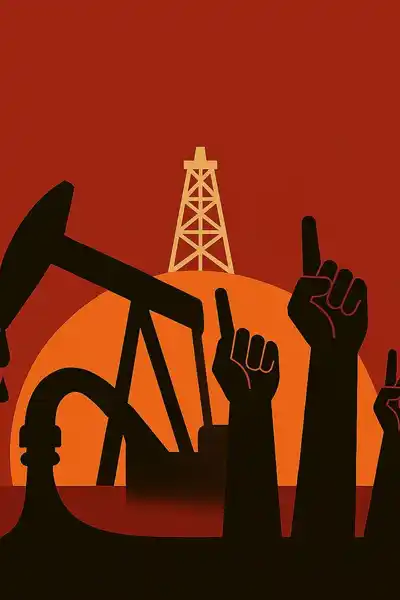
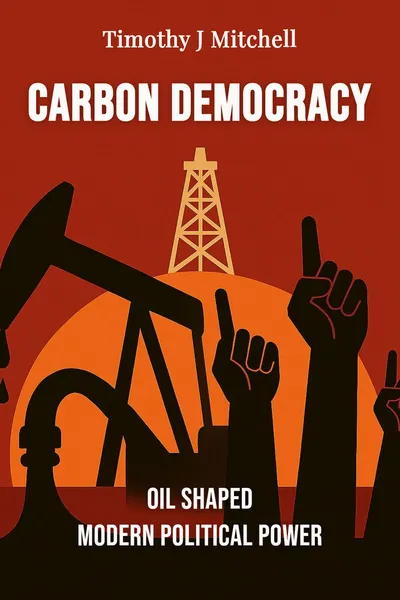
Carbon Democracy
Oil shaped modern political power
Description
Somewhere between the 1880s and the 1920s, the industrial world learned to strike. Coal miners in Britain, Germany, the United States and France discovered that a few thousand of them, stopping work at the right seam, could freeze an entire economy in place. Trains stopped, furnaces cooled, cities went dark. Out of that leverage came something new: the eight-hour day, the vote for working men, unemployment insurance, the mass party. We tend to file all of this under the heading of ideas — the spread of liberalism, the growth of solidarity, the slow triumph of reason. The political scientist Timothy Mitchell asks a colder question. What if it was the coal?
His book, Carbon Democracy, published in 2011, refuses to treat energy as mere backdrop. Mitchell argues that the fuels a society runs on shape the kind of politics it can have — not through metaphor, but through the physical geography of how the stuff is dug, carried and burned. Coal, concentrated and dependent on human muscle at every chokepoint, handed ordinary workers a power they had never held. Oil, liquid and pumped through pipelines, quietly took much of that power back.
It is an unsettling claim, because it cuts against the story democracies like to tell about themselves. We prefer to believe our rights were won by argument and courage alone. Mitchell does not deny the courage. He insists we also look at the pipes, the ports and the pumping stations — the unglamorous plumbing of energy that decides which demands can be made to stick, and which quietly become impossible.
The question we’re asking : Did the fuels of the modern world help build democracy — and then help hollow it out?What we’ll see : How the physical life of coal and oil reshaped what ordinary people could demand of power, and why that story reaches all the way to the climate.
Table of contents
01Chapter 1 — The energy nobody voted for
Start with the thing itself. For most of human history, societies ran on flows of energy they could not store or concentrate — sun, wind, water, wood, the labor of animals and people. These are diffuse. You cannot easily pile them up, and no small group of workers stands astride their supply. Then came coal, and with it a genuinely new arrangement: enormous quantities of stored energy, buried in a handful of seams, that had to be cut out by hand and moved along narrow, fragile routes to the surface and onward by rail and canal.
Mitchell's move is to take that geography seriously as politics. Coal did not just power factories. It created a set of bottlenecks — the pithead, the railway junction, the dock — where relatively few people controlled the passage of the entire system's fuel. A society that ran on coal was a society threaded with points where work could be stopped, and stopping the work stopped everything downstream.

02Chapter 2 — What coal made possible
Between roughly 1880 and 1930, the industrial democracies granted concessions that, a generation earlier, would have looked unthinkable. The franchise widened. Working hours were capped. Trade unions won legal recognition. The first pieces of what became the welfare state were assembled — pensions, insurance against illness and unemployment. Mitchell reads this wave not as the pure fruit of moral progress but as bargains struck under the shadow of the strike.
The point is not that miners were nobler than anyone else. It is that they were positioned. A strike in the coalfields, or a sympathetic walkout on the railways, could bring a national economy to a standstill within days. Governments and industrialists learned to negotiate rather than simply repress, because repression risked cutting off the fuel that kept armies, factories and cities running. The threat did not need to be carried out often; its mere credibility reshaped what employers offered before they were forced to.
03Chapter 3 — Oil breaks the circuit
Oil arrived and dissolved the choke-points. Where coal had to be hacked out by crews of miners, oil could be brought up under its own pressure by comparatively few workers. Where coal moved along rails that men could occupy and block, oil flowed through pipelines that ran underground and around trouble, and later across oceans in tankers. The whole system was designed, Mitchell notes, to reduce its dependence on any single group of laborers who might stop it.
This was not always a conscious plot, but it had a consistent effect. The geography of oil scattered the workforce and thinned out the bottlenecks. A pipeline can be rerouted; a tanker can sail from a different port; production can be shifted between fields on different continents. The kind of leverage that let coal miners freeze an economy became far harder to assemble. The physical basis of the mass strike quietly eroded.
04Chapter 4 — The politics we can no longer picture
Step back and the argument sharpens into something larger than a history of fuel. Mitchell is claiming that energy is part of the constitution of a political order — not written down, but decisive all the same. The way a society produces and moves its power sets the outer limits of what can be demanded of it. Coal made certain demands enforceable and so made a certain democracy thinkable. Oil rearranged the plumbing, and a whole repertoire of political action lost its grip, without any law being repealed.
This reframes debates we usually keep in separate rooms. Economists treat oil as a commodity whose price rises and falls. Mitchell treats it as a form of government by other means — a way of organizing what people can and cannot do to one another through the medium of fuel. The much-discussed idea that oil wealth corrupts politics, the so-called resource curse, becomes for him less a matter of bad luck than of how the physical stuff of oil resists the kind of collective pressure that coal invited.
05Conclusion
Return to the miners who learned to strike. Their power came from a fuel that had to pass through their hands, and it built much of what we still recognize as democratic life — the vote, the weekend, the safety net. Mitchell's account does not sentimentalize them; it locates their strength in the pipes and seams and rails around them. Change that infrastructure, as oil did, and the strength quietly migrates elsewhere, into companies, pipelines and distant fields where no picket line can reach.
Related books