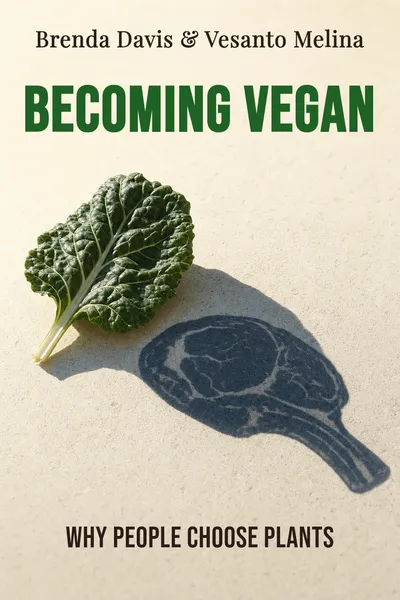
Becoming Vegan
Why people choose plants
Description
The word is younger than most people assume. In November 1944, a small group in England, led by a woodworker named Donald Watson, broke away from the vegetarian movement and coined a new term for people who ate no animal products at all — no meat, no fish, no eggs, no milk, no cheese. They shortened "vegetarian" to its first three and last two letters and got vegan. Before that, there was no single word for it. The practice existed; the label didn't.
Eighty years later, the label is everywhere, and the numbers behind it have shifted from a fringe curiosity to something food companies plan around. What began as a small ethical stance has become a diet that dietitians study, athletes adopt, and supermarkets stock a whole aisle for. And yet a lot of confusion travels with it. Is a diet without eggs or dairy actually good for the body, or a nutritional gamble dressed up as virtue? Do people go vegan for their health, for animals, for the planet — and does the reason change what ends up on the plate?
In Becoming Vegan, the dietitians Brenda Davis and Vesanto Melina take the question seriously from both ends: what the science says about eating entirely from plants, and what actually pushes a person to make the switch. They are sympathetic to the choice but unsentimental about it — a vegan diet, in their telling, is neither automatically healthy nor automatically risky. It depends on how it's built.
The question we’re asking : Why do a growing number of people choose to eat entirely from plants — and does the choice hold up when you look at what it does to the body?What we’ll see : How the practice got its name, what leaving out animal products does inside the body, the very different motives that lead people there, and why the diet has to be designed rather than simply adopted.
Table of contents
01Chapter 1 — The word arrived late, the practice arrived early
Eating without animal products is far older than the vocabulary we use for it. Long before Donald Watson's group met in 1944, communities across the world had eaten close to entirely from plants — some for religious reasons, some out of necessity, some because meat was simply scarce. Vegetarianism as an organized Western movement dates to the nineteenth century; the Vegetarian Society formed in England in 1847. But those early vegetarians still ate eggs and drank milk. The people who wanted to leave those out too had no name of their own, and no organization that spoke for them.
Davis and Melina locate the modern turn in that 1944 split. Watson and his colleagues argued that if the ethical case against killing animals for meat held, it should extend to the industries that produced eggs and dairy — which, they pointed out, involved culling and slaughter of their own. The new word carried a claim inside it: that the line most vegetarians drew was arbitrary. The Vegan Society they founded was tiny, a few dozen members, publishing a modest newsletter. For decades it stayed marginal.

02Chapter 2 — What the plate does inside the body
The heart of the book is the physiology — what happens when the food comes entirely from plants. Here Davis and Melina are at their most measured. A well-planned vegan diet, they argue, is associated with real and repeatable benefits: lower rates of heart disease, lower blood pressure, better cholesterol profiles, a reduced risk of type 2 diabetes, and lower body weight on average. These aren't marketing claims; they track with a large body of nutritional research on populations that eat mostly or entirely from plants.
The mechanisms are unglamorous but clear. Plant foods carry no dietary cholesterol and little saturated fat, while delivering fiber, which most omnivorous diets fall short on. Fiber slows digestion, feeds gut bacteria, and helps regulate blood sugar and cholesterol. Fruits, vegetables, legumes, and whole grains come packed with the antioxidants and phytochemicals that a diet built around animal products tends to under-supply. The effect isn't magic — it's the cumulative result of what's present and what's absent.
03Chapter 3 — The reasons that don't fit on a plate
If the physiology explains what the diet does, it doesn't explain why anyone bothers — and Davis and Melina spend real time on the motives, because they shape everything that follows. People arrive at veganism from at least three distinct directions, and the direction often predicts how they eat once they get there.
The first is ethical, the oldest strand and the one the word was coined to carry. For this group the argument is about animals: the suffering of industrial farming, and the claim that eggs and dairy are entangled with slaughter rather than exempt from it. The authors treat this seriously without turning the book into a manifesto. An ethical vegan, they note, tends to be all-or-nothing — the commitment is a line drawn on principle, not a health experiment to be adjusted.
04Chapter 4 — A diet that only works if it's built
Step back from the individual reasons and a larger point about veganism comes into view — one that separates it from almost every diet a person inherits. Most eating patterns are absorbed rather than chosen. You eat what your family ate, what your region grows, what's on the shelf, and the nutrition sorts itself out through variety and accident. Veganism can't rely on that. By removing whole categories of food that human diets have leaned on for millennia, it forces the eater to become, in a small way, the designer of their own nutrition.
This is the through-line of Becoming Vegan, and it explains the book's dual character — half science, half practical manual. Davis and Melina keep returning to the same structural fact: the vegan diet is not a subtraction that leaves everything else intact. Take out the animal products and you take out a set of nutrients that came bundled with them, and something deliberate has to move into that space. B12 has to be supplemented. Iron and zinc have to be sought. The plate has to be planned rather than assembled by habit.
05Conclusion
Donald Watson's small society coined a word in 1944 for a practice that had no name and, at the time, little scientific backing. Eighty years on, the word has gone mainstream while the knowledge behind it has struggled to catch up — which is exactly the gap Davis and Melina write into. Their answer to why people choose plants is layered: for animals, for the planet, for their own bodies, and often for some mix of the three. But their more durable contribution is the reminder that the reason shapes the result, and that no reason, however sincere, feeds a body on its own.
Related books