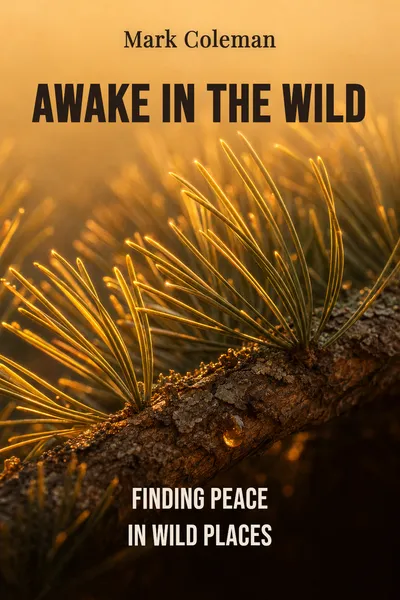
Awake in the Wild
Finding peace in wild places
Description
Somewhere on a mountainside in the Sierra Nevada, a meditation teacher named Mark Coleman sits with a group of students who have spent the morning walking in silence. They are not doing anything, in the productive sense. They are watching light move through pine needles, listening to wind change the sound of the trees, feeling the ground hold them up. Coleman has led hundreds of these retreats over the years, and the pattern is familiar: people arrive tense, sleepless, mentally elsewhere, and after a few days something in them settles. He calls it coming home. What interests him is that home, in this case, is not a place they've never been. It's a place they left without noticing.
Coleman's argument, laid out across the short chapters of Awake in the Wild, is that most of us live at a strange distance from the living world. We might love a good view, we might hike on weekends, but we treat nature the way we treat a screensaver — pleasant, background, watched rather than entered. He draws on a phrase that had begun circulating in the early 2000s, "nature deficit disorder," to name a hunger we can't quite locate. And he pairs it with something older: the contemplative traditions of Buddhism, which spent centuries teaching people to pay attention on purpose.
The book is less a manifesto than an invitation. Each chapter offers a small, concrete meditation — attuning to sound, walking with the earth, weathering a literal storm — grounded in retreat anecdotes, Buddhist teaching, and the nature writing of people like Thoreau and Mary Oliver. What holds it together is a single conviction: that the split we feel between ourselves and the wild is not permanent, and closing it changes more than our mood.
The question we’re asking : What does it actually mean to reconnect with nature, and why does an ancient contemplative tradition turn out to be the tool for it?What we’ll see : How a meditation teacher folds Buddhist attention into pine forests, rivers and storms to close a distance we barely knew we'd opened.
Table of contents
01Chapter 1 — The disorder nobody diagnosed
Coleman begins with a condition that has no entry in any medical manual. "Nature deficit disorder" is a term the writer Richard Louv popularized in his 2005 book Last Child in the Woods, and it describes something most of us recognize even if we've never named it: a low-grade alienation that comes from spending our lives indoors, indexed to screens, moving through built environments that keep the weather and the seasons at arm's length. We are, statistically, an indoor species now. The average person in a wealthy country spends the overwhelming majority of their hours inside, and the wild has become somewhere we visit, not somewhere we are.
The cost, Coleman argues, is quieter than a diagnosis but just as real. There's a restlessness, a sense of being cut off from something we can't quite name, an urban loneliness that persists even in crowded cities. He isn't romantic about it — he doesn't claim a walk in the woods fixes everything. What he claims is subtler: that the disconnection is learned, and therefore can be unlearned. We were not born strangers to the earth. We became strangers gradually, one convenience at a time.

02Chapter 2 — Meditation with the shoes off
What does a nature meditation actually look like, stripped of jargon? In Coleman's hands it is almost embarrassingly simple. You go outside. You stop moving. You let your senses open — not toward a goal, not to identify the bird or photograph the light, but simply to receive whatever arrives. He describes sitting beside a river until the boundary between the sound of the water and his own thinking begins to blur. He describes walking so slowly that each footfall becomes an event, the pressure of earth against skin a small revelation.
The Buddhist frame here is mindfulness, but Coleman is careful to keep it from becoming another self-improvement project. The point is not to achieve calm the way one achieves a fitness goal. The point is to notice that calm is already available, buried under what he calls the inner noise — the running commentary, the planning, the low anxiety we carry into every setting including beautiful ones. A meadow does nothing to earn our peace. It simply doesn't add to the noise, and in that silence we can hear how much of the racket was ours all along.
03Chapter 3 — The animal we forgot we were
One of the book's recurring chapters invites the reader to "free the animal within," and it means this more literally than it first sounds. Coleman's point is that we habitually place ourselves above nature — observers of it, managers of it, occasionally visitors to it, but never quite members. Buddhism has a long history of puncturing that separateness, and the wild does it too, more bluntly. Cold reminds the body it is a body. Hunger, fatigue, the animal alertness that comes from being somewhere without walls: these strip away the story that we are minds temporarily housed in flesh.
Coleman tells of retreats where the ordinary hierarchy simply falls away. Sleeping on the ground, waking with the light, eating simply, people rediscover rhythms their ancestors lived by and their calendars have overwritten. He calls this reflecting the rhythms of nature — the recognition that we, too, have seasons, tides, cycles of energy and rest that industrial time flattens into a uniform grind. To feel oneself as a creature among creatures is not a demotion. In his account it is a relief, the setting down of an exhausting pretense.
04Chapter 4 — A love that looks like activism
Step back from the individual practices and a larger claim comes into view — one that separates Coleman's book from the wider self-care shelf it might otherwise sit on. He argues that cultivating a loving connection to the earth is itself a form of environmental activism. This is a bolder idea than it appears, because it refuses the usual split between inner work and outer action, between meditating quietly and doing something about the state of the world.
The logic runs like this. We protect what we love, and we love what we know intimately. Abstract concern for "the environment" is thin and easily exhausted; it competes with a hundred other headlines. But a felt, embodied relationship with a particular river, a particular stand of trees, the particular weather of a place you have actually sat still inside — that is not abstract, and it does not exhaust so easily. Coleman's wager is that the person who has genuinely reconnected with nature will not need to be argued into caring for it. The caring becomes structural, a matter of relationship rather than obligation.
05Conclusion
The image the book keeps returning to is the one it opens with: people arriving frayed and leaving settled, having done nothing but pay attention to a place. Coleman's claim throughout is that this is not a trick of scenery or a vacation effect that evaporates on the drive home. It is the recovery of a capacity we always had and mostly stopped using — the ability to be present to the world that is already holding us up. The Buddhist tradition supplies the method; the wild supplies the teacher; the reader supplies only the willingness to slow down and go outside.
Related books