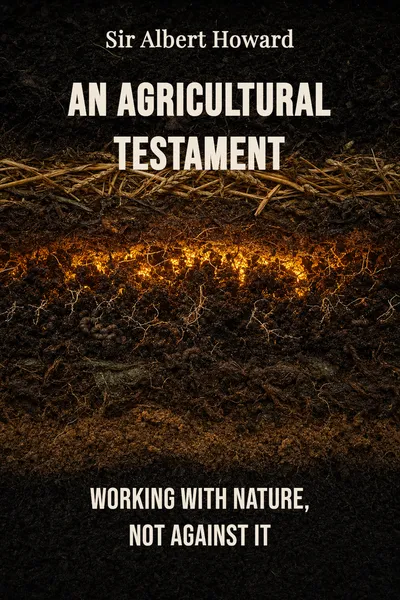
An Agricultural Testament
Working with nature, not against it
Description
In the 1920s, on a research farm at Indore in central India, a British agricultural scientist named Albert Howard was doing something his colleagues found faintly embarrassing. He was building heaps. Layered mixtures of crop waste, animal dung, urine-soaked earth and leaves, turned and watered on a schedule, left to rot into a dark, sweet-smelling crumb he called humus. Howard had been sent East to teach Indian farmers modern Western methods. Instead, watching their fields and their oxen, he began to suspect the traffic ran the other way — that the peasants working small plots without a gram of imported fertilizer had understood something his own science had mislaid.
Howard had impeccable credentials: Cambridge, the Imperial Department of Agriculture, decades of fieldwork. He could have spent his career refining chemical inputs, the great promise of the age. Nitrogen, phosphorus, potassium — feed the plant three elements and yields would climb. And they did climb, for a while. But Howard kept noticing what the ledgers ignored: soils that went dead, crops that fell to disease, livestock that sickened on the produce of exhausted land. The gains looked like profit and behaved like borrowing.
In 1940 he set it all down in a book, An Agricultural Testament — a testament in the old sense, a thing left behind by someone convinced he has seen a truth others are about to lose. It reads less like a manual than a long argument with the direction farming had taken, and a patient case for turning around before the ground gave out beneath everyone standing on it.
The question we’re asking : What did a lifetime of watching soil teach Howard that the chemistry of his era had stopped seeing?What we’ll see : How one heretical scientist rebuilt farming from the ground up — starting with what happens beneath our feet.
Table of contents
01Chapter 1 — The Indore heap and the making of a heretic
Howard arrived in India in 1905 as an Imperial economic botanist, carrying the confidence of a discipline that believed it had cracked the code of growth. The plan was simple: measure, isolate, improve. Apply the findings of the laboratory to the field and watch the numbers rise. What unsettled him was the field itself. The Indian cultivators he was meant to instruct grew healthy crops year after year on land that had been farmed for centuries, and they did it by returning everything the soil gave up — straw, waste, dung, leaf — back to the ground.
He also kept oxen, and he watched them closely. His animals, fed on crops grown in properly composted soil, resisted the diseases that ravaged neighbouring herds, even when he deliberately exposed them to infection. That observation stayed with him. It suggested that health was not something you injected or sprayed; it was something the whole system either had or lacked, running from the soil through the plant into the animal that ate it. Break the chain anywhere and the weakness showed up somewhere down the line.

02Chapter 2 — Nature farms without a chemist
The argument at the centre of the book begins with an observation so plain it is easy to walk past. Nature has been growing things, in forests and grasslands and prairies, for a very long time, and she has done it without anyone spreading superphosphate. How? Howard's answer was that nature never grows a single crop, never leaves the ground bare, never removes without returning. A forest floor is a slow, continuous manufacture of humus: leaves and animals fall, decay, and feed the next generation of roots. Growth and decay are two halves of one wheel that never stops turning.
This is what Howard called the Law of Return, and he treated it as the first principle of all sound farming. Whatever the soil yields must eventually go back to it. The peasant who composts his straw and dung is obeying that law; the industrial farmer who ships his harvest to distant cities and replaces the loss with a bag of chemicals is breaking it — draining the account and topping it up with a substitute that does not restore what was taken.
03Chapter 3 — The soil as a living organism
The move that makes the book still worth reading is Howard's insistence that soil is not a mineral medium but a living thing. Fertile earth, in his account, is dense with organisms — bacteria, and above all fungi whose fine threads weave into plant roots in a relationship he considered the master key to the whole system. This root partnership, the mycorrhizal association, was for Howard the bridge by which humus became nourishment. A soil rich in humus supported it; a soil dosed with soluble chemicals and stripped of organic matter starved it out.
Health, then, was not the absence of disease but the presence of this living fertility. Howard came to distrust the entire apparatus of specialists — the plant pathologists, the entomologists, the breeders of resistant varieties — not because their work was false but because it was busy treating symptoms. Spray the fungus, kill the insect, engineer the immune strain: each intervention accepted the sick soil as a given and fought its consequences. Howard wanted to make the soil well and let health rise from there. Disease, he liked to say, was nature's censor, marking out the badly farmed.
04Chapter 4 — What the wheel of life asks of us
Strip Howard's book to its spine and what remains is a single reversal of stance. Conventional farming, as he found it, treated the land as a stock to be drawn down — a deposit of fertility you mine until it is gone, propping up the shortfall with inputs bought from elsewhere. Howard asked instead that we treat the land as a partner in a cycle we did not invent and cannot escape. The difference is not merely technical. It is the difference between extraction and participation, between spending a thing and tending it.
That reframing carries further than the field. If soil, plant, animal and human are links in one chain of nourishment, then the quality of a nation's food and the health of its people are not separate questions from the state of its ground. Howard drew the line without flinching: exhausted soil produces feeble crops, which feed feeble livestock and feeble people, and no amount of medicine downstream repairs a failure that begins in the earth. Health, in his telling, is indivisible.
05Conclusion
We began at a compost heap in Indore, an image that struck Howard's peers as beneath the dignity of science. By the time he wrote his testament, that heap had become the emblem of an entire way of seeing. Feed the soil, not the plant; return what you take; measure a farm not by this year's tonnage but by whether it can still grow food in a hundred years. The dark crumb of humus was, for Howard, the visible proof that decay and growth are one motion, and that a farmer's real work is to keep it going.
Related books