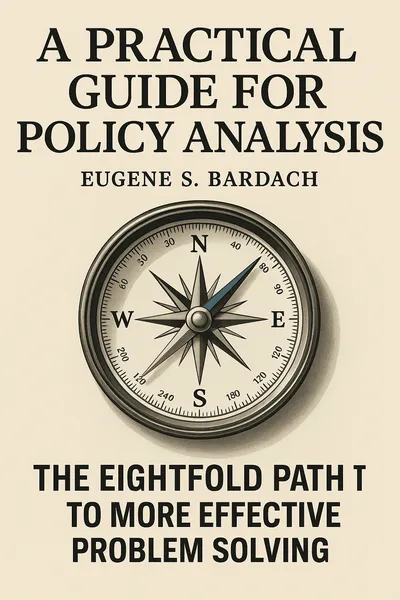
A Practical Guide for Policy Analysis
When theory meets messy reality
Description
Eugene Bardach's "A Practical Guide for Policy Analysis" presents a methodological framework designed to demystify policy analysis for practitioners and students alike. Drawing from his extensive experience in policy education and governmental consulting, Bardach addresses the persistent gap between theoretical policy studies and the practical demands of governmental decision-making. The work emerges within the broader context of New Public Management reforms, where evidence-based policy-making has become increasingly valorized yet remains elusive in practice.
The central research question asks: How can policy analysis be transformed from an abstract academic exercise into a systematic, actionable methodology for governmental decision-making? Bardach's defended thesis argues that effective policy analysis requires a step-by-step analytical framework that balances methodological rigor with practical constraints of political environments. The main stake involves democratizing policy analysis by making sophisticated analytical tools accessible to practitioners while maintaining analytical validity.
Bardach's foundational premise rests upon the possibility of rationalizing inherently political processes through structured analytical frameworks. This approach reflects broader technocratic tendencies within contemporary governance, where complex social problems are rendered manageable through procedural decomposition. The author's emphasis on defining problems and establishing clear objectives reveals an underlying faith in instrumental rationality that echoes Weber's bureaucratic ideal type.
The work successfully translates complex methodological literature into accessible guidance for practitioners, demonstrating considerable pedagogical skill and practical wisdom. His emphasis on structured thinking and systematic approach addresses genuine needs within governmental decision-making processes. The guide's intellectual contribution lies primarily in its synthetic achievement, integrating diverse methodological traditions within a coherent framework that maintains practical relevance.
Table of contents
01 The Rationalization of Political Decision-Making
Bardach's foundational premise rests upon the possibility of rationalizing inherently political processes through structured analytical frameworks. This approach reflects broader technocratic tendencies within contemporary governance, where complex social problems are rendered manageable through procedural decomposition. The author's emphasis on defining problems and establishing clear objectives reveals an underlying faith in instrumental rationality that echoes Weber's bureaucratic ideal type.

02 Stakeholder Management and Democratic Participation
The guide's treatment of stakeholder involvement reveals sophisticated understanding of democratic governance challenges while simultaneously instrumentalizing citizen participation. Bardach recognizes that effective policy analysis must account for multiple perspectives and competing interests, acknowledging the inherently pluralistic nature of democratic societies. His strategies for managing conflicting stakeholder positions demonstrate practical wisdom gained from extensive governmental experience.
03 Methodological Pluralism and Analytical Limits
Bardach's survey of analytical methods demonstrates methodological sophistication while revealing the inherent limitations of policy analysis as a discipline. His discussion of cost-benefit analysis, case studies, and forecasting techniques acknowledges that different policy contexts require different analytical approaches, rejecting methodological dogmatism in favor of pragmatic pluralism. This flexibility represents a mature understanding of policy analysis as craft rather than science.
04 Professional Identity and Institutional Power
The guide's conception of policy analysts as neutral technical experts reflects broader transformations in governmental authority and professional identity. Bardach constructs an idealized analyst who navigates political constraints while maintaining analytical integrity, embodying what might be termed "engaged objectivity." This professional identity offers attractive resolution to tensions between technical expertise and democratic responsiveness.
05 Critical Assessment and Future Directions
Despite its practical strengths, the work suffers from several theoretical blind spots that limit its critical potential. Most significantly, Bardach underestimates the extent to which analytical frameworks embody particular political values and interests. His emphasis on methodological neutrality obscures the ways in which technical analysis can serve to legitimize existing power arrangements while marginalizing alternative perspectives.
Furthermore, the guide's focus on individual analytical skills neglects broader institutional contexts that shape policy outcomes. Structural factors such as bureaucratic incentives, political cycles, and interest group influence may prove more decisive than analytical quality in determining policy success. The work thus risks encouraging unrealistic expectations about the transformative potential of better analysis.
Related books