The Dust Bowl
The environmental catastrophe that emptied a region
Description
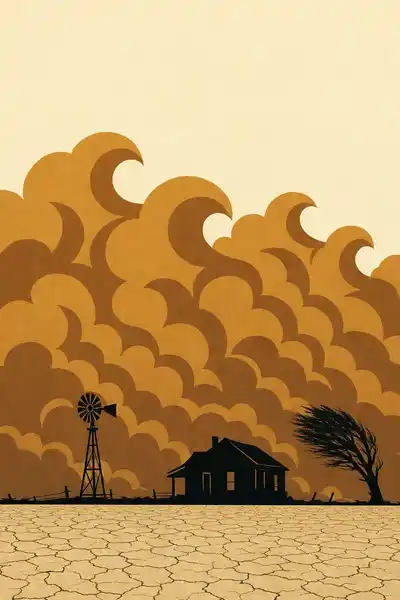
On April 14, 1935 the day that would later be called Black Sunday a massive dust storm rolled across the southern Great Plains of the United States, blackening the sky from Texas to the Dakotas and depositing soil from the plains as far east as Washington, D.C., New York City, and the ships at sea five hundred miles off the Atlantic coast. The storm was the most dramatic event in a five-year period during which the agricultural soils of the southern plains covering portions of Oklahoma, Kansas, Texas, New Mexico, and Colorado had been systematically lifting into the atmosphere and being carried away by winds. The region had been settled by farmers across the previous forty years, with the prairie grasses that had held the soil in place for thousands of years having been plowed up to plant wheat and other commercial crops. When a sequence of severe droughts began in 1930 and continued through 1936, the exposed topsoil had nothing to anchor it. The dust storms that resulted destroyed agricultural production across approximately 100 million acres, caused respiratory diseases that killed several thousand people, and produced one of the largest internal migrations in American history.
The cumulative effect of the Dust Bowl was substantial. Approximately 2.5 million people left the affected region between 1930 and 1940, with approximately 500,000 of them moving to California in what became one of the largest single internal migrations in American history. The agricultural economy of the southern plains was substantially destroyed, with crop production declining by approximately 75 percent across the worst years. The federal government’s response, organized substantially through the New Deal agencies established to address the broader Depression crisis, included the creation of the Soil Conservation Service, the planting of approximately 220 million trees in shelterbelts across the plains, the introduction of soil conservation programs that paid farmers to adopt practices that reduced erosion, and the substantial reorganization of American agricultural policy around the principle that the federal government had responsibility for managing agricultural land use. The framework that emerged has continued to operate, in modified forms, for approximately ninety years.
The case has become one of the central reference points in modern environmental history. The Dust Bowl demonstrated that human land-use practices could substantially destroy the productive capacity of an entire ecological region within a single generation. The framework of soil conservation that emerged in response has become one of the principal models for federal environmental management. The cultural memory of the period substantially shaped by John Steinbeck’s The Grapes of Wrath (1939), the photographs of Dorothea Lange and Walker Evans for the Farm Security Administration, the songs of Woody Guthrie has continued to operate as one of the most powerful documentary records of an American environmental disaster.
The question we’re asking: what produced the Dust Bowl, what did the federal response actually do, and what does the case reveal about how environmental catastrophes interact with human settlement patterns?
What we’ll see: the settlement pattern that produced the vulnerability, the meteorological and agricultural conditions of 1930-1936, the federal response and the long consequences, and what survives.
Table of contents
01The settlement that produced the vulnerability
The southern Great Plains had been settled across the late nineteenth and early twentieth centuries through homestead programs and railroad development. The Homestead Act of 1862 had offered 160 acres of public land to settlers willing to cultivate it for five years. The Enlarged Homestead Act of 1909 increased the claim to 320 acres specifically to encourage settlement of the drier western plains. The railroads Union Pacific, Atchison Topeka and Santa Fe, Rock Island actively promoted settlement to generate freight business. The cumulative effect was substantial population growth in a region whose ecology had not previously supported intensive agriculture.
The agricultural practices that the settlers adopted were substantially inappropriate for the regional ecology. The prairie grasses that had originally covered the region had been adapted across thousands of years to the highly variable rainfall, with deep root systems that held soil in place and substantial drought tolerance. The wheat and other commercial crops that replaced the grasses were substantially less drought-tolerant and had shallow root systems that did not hold soil. The plowing practices that the settlers used substantially destroyed the prairie root systems and exposed the underlying soil to wind erosion. The framework had operated tolerably during the wet years of the 1910s and 1920s, when above-average rainfall masked the underlying ecological mismatch.

02The droughts and the storms
The drought that began in 1930 was substantial. The southern plains experienced approximately seven consecutive years of below-average precipitation, with the worst years 1934 and 1936 producing approximately 40 percent of normal rainfall. The combination of low rainfall, high temperatures, and high winds produced conditions in which the exposed soils began to lift into the atmosphere in substantial quantities. The first major dust storms occurred in November 1933, intensifying across the subsequent three years with Black Sunday in April 1935 being the most dramatic single event.
The scale of soil loss was substantial. The Soil Conservation Service estimated that approximately 1.2 billion tons of soil had been blown away across the worst years of the storms. The lost soil was deposited across the eastern United States and the Atlantic Ocean, with measurements of dust deposition in cities including New York and Washington documenting the substantial scale of the transport. The agricultural productivity of the affected regions was substantially reduced, with the topsoil that contained the substantial majority of the agricultural nutrients having been lost.
03The federal response
The federal response to the Dust Bowl was substantial and operated through the broader New Deal infrastructure that had been established in response to the Depression crisis. The Soil Conservation Service, established in 1935 as part of the Department of Agriculture, was the principal federal agency tasked with addressing the ongoing erosion. The agency promoted soil-conservation practices including contour plowing, terracing, crop rotation, and the planting of cover crops. The Civilian Conservation Corps provided the labor for many of the conservation projects, with CCC crews planting trees, building check dams, and constructing the physical infrastructure that supported soil conservation.
04What survives, and what the case shows
The agricultural and ecological recovery of the southern plains has been substantial. The return of normal rainfall, combined with reduced cultivated acreage and adoption of soil-conservation practices, allowed the region’s productivity to recover. The shelterbelts continued to reduce wind erosion. Contour plowing and other practices reduced the vulnerability of the remaining cultivated land.
The deeper lesson the case offers is about how human settlement patterns interact with ecological systems across long time periods. The settlement of the southern plains had been encouraged by federal policy across the late nineteenth and early twentieth centuries, with the result that substantial populations and substantial agricultural infrastructure had been established in a region whose ecological characteristics did not support the intensive agriculture that had been developed. The Dust Bowl was substantially the consequence of the mismatch between the settlement pattern and the ecological reality. The framework that emerged in response federal management of agricultural land use, soil-conservation programs, the principle that the federal government had responsibility for managing ecological resources has continued to operate as one of the principal frameworks of American environmental policy.
05Conclusion
The Dust Bowl substantially ended around 1939, with the return of normal rainfall and the substantial implementation of soil-conservation practices. The migration to California continued through the 1940s, with the substantial majority of the migrant population remaining in California rather than returning to the plains. The federal infrastructure that had been established in response to the crisis has continued to operate, with substantial modifications, across the subsequent eight decades.
Related books