Plastic
A material we cannot retrieve
Description
In 1907, a Belgian-born chemist named Leo Baekeland, working out of a lab in Yonkers, New York, cooked phenol and formaldehyde together under heat and pressure and produced the first fully synthetic plastic. He called it Bakelite. It didn't rot, didn't burn easily, didn't conduct electricity, and could be molded into radios, telephones, billiard balls, whatever the century wanted. Baekeland had set out to find a substitute for shellac, a resin harvested from insects. He found something stranger: a material with no natural template, one that nothing in the living world knew how to break down.
That last property was the whole point. Plastic was celebrated precisely because it endured — because it resisted water, acid, rot, and time. For decades that was a triumph. Then, slowly, it became the problem. The same molecular stability that made plastic useful in a raincoat or a syringe means that almost every piece of it ever manufactured is still here, somewhere, in some form. We produced roughly 8.3 billion tonnes of it between 1950 and 2015, and most of that mass has not gone anywhere. It has only moved, and broken into smaller pieces, and spread.
What makes plastic worth sitting with is not that it pollutes — plenty of things pollute. It is that we built a global economy around a material designed to be permanent and then treated most of it as disposable. We tell ourselves a story about managing the fallout, a story with a green symbol and a chasing-arrows logo. The gap between that story and the physical reality of the stuff turns out to be very wide.
The question we’re asking : How did we come to depend on a material we can produce endlessly but cannot meaningfully take back?What we’ll see : How plastic went from laboratory marvel to something dispersed into every corner of the planet — and why the reassurance we lean on doesn't hold.
Table of contents
01Chapter 1 — The miracle that never leaves
Before Bakelite, the materials that shaped daily life were things you could trace back to something alive or mined: wood, wool, cotton, glass, metal, rubber tapped from trees, ivory pulled from animals. They wore out, and when they did, the world reabsorbed them. Baekeland's invention broke that cycle. Here was a substance assembled from small carbon molecules linked into long chains — polymers — that formed shapes the natural world had never encountered and had no enzyme, no microbe, no weather pattern equipped to dismantle.
The industry that followed was extraordinary. Through the 1930s and 1940s chemists produced a whole family of these long-chain materials: polyethylene, polystyrene, PVC, nylon, polypropylene. The Second World War accelerated everything — nylon for parachutes, plexiglass for cockpit canopies, plastic insulation for military electronics. When peace came, that manufacturing capacity turned toward consumers, and the plastics that had been strategic wartime resources became packaging, toys, furniture, and the film wrapped around a supermarket cucumber.

02Chapter 2 — From molecule to everywhere
Plastic production has never stopped climbing. From about two million tonnes a year in 1950, output rose past 400 million tonnes a year by the late 2010s, and it is still projected upward. Roughly forty percent of that goes into packaging — the wrappers, films, bottles, and clamshells built to be discarded within days of purchase. So the fastest-growing category of the most durable material we have ever made is the one designed for the shortest possible life. That mismatch is the engine of the whole crisis.
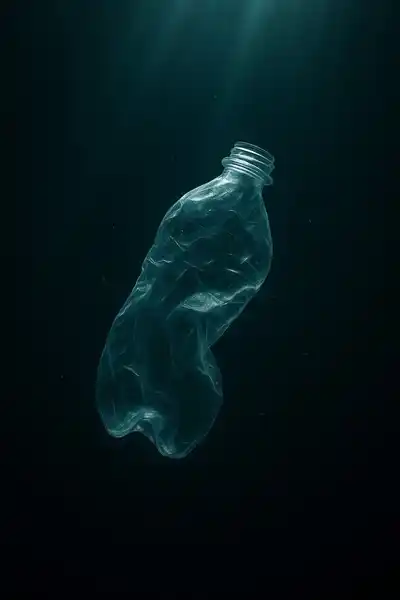
Once discarded, plastic does not so much disappear as disperse. Some is buried in landfills, where it sits largely intact. Some is burned, releasing carbon and toxins. A great deal simply leaks — off trucks, out of overflowing bins, down rivers, into the sea. Estimates suggest that on the order of eight to ten million tonnes enter the ocean each year. It collects in slow-spinning ocean gyres, the largest of which, between California and Hawaii, has become known as the Great Pacific Garbage Patch — not a solid island, as the name implies, but a diffuse soup of fragments spread across an enormous area.
03Chapter 3 — The nine percent that got recycled
The reassurance we reach for is recycling. The blue bin, the sorted household waste, the green arrows on the packaging — these were meant to close the loop, to let us keep consuming plastic while trusting that it circled back into new products rather than into the ocean. It is a comforting picture. It is also, at the scale of the problem, largely a fiction. Of all the plastic ever produced, researchers estimate that roughly nine percent has been recycled. Around twelve percent has been incinerated. The rest — close to eighty percent — sits in landfills or loose in the environment.
There are hard physical reasons the number stays so low. Plastic degrades when reprocessed: the polymer chains shorten, so a recycled bottle rarely becomes another bottle but instead something lower-grade, and that item usually cannot be recycled again. It is downcycling, not a true loop. The dozens of different resin types don't mix, so sorting is costly and imperfect. Food residue, dyes, and mixed-material packaging ruin whole batches. And virgin plastic, made cheaply from oil and gas, is almost always cheaper than collecting, cleaning, and reprocessing the used kind — so the economics quietly punish the very behavior the symbol encourages.
04Chapter 4 — What a permanent material asks of us
Step back from the bottles and the beaches and plastic starts to look less like a waste problem and more like a category error. Almost every system we use to deal with the objects of daily life assumes those objects are temporary — that things wear out, decay, return to the ground, get absorbed. Compost rots. Metal rusts. Paper pulps. We inherited a world in which "throwing away" made a kind of sense, because the world did the finishing work for us. Plastic broke that arrangement by being, for practical purposes, permanent, while we kept managing it as though it weren't.
That is the deeper discomfort. We are extremely good at making plastic and structurally incapable of retrieving it. Production is centralized, cheap, and fast — a handful of petrochemical plants can turn out millions of tonnes. Retrieval is diffuse, expensive, and slow, and it fights physics the whole way, because the material's defining trait is to endure and to fragment rather than to stay in one collectible place. The asymmetry is total. We can make it in a factory; we cannot un-make it anywhere.
05Conclusion
Leo Baekeland got exactly what he was looking for. He wanted a substance immune to rot, heat, and time, and he built one so durable that more than a century later the earliest Bakelite objects still sit intact in museum cases. His success was real and complete. What he could not have foreseen was that the same durability, multiplied across billions of tonnes and scattered into water, soil, and air, would turn the great virtue of his invention into its lasting signature on the planet.
Related books