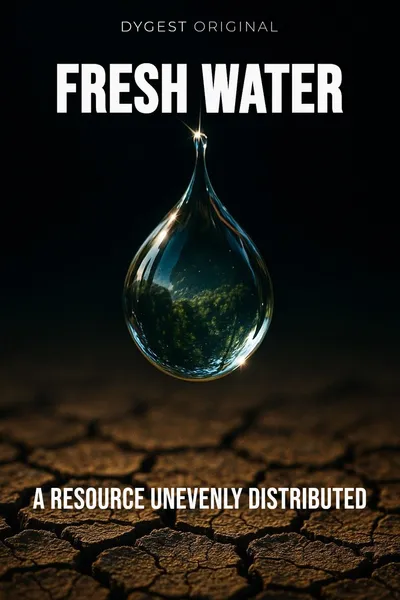
Fresh Water
A resource unevenly distributed
Description
Turn on a tap in a wealthy city and water arrives so reliably that we forget it's a substance at all. It's just there — behind the wall, under the street, priced at a few cents for the amount most of us waste before breakfast. That flatness is a kind of trick. Globally, roughly two billion people don't have safely managed drinking water at home, and hundreds of millions walk, wait, or pay dearly for what comes out of our walls without a thought. The gap between those two experiences isn't mainly about how much water sits on the planet.
Because the planet has plenty. Earth is a wet place — oceans cover most of it, ice sheets hold vast reserves, and the atmosphere is thick with vapor. The problem is that almost none of that water is the kind we can drink, and the fraction that is arrives in the wrong places, at the wrong times, in wildly uneven amounts. A country can sit on a great river and still ration; a desert nation can have water on tap by buying its way around the shortage. Fresh water is abundant and scarce at once, depending entirely on where the map drops you.
So the interesting thing about water isn't chemistry. It's distribution — how a cycle that looks perfectly natural ends up producing something that feels perfectly unfair, and what happens when the same finite flow has to serve farms, cities, factories, and often more than one country at the same time.
The question we’re asking : Why does a planet covered in water still leave billions of people short of the water they can actually use?What we’ll see : How fresh water moves, why so little of it is usable, and how a natural cycle becomes a question of who holds the tap.
Table of contents
01Chapter 1 — Almost none of it is ours to drink
Start with the raw arithmetic, because it reframes everything that follows. Around 97 percent of the water on Earth is salt water, sitting in the oceans, useless for drinking or growing crops without expensive treatment. That leaves roughly 3 percent as fresh water. But most of that isn't available either: the bulk is locked in glaciers, ice caps, and permanent snow, or buried deep underground beyond easy reach. The share that's actually accessible as surface fresh water — the rivers and lakes we picture when we think of water — comes to well under one percent of the whole.
So when we talk about the water that feeds the world, we're talking about a thin sliver of the total, constantly recycled. And even that sliver isn't spread evenly. A handful of countries — Brazil, Russia, Canada, Indonesia, China, among others — hold a large fraction of the planet's renewable fresh water, while whole regions across the Middle East and North Africa get almost none of it from rainfall. The Amazon basin carries an enormous flow past relatively few people; densely populated dry regions get a trickle they must stretch across millions.

02Chapter 2 — The cycle that moves everything except itself fairly
The water cycle is one of the few pieces of science almost everyone half-remembers: water evaporates from oceans and land, rises, cools, condenses into clouds, falls as rain or snow, and eventually runs back to the sea to start again. It's genuinely elegant, and it's the reason fresh water is renewable at all. The sun does the desalination for free, lifting pure water off salty oceans and dropping it inland as rain. Every drink we take is, in a sense, borrowed from that endless loop.
But the cycle is indifferent to human borders and human need. It delivers water where temperature, wind, and terrain send it, not where people happen to live. Mountains wring rain out of passing air on one side and leave deserts in their shadow on the other. Monsoons dump a year's worth of rain in a few violent months, then vanish. The same cycle that keeps a rainforest soaked keeps a plateau bone-dry a few hundred miles away, and neither outcome has anything to do with who needs the water more.
03Chapter 3 — When the same river feeds two countries
Rivers don't stop at customs. The Nile passes through eleven countries before reaching the sea; the Mekong feeds six; the Tigris and Euphrates, the Indus, the Colorado, the Jordan all cross borders drawn long after the water started flowing. That creates a simple, combustible fact: what an upstream country does with a river decides how much reaches everyone downstream. A dam, a diversion, a burst of new irrigation upriver can quietly reshape life for millions who live below it.
The Nile has become the textbook case. For decades Egypt, at the river's end, treated the flow as effectively its own, backed by colonial-era agreements that gave it and Sudan the lion's share. Then Ethiopia, upstream, began building the Grand Ethiopian Renaissance Dam — one of Africa's largest — to generate power for a country desperate for electricity. Egypt, which depends on the Nile for the overwhelming majority of its fresh water, saw an existential threat in how fast the reservoir behind it would fill. Years of tense negotiation followed, at moments edging toward talk of force over the pace of filling a lake.
04Chapter 4 — The line between having water and having power
Step back from the specific rivers and a larger point comes into focus. The story of fresh water is only partly about how much of it exists. Just as decisive is who controls its movement — who gets to build the dam, set the price, dig the deeper well, or turn the valve. The resource is physical, but access to it is arranged, and the arranging is where power lives. Two people can stand over the same aquifer and have completely different amounts of water, because one can afford to pump from farther down.
That's true within countries as much as between them. In many cities, wealthier neighborhoods get treated, pressurized water around the clock while poorer districts nearby buy it by the jug from trucks and pay several times more per liter. During droughts, the same asymmetry sharpens: those who can drill private boreholes, install tanks, or simply pay carry on, while those who can't queue at standpipes. The water table doesn't recognize class, but the infrastructure sitting on top of it does. Scarcity, in practice, is almost always distributed downward.
05Conclusion
Come back to the tap. The reason it runs so reliably in some places and not in others isn't that the planet ran out of water in one spot and kept it in another. The cycle keeps turning everywhere, lifting pure water off the oceans and dropping it inland, renewing a resource that is, in total, staggeringly abundant. What differs is everything built on top of that cycle: the reservoirs and pipes, the treaties and prices, the deeper wells and private tanks that decide whose share of the thin usable sliver arrives first, and whose arrives late or not at all.
Related books